The Quantum Theology of Cheese


Abrtaham + 3 Angels eeckhout 1656
Abraham and the Three Angels”  Gerbrand van den Eeckhout (1656)
“[Abraham] then brought some curds and milk and the calf that had been prepared, and set these before them. While they ate, he stood near them under a tree.”
– Genesis 18:8

Consider the miracle and mystery of cheese. You take milk. You combine it with the sloughed-off lining of the stomach of a calf called rennet. Store it away and in a few days or weeks and voila! We got cheese!

Neolithic tribes worshiped cheese. Since then, cheese has been intimately entwined with civilization. But for Jews, cheese poses a special problem. The Torah forbids Jews to cook the meat of the kid with the milk of the mother, possibly because of its intrinsic cruelty. In the mystical tradition, milk represents mother’s nurturing and it comes from sheep and cows and goats, animals we domesticate and nurture. Meat requires spilling blood. It is predatory and reminds us of our bestial natures. Milk, then, needs to be protected from meat. They should never touch, and when they have to interact, Jews erect barriers in time and space to separate them. Over the centuries, this has evolved into an elaborate system of kosher rules separating all meat foods from anything that has touched milk. So while serving our body’s need for sustenance by eating milk and meat, kosher laws remind us of the sources of our food. We discipline our cognizance and actions in eating them at separate times off of separate dishes and cooking them in separate pots. Kosher eating is mindful eating.

With all this invested in the barrier between the two realms, then how is it possible that cheese, made with lining from a cow’s stomach, somehow gets an exemption?  The sages of the Talmud give us what seems like a technical reason, but as Aeschylus said, “Wrong should not get by on a technicality.” If we look closely though, we’ll see that the technicality anticipates discoveries only recently made by science. The details of their apparent foreknowledge suggests that the Torah is a channel for knowing things that are only slowly revealed over the millenia by science. To put it more simply, though as a rational modern I resist this conclusion, it seems science is catching up to wisdom revealed thousands of years ago to the Jews. To see that this is more than just a coincidence and the Talmud’s technicalities reveal a true understanding of the science of cheese, we’ll have to dip into we’ve learned more recently about the science behind the magic of cheese. Continue reading “The Quantum Theology of Cheese”

The Quantum Theology of Matzah: Science delves the spiritual mysteries of yeast

Seven days you shall eat unleavened bread; on the very first day you shall remove leaven from your houses, for whoever eats leavened bread from the first day to the seventh day, that person shall be cut off from Israel. (Ex 12:15)

What’s the difference between bread and matzah?

Screen Shot 2017-04-18 at 11.16.48 PMThe youngest child at the Passover seder asks, “Why on other nights do we eat bread or matzah but on this night only matzah?”  The Torah says that the matzah didn’t have time to rise before the slaves had to flee Egypt, so Jews focus on this inflation and all its many symbolisms: inflation of self, of ego, of pride, of valuing material achievements, Pharaoh’s  tyrannical sense of himself as a deity, and so on.

But this answer skips over a more fundamental question: Isn’t matzah really, after all, just bread? Both matzah and bread are just flour, and water, so aren’t they just versions of the same thing?  If they’re different, what’s the difference? What makes bread bread and matzah matzah? Why do we say an extra prayer over matzah?

The simplest answer is yeast. But what does yeast do? Yeast makes flour and water into bread. Yeast makes bread rise. It also makes grapes into wine. Grape juice is just a soft drink, but wine is literally a spirit. A cracker is a good delivery platform for dip, but bread is the staff of life itself. Wine leavens our spirit. Bread sates. It’s no wonder humans worshiped bread and wine for thousands of years and even now many religions still sanctify them and use them to sanctify us. And it’s no wonder the Passover haggadah calls matzah “the bread of affliction.” Matzah is dead bread. Yeast adds life to inert foodstuffs, transforming them magically into something spiritual. By ingesting wine and bread, we take some of that magic into us.

Humans recognized and harnessed the magical properties of yeast millenia before they learned to write 5000 years ago, but we are now just discovering the truly mysterious – even mystical – properties of  yeast, and these new scientific discoveries seem to answer our questions about matzah. In other words, science gives us a window into the spiritual mysteries of yeast.

The quantum biology of yeast and enzymes: gateway between life and death

Yeast is a single-celled living creature. When we let these creatures feed on their favorite food – sugar or carbohydrates – they digest it into sugar’s components: energy, alcohol, carbon dioxide, and some residue molecules that add flavors. Even pre-literate cultures were in awe of the way yeast brought bread and wine to life and worshiped it as divine. Now, modern biology is coming to grips with this ancient wisdom: yeast is the gateway between the living and the inert. But how, precisely, does it perform this trick? After tens of thousands of years, the new science of quantum biology has finally given us a glimpse of how yeast performs its magic.

The process the ancients observed as a result of yeast’s action is bubbling, rising fermentation – chemists call it catalysis. In the cooler processing of wine, the alcohol is retained in the liquid for our pleasure. Carbon dioxide is partly released when wine is moved in barrels. Some winemakers leave some of this carbon dioxide in the wine, and wine with lots of it is nicknamed “bubbly- like champagne – but most wine is “degassed.” When we bake bread, we don’t get drunk on it because the higher heat of baking evaporates the alcohol, but like it does in wine, the carbon dioxide gas creates bubbles. These expand and burst in the sticky dough, giving bread its texture.

High school chemistry labs often use yeast as an example of enzymatic activity. But what they didn’t teach us, because chemistry isn’t etymology, is that enzyme is just the Greek for “in yeast.”

Enzymes are present in all living things. They are incorporated into every living cell on Earth and are essential in every process that sustains life: digestion, neural action, making new cells and repairing old ones (growth and healing), reproduction, and so on. They’re not organisms, but no organism or living process survives without them. In short, they’re a good battleground for the eternal philosophical war between materialists and vitalists. Materialists believe the universe and everything in it, including humans and human consciousness, is a vast machine. It is made up only of physical things and the physical processes or forces between them. Vitalists argue that there is a meta-physical force in the universe that animates all life, a force that cannot be reduced to mechanical explanations. Human consciousness illustrates the problem and limitation of materialism: how does our experience of having a mind arise from mere stuff? Fundamentalist materialists argue that everything can be explained ultimately, by self-consistent systems of reason, like logic or mathematics. Religious vitalists argue that the metaphysical force is divine. And although there’s plenty of fake news and overheated press that periodically announces it, no one has ever created life from non-living stuff. No frankensteins, though the dream and nightmare of achieving godlike powers haunts humanity.

Yeast is so powerful a stage for this contest between mechanism and vitalism because although it is a living thing, science until recently seemed confident it was purely a chemical machine. True, how yeast and other enzymes brought life to non-living stuff so efficiently was still mysterious, but in the debate, yeast offered the best proof for the materialist view of life. It seemed to explain how life is introduced into inert matter without resort to purely non-mechanistic explanations. Until now.

It turns out that enzymes require quantum effects to do their work, and quantum mechanics defy a strictly materialist view of the cosmos. Quantum physics defies logic, though we’ve learned to use it in MRIs and computer chips, and most scientists and engineers simply put aside the way quantum mechanics rattles the foundations of science. In the majority version of quantum theory, every quantum process requires an aware being, an observer, to watch it work in order for it to become real. This has mind-boggling implications, not least of which is it hints at the essence we invoke when we say the extra prayer over matzah. In order for me to explain, I first need to review the craziness of the quantum world.

Five weird things about quantum mechanics

To most, even sophisticated scientists, quantum mechanics seems just weird. There’s no way to explain quantum processes without over-simplifying or resorting to analogies which only dimly picture its actual, full-on weirdness. But here are a few of the facts that you will need to know as we continue with our discussion of matzah. I leave it to you to decide how, or even if, you want to grapple any of it yourself:

  1. Sub-atomic entities behave like both waves of energy and particles at the same time.
  2. A sub-atomic entity isn’t in any one specific place until you observe it. Then it seems to settle on one. (Called “the Uncertainty Principle”)
  3. A single sub-atomic particle can be in two places at once. But if you affect one, its other self will react, even if they are separated by millions of miles. (Called “Superposition”)
  4. They can pass through otherwise impassible-seeming barriers and travel faster than the speed of light, and both backwards and forwards in time. (Called “Quantum Tunneling”)
  5. A subatomic particle holds multiple possible logically exclusive properties at the same time. When it is observed or measured, it “collapses” from its various possible quantum states into one state. I.e,. it stops behaving quantumly and starts behaving classically. (Called “Measurement”)

Quantum tunneling in yeast

To understand the quantum theology of matzah, the last is the most important. Until now, biologists have been content to leave the weirdness of the quantum world to physicists, because they thought they were immune to it. Biologists assumed there was an unbreachable barrier between the sub-atomic world of quantum weirdness and the macroscopic world of biology, which conveniently remained obedient to classical laws of physics. Thankfully (they believed) subatomic monkey business disappears when it pokes its head up into an organism, because the complexity of the organism automatically “measures” (observes) it, though no one specified how. They now seem to be really wrong. It’s awkward.

Resurrected by water, living yeast seems to make the inert come alive. Yeast explodes the flat mound of dough and makes it rise as little bubbles of alcohol explode inside. It adds tastes by creating new molecules. But what was once thought to be a classical, if incompletely understood, mechanical process, we now know requires quantum tunneling (see above, #4).

If you’d rather nap, this is a good time

Here’s the technical explanation: an enzyme in yeast takes a positively charged sub-atomic particle, the proton from the alcohol it has created, and transfers it to another molecule. This new molecule, with the addition of its extra proton, now has a positive charge. Like a magnet, it now attracts molecules carrying a negatively charged particle, the electron. So the new molecule that the yeast created (called nicotinamide alcohol dehydrase or NADH) becomes a very effective carrier and releasor of electrons. With NADH, the ingredients can now perform their actions very quickly, hundreds of times more efficiently. It’s like the brew now has an electric current running through it, with electrons able to hitch a ride and jump off when a chemical reaction needs an extra jolt of energy to make it happen.

So far so good. This is all safe, mechanical chemistry.

As it turns out, though, the speed at which electrons get transferred from alcohol to NAD+ to make NADH cannot be explained by classical chemistry. Quantum tunneling, number three on our list of weird quantum effects above, can. Again, at the risk of over-simplifying, a subatomic particle like an electron can travel across barriers instantaneously by using its superpower of quantum tunneling. As this effect occurs among millions of molecules in the dough, it speeds up the process enough for biologists to conclude it must be involved.[1] Since quantum tunneling have been confirmed in the activities of other enzymes, this is more than a guess.

This neat explanation of the quantum role in enzymatic action leaves one huge mystery, though: In order for the transport of the electron to occur, it can’t be just a probability, and in order for it to be more than a probability, it has to be observed or measured. The quantum Uncertainty – the electron can be here or there and therefore nowhere at all, really – has to become classical behavior: I see it now. Until now, biologists, scientists and other materialists have maintained that the sheer bulk and realism of the organism in which the quantum action occurs somehow collapses any quantum craziness, that the fact of the organism as a macroscopic entity itself performs the “observing.” But that argument no longer holds water and even seems like a tautology, fabulous circular reasoning, because enzymes drag quantum action and weirdness into the scene of the organism at every level. Enzymes, and the quantum, is ubiquitous in every process of every cell in an organism.

Wake up

In short, enzymes seem to be the essence of life itself.

“Enzymes have made and unmade every living cell that lives or has ever lived. Enzymes are as close as anything to the vital factors of life. …. [T]he discovery that enzymes work by promoting the dematerialization of particles from one point in space and their instantaneous materialization in another provides us with a novel insight into the mystery of life.”

– Johnjoe McFadden, Jim Al-Khalili, Life on the Edge: The Coming of Age of Quantum Biology  (Broadway Books, Jul 26, 2016) p. 97

There’s simply too much quantum funny business going on everywhere in a living being to say one part of the organism is classical and collapses the other part that is quantum just by dint of being a big thing like a fish or a bird.

Another way materialists banish the quantum: the Many Worlds Hypothesis

Scientists have resolved the measurement problem another way. When the wave of quantum possibilities collapses into an actuality, the information contained in those probabilities has to go somewhere. Information, like energy, has its own law of conservation in the universe. Some quantum physicists suggest that instead of collapsing the quantum into the classical through observation, every time a quantum event collapses into a classical one, other universes are spawned. All the other probabilities that didn’t occur here do occur there, in these new universes. This is the Many Worlds Hypothesis, although I personally think the adjective “many” doesn’t do justice to its hyperbolic claim. The Many Worlds Hypothesis is mathematically satisfying and sidesteps any suggestion of metaphysics. But let’s look at how radical it really is.

There are a virtually infinite set of quantum events occurring everywhere at every instant everywhere in an organism, let alone the whole universe. Each of them would create an incalculable set of alternate universes. Now imagine all the quantum processes going on all over the universe every instant, each one spawning an alternative universe of its own, presumably where the same laws of physics apply so they are spawning and infinity of multiverses, too. When I do the dizzying visualization of this scenario, it leads me to ask: Which is the more ridiculous vision of the cosmos, the one where there are unlimited infinities of universes or there is a Single Entity observing everything? In my opinion, the Multiverse Hypothesis creates a vision of the cosmos that is at least as crazy as imagining an unprovable Big Guy in the Sky watching everything.

But who knows? That’s what they said about quantum theory in the twentieth century. And that’s what most well-educated, postmodern, rational, sophisticated people say about God.

Quantum theology of matzah: Where is He?

Quantum theology is a term used by a few but growing number of theologians and mystics. On one side of this philosophical tug of war are enthusiasts eager to seize on quantum theory to prove the existence of God. Many of their essays and speculations are plagued by vagueness, weak understanding of science, and an over-heated, optimistic leap into the irrational analogies between quantum science and the mystical. Their “proofs” often require taking analogous-sounding mysteries as literal equivalents. Quantum theology is largely the provenance of well-educated but reductionist fundamentalists.

On the other is a simple but rigorous contention

The case of yeast is different. In this dance between the material and the vital, between science and faith, science leads us to conclude something strange is happening in bread that doesn’t occur in matzah. The new science of quantum biology shows quite specifically how the process of life itself depends on quantum action. In every possible process where life is created or sustained, enzymatic action is involved. And with quantum action comes the requirement that someone or something is observing the process. The nose of the quantum camel, and the problem of a conscious observer, has entered the tent of biology, but they were summoned by the biology. In fact, the tent is the camel. Something or someone has to be observing quantum events in enzymes to make them operative in life. Someone or something has to be operating life. Omnisciently.

Sermon on Matzah

Put biophysics together with the metaphysics of matzah and you get many powerful sermons. Matzah is bread without human attention (shmurah matzah notwithstanding) and without the attention of a Cosmic Consciousness. It represents enslavement to inert material. It is both literally the bread of affliction, the food of slaves, and symbolically life without redemption from our inner Egypt, the body without a soul. Matzah invokes a God who redeemed the Children of Israel from slavery more than three thousand years ago and Who continues to operate the universe today by attending to its every quantum event. He is an incomprehensibly vast God Who observes every infinitesimal event, all the infinite infinitesimal events that occur every instant to sustain each living cell of each living organism. This is a God that watches everything actively. This God expands and unfolds His Cognizance as vastly, but more comprehensibly, than the universes imagined by the Many Worlds Hypothesis, where every quantum event creates disconnected alternatives. This God gives the universe an elegant unity. His watchfulness also makes life possible. It’s hard not to like this God and this idea of Him. Unless of course you find the very idea of anything not mechanical offensive to reason.

So one of the sermons on matzah is a kabbalistic one. Isaac Luria, the 16th century mystic of Safed, explains that the three matzahs on the seder plate represent Knowledge, Understanding, and Wisdom. Matzah invites us to stretch our scientific wisdom to its fullest extent beyond enslavement to our preconceptions, confirmation of our biases. It suggests the liberation of science from its prejudices. Is it really harder to believe in God than in the Multiverse Hypothesis? I don’t think so. The benefits of embracing both the intrinsic beauty of the metaphysical explanation and the elegance of its logic make a pretty persuasive case against scientific atheism. From the outside looking in, all the attempts to exclude a Universal Observer from the quantum situation look like contortions by science to avoid the obvious, the result of a fundamentalist-like commitment to a belief that there must not be a God in the universe.

This message in the matzah makes it the twin of Elijah’s cup, its secret sharer and, perhaps, the answer to the question it poses. One seder decades ago, when my children saw Elijah’s cup standing at the end of the seder, they asked, “Where is he?”

The matzah asks the same question about God: “Where is He?” and answers, “Not in this poor, dead bread that we eat because we are slaves. But yes, in everything that lives.”


[1] Prof. Judith Klinman of UC Berkeley first suggested that quantum processes were involved in the enzymatic action in 1987. She has more recently found experimental evidence for it. See, for instance, Judith P. Klinman and Amnon Kohen, “Hydrogen Tunneling Links Protein Dynamics to Enzyme Catalysis,” Annual Rev Biochem. 2013; 82: 471-496.

[2] Chasidus, which channeled Kabbalistic thought for common Jews, saysemphasizes the symbolism of the miraculous in matzah. By commemorating our redemption from Egypt in something so ordinary, we also rehearse the transformation of Hebrew destiny from the fantastic, demonstrably miraculous to the miraculousness of ordinary life, what we call reality.  “The symbolic acts that we, ‎the descendants of the generation of Israelites leaving Egypt at ‎that time, perform on the anniversary of that event, all reflect ‎the suddenness and haste in which the redemption literally ‎overtook them. These acts mirror the impact that G’d’s miracles ‎had on the Jews at that time. In contrast to this, when the same ‎people arrived in the desert of Sinai, prior to receiving the Torah, ‎seven weeks later, they had time to prepare themselves for that ‎event for three days, i.e. the miracles that occurred in connection ‎with that event did not take them by surprise. By that time they ‎had come to realize that G’d’s performing miracles was something ‎‎“natural,” not supernatural, seeing that the source of these ‎‎“miracles” was the same Creator Who had performed the greatest ‎miracles by creating the universe. When they reflected that out ‎of all the phenomena in the universe that they were aware of it ‎was only G’d Who could have created them by merely uttering ‎the necessary words, they no longer needed “miracles” to ‎persuade them that there was such a power, [even though ‎it remained invisible. Ed.] To reflect their new found ‎insights, the offerings presented on the festival of Shavuot did ‎not require matzah as a symbol of the Israelites’ recognition ‎that their redemption had been a miracle, in the sense of ‎something supernatural performed by G’d.‎” Kedushat Levi, Exodus, Pekudei 4

Perpetual Chanukah in the West – or – Why the Pythagorean Theorem is More Than Just Math

’כהיומ הזה’ – “…even like today” – Chanukah prayer
This is dedicated to my son, Avraham Benyamin (Ben) Porush, whose birthday is the first day of Chanukah and bris the last.

Why does the Talmud warn against teaching Greek to Jewish children?

Pythagoras traveled through the Middle East for twelve years, imbibing Egyptian & Jewish philosophy.

The last pages of the Talmud volume Sotah portrays the decline of Jewish spirit after the destruction of the Temple. It marches through a long, dispiriting list of the horrible things that happen as Jews have to abandon customs that could only be kept alive when there was a spiritual center in Jerusalem and they lived as a nation inside their own borders.

In the middle of this lamentation (called Yeridas HaDoros – “decline of the generations”), the Talmud warns somewhat mysteriously that fathers shouldn’t teach Greek to their sons.What did the Sages have in mind? They can’t have meant Greek language, because the Rabbis were conversant with Greek and spoke it in the streets of Jerusalem. By the first century CE, and almost certainly earlier, it had displaced Hebrew as the lingua franca. And in various places in the Talmud, Greek is praised as the only language into which the Torah can be elegantly translated. Indeed, Sotah itself recounts a lament of Shimon ben Gamliel, the great Sage (50 CE) that shows how much the rabbis thought of Greek:

Continue reading “Perpetual Chanukah in the West – or – Why the Pythagorean Theorem is More Than Just Math”

Hearing vs Reading the Bible

The play between orality and literacy in Jethro

When did the Israelites become literate?

If you piece the clues together, the Torah tells us pretty clearly that Moses received the alphabet from God on Sinai.  It happens during the same sequence of revelations that begin with the burning bush and the revelation of God’s Name during their first encounter. God tells Moses to return to Egypt and instruct the elders of Israel in “the signs” or “ the letters” that God shows him.  Moses quails at his assignment.

But don’t worry, God reassures him, “If they don’t heed the voice of the first sign, they will listen to the voice of the last sign.”

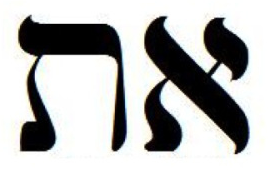
The Aleph Tav
The first and last signs in Hebrew.

The first and last signs might refer to the silent conjuror’s tricks that God has just shown Moses:  a rod turns into a snake and Moses’ hand turns leprous and back again.

But more sensibly, the “voice of the signs” refers to  the core breakthrough that made the phonetic alphabet a monumentally disruptive invention: signs, instead of being pictures for words as in hieroglyphics, are instructions for the voice to make sounds, like musical notes. The first and last symbols refer to the aleph and the tav, the beginning, the whole of this new invention.  God is telling Moses: show the Israelites back in Egypt this new explosive technology, these letters, and with them you shall set them free. Continue reading “Hearing vs Reading the Bible”

The Origin of the Weekend: The Slave’s Lesson

shabbat candles in the windIt‘s only Monday, and I‘m already looking forward to the weekend. But since I’ve got a ways to go, it got me to thinking, Where did the idea of the weekend come from? 

The fact is, it took a nation of former slaves, the Jews, to invent the idea around the 14th century BCE. Moses liberates them from bondage in Egypt. They flee as quickly as they can, knowing Pharaoh is likely to change his mind again. He does, and while pursuing them his army is drowned in the Red Sea. Moses leads the Children of Israel, now a horde of several million, safely across into the Sinai desert, the wasteland east of Egypt. They come to Mount Sinai and camp at the bottom while Moses ascends to get further instructions from God. After 40 days, he brings down the Ten Commandments. One of the ten is this incredible innovation: set aside one day a week to rest and worship God and keep the day holy. Since then, the Shabbat, as Jews call it, has become one of the Jews’ extraordinary gifts to world civilization. Continue reading “The Origin of the Weekend: The Slave’s Lesson”

The Quantum Theology of Matzah [long]

In recent years, matzah seems tastier to me.  I don’t know whether it’s because I’ve got so many good associations with the other tastes of the holiday, including brisket, matzah brie, gefilte fish, and macaroons. Or maybe the shmurah (super-orthodox watched-while-it’s-baked) matzah we now get is better than Manischevitz of yore. But I’m probably fooling myself. Matzah really is the bread of affliction. It’s dusty, dry, brittle, tasteless, mean fare. Every year, I ask the ancient theological questions plaguing the Jews, “Does matzah ever go stale? Would anyone know? Why would such a dispiriting food be so central to the most delightful, and perhaps the most important, Jewish holiday? Why is matzah so important that even the Torah calls Passover The Holiday of Matzahs?

Screen Shot 2017-04-18 at 11.16.48 PMMatzah is itself and an invitation to interpretation

Like many things in Jewish ritual, matzah is both itself and symbolic of many other things all at once. When we eat matzah, we collapse the 3330 years between us and our slave ancestors by reliving the sensation of the Children of Israel, who ate matzah on the night before the Exodus. They then ate it a second time when they didn’t have time to let the bread rise before we exited Egypt. We can taste what it’s like to be slaves who cannot choose the bread they eat. Matzah means itself.

For something so flat, matzah also has so many layers of meaning that it seems to be a paradox about layering. It is flat but infinitely deep. During the seder, we focus on the difference between bread and matzah and bring out the symbolism that makes it the centerpiece of Passover. This is one of the beauties of the seder: along with teaching children the central story of our people, it also teaches them a way of thinking. The matzah and the other objects on the seder plate multiply meanings, which we somehow hold in parallel in our minds like a symphonic theme weaving in and out of different instruments and keys through the course of a performance. Somehow, the meanings don’t clash. They magically harmonize and make each other grander. Even more amazingly, after all the sermons, the things in front of us, the egg, greens, bitter herbs, matzah, charoset and wine remain fully themselves. In the end, though, we still get to eat them, to ingest the sermon.

Even at my grandfather’s home, where he blazed through the seder in Hebrew  (he was born in Jerusalem in 1899), Passover seemed like deliverance from the slavery of school. Compared to the arguments of the seder, school was all rote learning and dull algebra, a race to get the one right answer. In school, the signifier meant one thing only, a simple tune played on a three-penny pipe. The seder was a tutorial about the promised land of full-throated, orchestral argument, where even children are urged to join in. The other grand traditions of our seder – the red-faced shouting about politics and the cutthroat 25 cent pinochle game at the end – all seemed to flow from the sages in Bnei Brak who tried to one-up each other over the number of plagues. Such disagreements, as Rav Kook said, are a noisy route to universal peace.

That’s why this year I was so childishly excited to discover a new sermon in matzah that harmonized with all the others. By looking at the most literal physics of its nature, this is what I saw:

Matzah is a sermon on God’s absence. By noting matzah is not bread, we open a door, inviting Him to enter the home during the seder. It is the secret twin of Elijah’s Cup, asking the same question left by the untouched wine in Elijah’s cup: Where is He?

The Matzah Sermons

The Matzah Sermon has many versions.

We forego bread because the difference between bread and matzah is inflation, the chewy fullness that grants satisfaction. We should beware our own puffed-up egos and liberate ourselves from enslavement to the things that make us too swollen with pride and arrogance.

The difference between bread and matzah is our taste for sensuality, so beware enslavement to material things that give us sensuous pleasure. As the Zohar says, the Hebrew word for “taste” – tam – also means “reason.” Don’t let temptations of the body blind you to the truths that come from your higher intellect.

The difference between bread and matzah is time: if you let even flour and cold water sit for eighteen minutes, it will begin to ferment.  Matzah was hurried because the Israelites had to stay small in the night. So they ate humble bread while the terrible tenth plague, the slaying of the first born, passed over. Then they had to hurry because the next morning they were rushing out of Egypt. They made and ate matzah a second time. Rush towards redemption. Yearn for freedom.

The difference between bread and matzah is we eat bread three times a day through the year, but “on this night, only matzah.” Beware enslavement to routine habits or desires.

Matzah is bread without spirit, its golem. Beware idolatries, worshiping things that are mere flat objects, empty of true dimension or inner meaning, else you will become like matzah, flat and de-spirited.

Many hosts answer the invitation to interpret by writing fashionable causes du jour into their Haggadah. Fifty years ago, the spirit of Passover helped fuel the civil rights movement. Now, almost every homegrown haggadah now includes passages about Martin Luther King, or genocide and slavery in other regions of the world, or calls for equality for transgender people and an end to the oppression of animals by us Pesach carnivores, or analogies between an unpopular president and pharaoh, or even, chas v’chalilah, insanely misguided pleas for Israel to end its so-called apartheid.

For that reason, the sermons that move me the most are not political but ones that drive to mystical implications. Matzah reminds us that God himself intervened in nature and time to free us. Because in Egypt we had only flattened slave-perception, we, and the world, had to witness His miracles firsthand to be convinced. At other times, He works only through nature, quietly if ubiquitously. In the kabbalistic  tradition, matzah represents the absence of this true knowledge and understanding of God.

Metaphysics in the physics of matzah

It was my idolatrous love of sushi that drove me to look at the physics of matzah.

This year, I thought we would fulfill the theme of liberation by “going Sephardi”: giving ourselves permission to eat rice on Passover. Since Talmudic time, all Jews who follow strict practices have agreed to avoid the five grains that expand when cooked – oats, barley, spelt, wheat and rye. But a schism arose in the last five centuries between the Ashkenazi, Jews of Europe and the Sephardi, Jews descended from exiles from the Spanish Inquisition (and then most Arab countries in Northern Africa and the East). Maybe because they lived where the weather made them grumpier, Ashkenazi Jews constructed the anti-inflation rule strictly and also forbad lentils, beans, corn, and rice. The Sephardi continue to enjoy them. I voted for rice, largely because I had a fantasy about kosher for Passover sushi.

I lost. But to defend my unpopular position, I was driven to science to try to find out what exactly caused the dread “inflation.” What I discovered didn’t help me win my case, but it opened up an incredible vista about the difference between bread and matzah incarnated in the biophysics of yeast.

Matzah and bread both are essentially wheat flour and water. Outside the seder, on Passover we can add eggs and salt for flavor, and some matzahs that are KLP (kosher for Passover) even include oil, honey, juice, or even wine, as long as they don’t make the dough rise. But during the seder proper, we are supposed to eat only “poor matzah”: flour and water. To make bread, you need yeast.

Humans recognized and harnessed the magical properties of yeast even before they could write. Yeast makes flour and water into bread. It also makes grapes into wine. It seems to add life to inert foodstuffs, transforming them magically into something else alive. Grape juice is just a soft drink. But wine is literally a spirit. A cracker is a good delivery platform for dip, but bread is the staff of life itself. By ingesting wine and bread, we take some of that magic into us. Bread sates. Wine leavens our spirit. It’s no wonder bread and wine were worshiped by the ancients and are central to many religious rituals.

Though the technology of yeast has been perfected, the science of yeast still holds mysteries and surprises. To put it another way, we know the mechanics of how yeast work down to the molecular level, but we’re not completely sure how it performs its magic. 

The quantum physics of yeast

Yeast is a single-celled living creature. When we let these critters feed on their favorite food, sugar or anything that contains sugar or carbohydrates, they digest it into sugar’s components: energy, alcohol, carbon dioxide, and some residue molecules that add flavors. The process the ancients observed was bubbling, rising fermentation. When we bake bread, the heat evaporates alcohol produced by the yeast into gas bubbles that expand and burst, contained by the sticky dough. This gives bread its texture. In the cooler processing of wine (and beer), the alcohol is completely contained in the liquid for our pleasure.

All this you probably learned in high school chemistry as an example of enzymatic activity. But what they didn’t teach us, because chemistry isn’t etymology, is that “enzyme” is just the Greek for “in yeast.” And what you didn’t learn, because chemistry didn’t know, is how yeast, or enzymes, are the gateway between the living and the inert, literally life and death.

The new science of quantum biology has started to answer the question of how yeast performs this magic.

Yeast is the ur-type of all enzymes. Enzymes are present in all living things, in every living cell, and in every process that sustains life: digestion, neural action, making new cells and repairing old ones (growth and healing), reproduction, and so on. There is an eternal philosophical battle between materialists and vitalists. Materialists believe the universe and everything in it, including humans and human consciousness, is a vast machine. It is made up only of physical things and the physical processes or forces between them. Vitalists argue that there is a meta-physical force in the universe that animates all life, a force that cannot be reduced to mechanical explanations. Human consciousness particularly illustrates the problem and limitation of materialism. Fundamentalist materialists argue that everything can be explained ultimately, by self-consistent systems of reason, like logic or mathematics. Religious vitalists argue that the metaphysical force is divine.

Although yeast is a living thing, enzymes have until recently seemed to be purely chemical machines. In the debate between materialists and vitalists, enzymes have been the best proof for the materialist view of life. They seem to explain how life is introduced into inert matter without resort to non-mechanistic explanations. Until now.

It turns out that enzymes require quantum effects to do their work, and quantum mechanics defies the materialist view of the cosmos. At its best, quantum mechanics defies logic, though we’ve learned to use them in MRIs and computer chips. At its worst, every quantum process requires an aware being to watch it work in order for it to be real.

I know to most of  you unfamiliar with it this claim for quantum mechanics seems just weird. There’s no way to explain any quantum process without over-simplifying it or resorting to analogies which dangerously distort its actual, full-on weirdness. Many have tried and some have succeeded. (See a very spare reading list at the end of this blog of some I think do the best job.) Let’s just say the quantum is profoundly counter-intuitive. But here are a few of the weird facts that you will need to know as we continue with our discussion of matzah. I leave it to you to discover whether you buy any of it yourself:

  1. Sub-atomic entities behave like both waves of energy and particles at the same time.
  2. A sub-atomic entity isn’t in any one specific place until you observe it. Then it seems to settle on one. (Uncertainty)
  3. A single sub-atomic particle can be in two places at once. But if you affect one, its other self will react, even if they are separated by millions of miles. (Superposition)
  4. They can pass through otherwise impassible-seeming barriers (quantum tunneling) and “travel” faster than the speed of light.
  5. When a subatomic particle is observed or measured, it “collapses” from its various possible quantum states into one state. Ie, it stops behaving quantumly and starts behaving classically. (Measurement)

To understand the quantum theology of matzah, the last aspect is the most important. Until now, biologists have been fairly content to leave the weirdness of the quantum world among physicists. They assumed there was an unbreachable barrier between the sub-atomic world of quantum weirdness and the macroscopic world of biology obedient to classical laws of physics. Thankfully (they believed) micro monkey business collapsed when it poked its head up into an organism because the complexity of the organism automatically “measured” (observed) it (though no one specified how). They now seem to be really wrong. It’s uncomfortable.

Resurrected by water, living yeast seems to make the inert come alive. Yeast works enzymatically to ferment the sugars in flour. It explodes the flat mound of dough and makes it rise as little bubbles of alcohol explode inside. It adds tastes by creating new molecules. But what was once thought to be a classical, if incompletely understood, mechanical process (catalysis) we now know requires quantum tunneling.

Quantum tunneling in yeast

Here’s the technical explanation: an enzyme in yeast takes a positively charged sub-atomic particle, the proton from the alcohol it has created, and transfers it to another molecule. This new molecule, with the addition of its extra proton, now has a positive charge. Like a magnet, it now attracts molecules carrying a negatively charged particle, the electron. So the new molecule the yeast created (called nicotinamide alcohol dehydrase or NADH) becomes a very effective carrier and releasor of electrons. With NADH, the ingredients can now perform their actions very quickly and efficiently. It’s like the brew now has an electric current running through it, with electrons able to hitch a ride and jump off when a chemical reaction needs an extra jolt of energy to make it happen.

So far so good. This is all safe, mechanical chemistry.

As it turns out, though, the speed at which electrons get transferred from alcohol to NAD+ to make NADH cannot be explained by classical chemistry. On the other hand, quantum tunneling, number three on our list of weird quantum effects above, can. Again, at the risk of over-simplifying, a subatomic particle can help an electron travel across barriers instantaneously by using its superpower of quantum tunneling. As this effect occurs among millions of molecules in the dough, it speeds up the process enough for biologists to say it must be involved. [1]

This neat explanation of the quantum role in enzymatic action leaves one huge mystery, though: In order for the transport of the electron to occur, it can’t be just a probability, and in order for it to be more than a probability, it has to be observed or measured. The probabilistic quantum behavior – the electron can be here or there and therefore nowhere at all, really – has to become classical behavior. I see it now. Until now, biologists, scientists and other materialists have maintained that the macroscopic bulk of the organism in which the quantum action occurs collapses any quantum craziness. I.e., the fact of the organism itself performs the “observing.” But that argument no longer holds water and even seems like a tautology, fabulous circular reasoning, because enzymes involve quantum action. Enzymes, and the quantum, is ubiquitous in every process of every cell in an organism. In fact, it seems to be the essence of life itself.

“Enzymes have made and unmade every living cell that lives or has ever lived. Enzymes are as close as anything to the vital factors of life. …. [T]he discovery that enzymes work by promoting the dematerialization of particles from one point in space and their instantaneous materialization in another provides us with a novel insight into the mystery of life.”

– Johnjoe McFadden, Jim Al-Khalili, Life on the Edge: The Coming of Age of Quantum Biology  (Broadway Books, Jul 26, 2016) p. 97

There’s simply too much quantum funny business going on everywhere in a living being to say one part of the organism is classical and collapses the other part that’s quantum.

Another way materialists banish the quantum: the Many Worlds Hypothesis

Scientists have resolved the measurement problem another way. They hypothesize that instead of collapsing the quantum into the classical through observation, every time a quantum event collapses into a classical one, other universes are spawned. All the other probabilities that didn’t occur here does occur there, in these new universes.

This hypothesis is mathematically satisfying and sidesteps any suggestion of metaphysics. But there are a virtually infinite set of quantum events occurring everywhere at every instant everywhere in an organism, let alone the whole universe. Each of them would create an incalculable set of alternate universes. You do the dizzying math. Or alternatively, ask yourself: Which is the more ridiculous vision of the cosmos? This vision creates an even crazier and more incomprehensible cosmos than the one we have.

But who knows? That’s what they said about quantum theory in the twentieth century. And that’s what most well-educated, modern, rational sophisticated people say about God.

Quantum theology of matzah

Quantum theology is a term used by a few but growing number of theologians and mystics. Many of their essays and speculations are plagued by vagueness, weak understanding of science, and an over-heated, optimistic leap into the irrational analogies between quantum science and mysticism to prove God’s existence. Their “proofs” often require taking analogous-sounding mysteries as equivalents. Quantum theology is largely the provenance of well-educated fundamentalists.

The case of yeast is different. In this dance between the material and the vital, between science and faith, the science leads us to conclude something mystical is happening in bread that doesn’t occur in matzah. That matzah has been promising something like this is lurking in its layers of meaning is a deligthful coincidence. Even on its own terms, though, the new science of quantum biology shows quite specifically how the process of life itself depends on quantum action. In every possible process where life is created or sustained, enzymatic action is involved. And with quantum action comes the requirement that someone or something is observing the process. The nose of the quantum camel has entered the tent of biology, but it was summoned by the biology. In fact, the tent is the camel. Something or someone has to be observing omnipresent quantum events in enzymes to make them operative in life. Someone or something has to be operating life. Omnisciently.

Couple the biophysics with the metaphysics of the matzah and we get a powerful sermon. Matzah is bread without attention, perhaps without the attention of a Cosmic Consciousness. It represents enslavement to inert material. It is both literally the bread of affliction, the food of slaves, and symbolically life without redemption from our inner Egypt, the body without a soul. Matzah invokes a God  who redeemed the Children of Israel from slavery more than three thousand years ago and Who continues to operate the universe today by attending to its every quantum event. He is an incomprehensibly vast God Who observes every infinitesimal event, all the infinite infinitesimal events that occur every instant to sustain each living cell of each living organism. This is a God that watches everything actively. This God expands and unfolds His Cognizance as much as the universe imagined by the Many Worlds Hypothesis multiplies infinitely bubbling alternatives, only this God gives it life and an elegant unity. I like this God and this idea of Him.

One of the sermons on matzah is a kabbalistic one. Isaac Luria, the 16th century mystic of Safed, explains that the three matzahs on the seder plate represent Knowledge, Understanding, and Wisdom. Matzah invites us to stretch our scientific wisdom to its fullest extent beyond enslavement to our preconceptions. Matzah also contains a sermon about the liberation of science from its prejudices.


[2] Prof. Judith Klinman of UC Berkeley first suggested that quantum processes were involved in the enzymatic action in 1987. She has more recently found experimental evidence for it. See, for instance, Judith P. Klinman and Amnon Kohen, “Hydrogen Tunneling Links Protein Dynamics to Enzyme Catalysis,” Annual Rev Biochem. 2013; 82: 471-496.

Chukat and Water: The Gift of the Desert

In memory of my father, Avraham ben Shlomo Zalman, Z”L

The chapter of the Torah called Chukat [“Statutes”][1] seems like it’s disastrous, filled with confusion, Screen Shot 2016-07-17 at 8.47.34 PMcontradiction, and despair. It begins with a brain-bending formula for purification – the red heifer – which no one has convincingly explained. It is followed by calamity after calamity.  Miriam and Aaron, Moses’ sister and brother, two of the greatest prophets, die. This is a national tragedy for the Israelites but an inconceivably painful personal loss for Moses. I have one brother and one sister. I can only imagine what Moses felt. Yet, his grief isn’t even mentioned, maybe because the story has to move on to a lot more dismal news.

When Miriam dies, the well which sustained Israel in their forty years of wandering in the desert dries up. Unbelievably, after all this time, the people panic and protest and moan again for Egypt just as they did after, among others, the incidents of the Golden Calf, the manna, the spies, and Korach’s rebellion:

Why have you brought the LORD’s congregation into this wilderness for us and our beasts to die there?

Moses and Aaron again fall on their faces and appeal to G-d, Who says

“You and your brother Aaron take the rod and assemble the community, and before their very eyes order the rock to yield its water. Thus you shall produce water for them from the rock and provide drink for the congregation and their beasts.”

Moses took the rod from before the LORD, as He had commanded him. Moses and Aaron assembled the congregation in front of the rock; and he said to them, “Listen, you rebels, shall we get water for you out of this rock?” And Moses raised his hand and struck the rock twice with his rod. Out came copious water, and the community and their beasts drank.

But the LORD said to Moses and Aaron, “Because you did not trust Me enough to affirm My sanctity in the sight of the Israelite people, therefore you shall not lead this congregation into the land that I have given them.”[2]

Seems like the horrible punishment of Moses is disproportionate to his petty infraction, right?

Wait, there’s more! The Israelites then look for access to the Promised Land through the Edomites, the Amalekites, Sihon, and Moab, but they are met at every turn with opposition and refusal. The Kings of Sihon and Arad even wage war against them.

Then poisonous snakes arise out of nowhere to attack and kill the Israelites for their lack of faith.

In short, from start to finish, Chukat looks like it’s going to be a hard and dispiriting slog through the wasteland. After decades of wandering, they are now besieged by enemies, plagued by rebellion, tortured by despair and grief, and perhaps worst of all, confounded by God’s incomprehensible Torah, filled as it is with commandments like the red heifer, they cower and yearn for Egypt. More than any other parsha, Chukat communicates the despair and pessimism of the desert, at least in its opening scenes.

The Countercurrent

But if we look closely at Chukat, there is a counter-theme which courses and babbles and carves a redemptive streambed through the story, revealing a hidden depth and a surprising counter-narrative. Chukat is like the rock Moshe strikes for water. Mayim, is mentioned 22 times in the course of the parsha. The section of the red heifer tells us to bathe, cleanse, wash, sprinkle, and dip. There are wells, rivers, brooks, springs, tributaries, and wadis. As if to identify the Israelites with water, when Moses begs the kings of Edom and Sihon for peaceful passage through their territories, he promises them that neither the Israelites nor their cattle will drink their water. The chapter ends with the Children of Israel poised within view of the salvation for which they have thirsted for forty years, at the east bank of the Jordan River.

Further, this is in stark contrast to the parched chapters directly before and after, Korach and Balak. Korach[3]is a desperate, parched story.  The symbol of that parsha is fire: Aaron shows his superiority to Korach and all of his followers with a test of all their individual firepans against his; when they lose, earth belches fire and swallows the leader of the rebellion and 250 of his followers “and all their households.” Aaron is commanded to expiate Israel and stop the plague that broke out among them and he rushes to perform the offering of incense on his firepan; plague kills 14,500 more of Korach’s followers. Korach’s rebellion burns with the heat of a mob, and it mentions water zero times.

The parsha following Chukat, Balak, mentions water only three times, and then only in one sentence (during Bilam’s extended blessing of Israel).

Why are the floodgates suddenly opened in Chukat? Why here, in this desperate passage?

The key is Miriam’s death. The sages famously tell us Miriam’s name comes from “mar” – bitter, but any schoolchild can see it is closer to the word for water – mayim, and the kabbalists agree.[4]  After all, her entire story is bound up with water. She follows her brother Moses as an infant in his basket down the Nile, making sure he is picked up by the princess of Egypt and cared for by his own mother, Yocheved. When the Israelites make it safely across the Red Sea and pharaoh’s army is drowned, she leads the women out of the camp with timbrels to sing the “Song of the Sea.” In the desert, a well of water miraculously follows the Israelites, sustaining them for most of the forty years. This is Miriam’s Well, because it is in her merit that it exists. When she is stricken with leprosy for gossiping about Moses’ divorce, the entire camp of Israel stops to wait seven days for her, both honoring her and waiting for her well to be ready to move. When she dies (recounted in this parsha), the well dries up, which leads to the events that follow.

So which is it? Is Chukat a dispiriting narrative of defeat, death, and despair? Or is it a tale of thirst slaked and pilgrims rewarded? Is it meant to afflict us with the feeling of wandering a desolated wasteland, never learning our lessons, always panicking and losing heart, or is it fertile with flowing waters, mayim chaim, the ‘living water’ of sustenance and hope, as the Torah calls it here?

The answer of course is both, but if we read the calculus of themes correctly, I believe the Torah tells us – even commands us with the force of a transcendent and mystifying statute – to trust in and celebrate the water of life. Or, no pun intended, to see the cup at least as half full, if not overrunning, with life. And to prove the point, the end of the parsha concludes with a vigorous new generation of Israelites defeating Sihon and occupying their lands. Then they conquer Og, King of Bashan – the Talmud tells us they were descendants of the aboriginal race of giants, a fitting contrast and rectification for the cowardice of the spies who first scouted out the Promised Land and saw only giants – and occupy their lands. The tide has turned and the conquest of the Promised Land is about to begin.

The 614th Commandment?

Towards the end of Chukat, the Jews celebrate water by breaking into song for the second time in the Torah, presumably by a well in the lands they newly occupy.

“Gather the people together and I will give them water.

Then Israel sang this song:

Spring up, O well,

sing ye unto it.

The princes dug the well,

the nobles of the people dug it,

by the direction of the Lawgiver,

with their rods.

And from the desert it is a gift.[5]

On the one hand, this hearkens back to Miriam’s “Song of the Sea” and puts a nice exclamation point on the theme of water in Chukat, giving it coherence and a sense of resolution. On the other hand, the Torah uses the imperative: “Sing, O Israel”!  Although this isn’t one of the 613 commandments (mitzvot), perhaps it should be the 614th, or maybe the 0th, because it is the premise for all the others. Praising water is itself a kind of chok, as the song seems to hint. Rambam, Bachya Asher  and others say the origin of the word chok is from chukikah – engraved in rock, like a picture.[6] The princes “dig the well” with their “rods.” Is it a metaphor for the luchot habrit – the two tablets engraved in stone that Moses brings down from Sinai? Is it meant to evoke the entire Torah itself, an impenetrable text that nonetheless brings forth waters of redemption? The “princes” … are they the Torah scholars inscribing the stony text with their pens, bringing forth water of wisdom from rocky, impenetrable sources beyond rationality? The red heifer formula dissolves the clear line between the tamei (contamination) of death and tahor (purity) of life, and water plays an essential role in the opaque ritual (along with fire). But the line between life and death isn’t a solid barrier, to be overcome by a mechanical ritual. It is a flow overspilling fixed boundaries and categories, working back into life to contaminate it. It can only be washed away by a torrent of paradoxes that dissolves the levee of those logical, mechanical boundaries. In some measure, all of Torah’s commandments have a mystical source beyond comprehension; they are all chukat.

Watering Our Internal Desert

Life is filled with want and strife and contradiction. We fail ourselves and those we’re responsible for. We flare in anger when quiet patience will do. Babies wail. Wells dry up. Enemies block the paths to quench our thirst and reach our goals. We try to get by, but nations wage war on us. Danger, like poison snakes, emerge out of nowhere to torment us. Innocents and great people and loved ones die. Though we try to keep the faith, how can we when we can’t even comprehend the rules for doing so? Even miraculous manna and well water turn to dust in our mouths when we’re afraid. The world is senseless and violent. We are bound to lose heart, even as we near the end of our journey. We find it impossible to believe in promises and miracles when our raw material survival is threatened. We are bound to cry to return to our spiritual Egypt where we might have been slaves but our bodies were provided for. If God is so wonderful and perfect, why did He even invent suffering and death, let alone lead us into the desert of history where hundreds, thousands, millions of Jews are slaughtered in every chapter of our wandering?

Chukat prescribes the cure to this nihilism and despair. It commands us to sing our joy and celebrate water even in the most parched desert. Water is the very gift of the desert, its special miracle, first through Miriam, then Moses. Though we are left poised in suspense near the end of our journey, on the expectant side of the River Jordan, there it is, the water of life, promise, and redemption. And here we are alive against all odds, ready. It’s still too early to have lost all hope.

Moses himself exemplifies this lesson.[7] At the end of his turbulent life, 120 years old, you would think he would be reconciled, even ready, to succumb to death. If anyone has earned the right to rest from stony conflict and dismay and disappointment, he has. Yet he is still defiant, thirsty for more, and begs God for more life.

L’mayim chaim!

* Although this one, by Reb Aaron Benjamin, is the best I’ve ever heard: http://www.weeklysugya.com/ <—- Click on July 7, 2019 podcast in list.

ENDNOTES

Thanks to my extended chavrusa, especially Ron Kardos, Marcos Frid, and Michael Wulfsohn for their suggestions, edits, and corrections. Mistakes are still all my own.


[1] Numbers 19:1-22:1

[2] Numbers 20:7-12.

As to this punishment, Ramban explains that G-d doesn’t punish Moses because he was angry and struck the rock instead of talking to it – the conventional explanation that Maimonides offered – it was because Moses didn’t remember to attribute the miracle to G-d, didn’t “affirm His sanctity,” in front of the congregation. Instead Moses made it seem like he an Aaron were performing the miracle, a much graver violation: “Shall we get water for you out of this rock?”

[3] Numbers 16:1-18:32

[4] See this discussion by Rabbi Aaron L. Raskin of the kabbalistic interpretation and gematria values of her name include “mar” raindrops + yam [sea]: she is the source of so many raindrops they amass to a sea. Another is the tradition that if you go to the same well, any well, on the evening after Shabbat, you will be blessed because Miriam’s well connects all the wells in the world. https://www.chabad.org/multimedia/video_cdo/aid/3557353/jewish/Inside-the-Name-Miriam.htm

[5] Num 21:16-18

[6] From Rabbeinu Bachya commentary to 19:3 “Still, the principal meaning of the word חק is derived from the word חקיקה, something that is “indelibly engraved in a rock,” like a picture. G’d hinted to the Children of Israel that their image is indelibly engraved in the celestial regions. In other words, seeing there are no rocks to inscribe things on in the celestial regions, the word חקיקה is a simile for immutable concepts, as basic to G’d’s legislation as if their counterpart had been engraved in rock in our terrestrial universe

[7] According to the Rabbinic tradition (Midrash On the Death of Moses, Petirat Moshe)

Literature, Letterature, Liturgy

I’m telling you this ’cause you’re one of my friends. My alphabet starts where your alphabet ends!”  – Dr. Seuss, On Beyond Zebra

Imagine a new alphabet on beyond zebra where every letter allows different ways of pronouncing it.

Screen Shot 2022-06-29 at 11.33.40 AM
Page from Dr Seuss, ON BEYOND ZEBRA, http://languagelog.ldc.upenn.edu/myl/OnBeyondZebra29.png

Now imagine reading a poem written in this crazy alphabet. Such a text would invite the reader into a mad tango of endless interpretation. Unfathomable depths would beckon us into an embrace. Every line would lure us to transcendence. It would be like taking a sacred psychotropic drug. Call this supreme hyperpoem, one that provides no certainty and leaves everything to the imagination, not literature but letterature.

Continue reading “Literature, Letterature, Liturgy”

What to Pray for When You’re Pregnant

How did the rabbis of the Talmud know details of pregnancy 1500 years before science did?

Screen Shot 2016-03-05 at 3.15.53 PM

There are no atheists in foxholes, and every expectant parent prays for the wellbeing of the life growing inside the mother. So first, I assume you’re here because you or someone you know is pregnant. Good luck and bless you.

The Jews have ancient wisdom for what to pray for when you’re pregnant.  In fact, the Talmud prescribes different prayers for different stages in the pregnancy that incredibly correspond to biological facts that science wouldn’t know about for fifteen hundred years. Continue reading “What to Pray for When You’re Pregnant”

God Laughs

… at History, at Man

Man plans, God laughs.

The world has come to admire the wisdom of the old Yiddish expression. Even our best-laid plans are often doomed to laughable failure in this crazy mixed up world of ours.
Continue reading “God Laughs”