The Mystery of Mysteries” Part 2: The Bible’s Darwinian Experiment


NOTE: This is Part 2 of a three-part series about the mule, the hybrid problem in science, and ways in which Darwinism and the Jewish Bible illuminate each other. You can find the other parts here:

“God is the source not only of order but also novelty.” – John Haught, God after Darwin (Boulder: Westview, 2000) p. 182

The Five Books of Moses often shows surprising literary coherence that is so subtle, it belies the notion that it was written across a millenium by many different authors. 

Some connections across the whole text are so well-hidden it seems improbable that an author deliberately placed them there for later discovery, although we could always argue they are the result of gazing at the text too long and over-interpreting it like obsessive graduate students. The traditional approach by Jews to reading the Bible even promotes it. Assume nothing is there by accident because its author is Divine and utterly intentional. Every word, every letter, the cuts between words, the rhymes and puns and cross-allusions, even the decorative marks on individual letters, carry meaning. Also the Torah is frugal. If something seems weird or extraneous, it’s up to us to figure out why. So when we discover hidden meanings and parade them as proof of a divine Author, a skeptic would argue it’s tautological: of course you did because you assumed they’re there.

However, there are some allusions and connections that are provably impossible. They couldn’t have been intentional because their meaning only become clear when we make new discoveries about the world much later than even the latest possible composition of the Bible. Some of these are archeological, like Merenptah’s Stelae describing the plundering of Canaan and of Israel that wasn’t discovered until the late 19th century. [1]

One of these is hidden in an apparently extraneous comment about a breeder of mules, tucked into an otherwise boilerplate genealogy at the end of a later chapter of Genesis, Vayishlach. As we understand it through modern evolutionary theory, it actually ripples out to embrace a theme that plays throughout the Bible. Continue reading ” The Mystery of Mysteries” Part 2: The Bible’s Darwinian Experiment”

“The Mystery of Mysteries” Part 1: The stubbornness of the mule problem in Darwinian science and Jewish cosmology.

This is Part 1 of a three-part series about the mule, the hybrid problem in science, and ways in which Darwinism and the Jewish Bible illuminate each other. You can find the other parts here:

“Evolutionary theory coincides with the lofty doctrines of Kabbalah more than any other philosophical doctrine.” – R. Avraham I. Kook (1921)1
“[We may bring proof] from natural scientists for it is permissible to learn from them, for God’s spirit speaks through them. ” – R. Israel Lifschitz (1842)2
” [Man cannot] search too far or be too well studied in the book of God’s word, or in the book of God’s works; divinity or philosophy; but rather let men endeavour an endless progress or proficience in both.” – Francis Bacon, Advancement of Learning, (1605) quoted as an epigraph to Darwin’s Origin of the Species
““The modern synthesis is remarkably good at modeling the survival of the fittest, but not good at modeling the arrival of the fittest.”3

Torah and Darwin share a mule problem. Continue reading ““The Mystery of Mysteries” Part 1: The stubbornness of the mule problem in Darwinian science and Jewish cosmology.”

The literary genius of Torah is cloaked in a single word

“God works through great concealment”- R. Moshe Chaim Luzzatto, Daas Tevunos 146
joseph_and_potiphars_wife_1
׳Joseph and Potiphar’s Wife’ by Guido Reni (1631)

Immortal literary works by mortals reveal a density of play with themes, images, words, sounds, hidden meanings and interconnections that leave us in awe of their genius even as they strike to our hearts and arouse our passions. But the Torah involves all this and more. It recruits individual letters, and even letters as numbers (gematria), to make meaning. It creates skeins of arithmetic-semantic puns, while hinting at mysteries and depths beyond our ken. It is so complex, even a skeptic would call it divinely inspired poetry.

Continue reading “The literary genius of Torah is cloaked in a single word”

Kavanaugh, Trump 2024, and the Messiah – or – How to be a prophet in your spare time

“Be ever hearing, but never understanding; be ever seeing, but never perceiving. Make the heart of this people calloused; make their ears dull and close their eyes. Otherwise they might see with their eyes, hear with their ears, understand with their hearts, and turn and be healed.” – Isaiah 6:9-10


I was the first person on Earth to predict the Trump presidency and explain why he was going to win in my blogs of March, June and July of 2016. My friends are still in awe at my 127.3% accuracy prophesying current events, up 12.6% in the last fiscal quarter. In fact, just this morning (October 8, 2018 at 9.07 am), I collected the downpayment on my Tesla ($20.25) from the bets my classmates made with me last Wednesday (Oct 3 at 10.34 am). Even though Senators Flake, Collins and Murkowski looked like they were going to vote against his nomination to the Supreme Court and the FBI was in the middle of its investigation, I still confidently assured them Judge Kavanaugh absolutely would be confirmed. I could have gotten really good odds at the time, but that would have been taking candy from babies and anyway, I’m forbidden to benefit from my gift. No Tesla. It’s part of the deal I made with the same Divine force that granted me my power.

In a moment, I’m going to tell you what else is going to happen. In fact, I’m going to lay out a complete prophecy describing the future of the Trump imperial reign and its impact on centuries to come. But first let me tell you how I knew the outcome of the Kavanaugh Kerfluffle. Prophets and magicians shouldn’t reveal their secret methods, but I don’t mind because you’re not going to believe me anyway. At best, you’re going to dismiss me as a formerly smart person who went whacko, or a religious nutball, or a paranoiac, or as my sore loser buddies did this morning, just someone who keeps getting lucky. Continue reading “Kavanaugh, Trump 2024, and the Messiah – or – How to be a prophet in your spare time”

Hell for Jews? The Case of the Epikoros

How do Jews get to hell?

The short answer is they don’t, because Jews don’t really have a hell, at least not in the sense of the fiery, eternal torture chambers Dante elaborately portrays in The Inferno (1321). Instead, they have a very Jewish idea of eternal punishment: call it a hell for the disputatious.

Gustave Dore 6th ring Dante Inferno
Gustave Dore, 6th Circle, Dante’s Inferno (Paris: Hachette, 1861) from Open Culture

In Canto X, Dante and Virgil, his tour guide, find the sixth ring of hell is filled with open graves, perpetually burning the still conscious bodies in them. Dante asks why the graves are open, and Virgil says,

 “They’ll all be shuttered up
when they return here from Jehosaphat
together with the flesh they left above.

Within this region is the cemetery
of Epicurus and his followers,
all those who say the soul dies with the body.

Later, Dante interviews one of the corpses in hell, and the zombie says,

“…  our awareness
will die completely at the moment when
the portal of the future has been shut.” [Digital Dante]

In other words, they will not be resurrected with the rest of the dead when the time comes (Jehosaphat is a euphemism for the Catholic messiah, who shares his initial). Their immortal souls, their “awareness,” will die when the they are summoned for final judgement. Epicurean souls won’t be reunited with their bodies with the Resurrection of the Dead. They die forever.

Dante seems to be deriving his ideas from a very specific discussion among Jews from a thousand years earlier. In the Talmud, rabbis discuss how heretical Jews can lose their souls forever, and they single out the “epikoros” for particular doom.  Though he didn’t know Hebrew or Aramaic and didn’t read the Talmud, Dante really knew his Catholic theology, which took a good deal from the Jews, and Dante is channeling it here. But where Dante takes the epicurean connection literally – Epicurus is one of the souls he sees – the Jews have a very different notion of hell, one revealed by their funny refusal to acknowledge Epicurus.  [1]

The three eternally fatal heresies

Jews, as in other religions, will be resurrected to go to the World to Come, but if they do one of three things, they’re dead meat [2]

#1 Deny that the Resurrection of the Dead is promised in the Bible [Torah]

#2 Deny that the Bible’s Author is Divine

#3: Be an “epikoros”

When we first encountered this list, my classmate Dr. Jack Brandes noted that it doesn’t make much sense. Why does denial that “resurrection of the dead is to be found in the Torah” take precedence over the denial that the whole Torah is Divine? Surely denial of the whole is more fundamental than any single proposition and should come first.

And we can add to Jack’s query, what the heck is an epikoros anyway? Why does it have its own word, one that hardly occurs anywhere else in Talmud and is named after a Greek pleasure-seeker? Why is he so singularly bad? After all, we’ve just come from pages of the Talmud that discuss rebellious sages and false prophets, and they seem much more worthy of eternal punishment than a common garden-variety sensualist or atheist, yet they are only condemned to mortal death. The epikoros, by contrast, faces eternal death. Where’s the equity here? “Lo fair!” as my son’s classmates used to shout in kindergarten in Israel, “No fair!”

Worse, when the rabbis finally get around to describing the epikoros nine pages of Talmud later,[3] they seem to have saved up their greatest outrage for him in a self-serving festival of indignation. What does the epikoros do that’s so bad? Why, he has the temerity to make fun of those same rabbis and Torah scholars. He mocks them for being useless or self-serving, or questions the absurdity of their rulings or disparages them for making senseless rules that make life harder just to keep themselves busy (“They forbade us the raven but let us eat dove”). He insults them in front of others. The over-sensitivity of the sages to even the merest slight leaves plenty of room for cynicism. It looks like they’ve constructed a great, self-serving Catch-22: if you make fun of us and our authority, like for instance for defining an epikoros as someone who mocks or questions us, then you are one, and you are going to die an eternal death.

Yet, by contrast, the section (Cheilik – “Portion” –  in Sanhedrin) has some of the most elegant and monumental displays of exegesis and story-telling in the Talmud. The rabbis’ eloquence is warranted because here they aren’t just adjudicating civil or capital penalties in this world, they are describing awesome cosmic events like the resurrection of the dead, when the Messiah comes, and the ultimate fate of your immortal soul.

So maybe when they come to the matter of the epikoros we should look at their condemnation as more than just an extended fit of self-serving peevishness.

Indeed, if we delve this strange word more closely, it tells a deeper story, one that reveals a startling unity to these seemingly mismatched list of three big sins. It uncovers a hidden sophistication carrying so much theological power that our cynical view of the rabbis as a bunch of racketeers protecting their turf is replaced with admiration for these learned mortals who have undertaken the dauntless task of trying to read the Divine Mind.

How to lose your portion in the world to come

Sometimes transliterated apikoros, apikorsis, apicorsis, epikores, or even ‘apikoyris’ with a Yiddish inflection, the word epikoros sticks out in the lexicon of the Talmud. It isn’t Hebrew and it doesn’t have an obvious precedent in Aramaic but seems obviously to come from the Greek philosopher Epikouros or as we know him, Epicurus.

Epicurus (341-270 BCE) taught that death was the end of both the body and the soul. He insisted that only the material world is real and he denied the existence of God or Heaven as logically absurd. After all, what kind of supreme being would introduce so much pain and misery into the world? For what purpose? Anyway, who has ever brought back a shred of proof of an afterlife where the soul receives reward or punishment?  All we get is this one go-round in the material world, so we better make the best of it. The proper role of philosophy is not to guide humans into good behavior that will ennoble their spirits and please the gods for some reward in the afterlife, but to teach them how to fulfill the ultimate goal of life: seek pleasure and avoid pain, especially the physical and psychic suffering that attends death.[3] In short, Epicurus was the very archetype of the heretic.

But if it is obvious their idea of a heretic refers to him or his followers, the rabbis are confoundingly silent about it. True, maybe their silence is because of their general reluctance to acknowledge Greek sources. They even warn against teaching Greek (see Perpetual Chanukah in the West – or – Why the Pythagorean Theorem is More Than Just Math). Greek philosophy was especially dangerous since its intellectualism and soaring embrace of knowledge of the universe was naturally appealing to the Jewish mind, just as science and philosophy are today, and Epicureanism certainly seduced many Jews over the centuries.) So perhaps the rabbis were simply following their policy of not acknowledging Greek thought.

Yet, they not only avoid any mention of the connection, they pun around it, as if to efface its source. They use an Aramaic word with similar spelling – apkayrousa – to define an irreverent Torah student (Sanhedrin 100a). Later commentators seem to contort themselves to follow this lead to a completely different and much less plausible etymology. Rashi, (1040-1105) expands the Talmud’s version by saying it alludes to “epkorousa,” [אפקרותא – disrespect]. Meir Abulafia (1170-1244, known as the Ramah), and Maimonides (1138-1204, known as Rambam) both agree the word derives from hefker, abandoned property that’s up for grabs. (Their agreement is even more remarkable because Ramah called Rambam a heretic for denying the Resurrection of the Dead.) In turn, Rambam explains his derivation of the word most completely. “The word epikores is Aramaic,” he insists. “Its meaning is one who abandons (mafkir) and denigrates the sages or a specific Torah scholar or denigrates his teacher.”[7] We can see where he’s coming from. Both words share three root letters: P-K-R, פקר. Mafkir comes from hefker. By connecting it with disrespect for a teacher, it gives a new and profound sense of walking away from your half of a transcendent teacher-student relationship, Indeed, in his next sentence, Maimonides gives more examples of heresy, and then just a few sentences later he announces his Thirteen Principles of Faith, one of the most influential codifications of Jewish belief ever written.

Is it possible they ALL were unaware of the popular Greek philosopher of pleasure? No.

Epicurus is counted as one of the greatest of the Greek philosophers, rivaling Plato. Plutarch and Cicero wrote about him in the 1st century CE. In the 3rd century CE, contemporary with the rabbis holding forth in the Talmud, he’s treated in a bestselling work, The Lives and Opinions of the Greek Philosophers by Diogenes Laertius, and he was well-known throughout the Medieval period (witness Catholic theology and Dante).  Maimonides was well aware of Greek philosophy in general as a follower of Aristotle, and mentions Epicurus several times in his Guide for the Perplexed (1190).

For a thousand years these heavy hitters are insisting on a hidden meaning of the word, purposefully ignoring the obvious, to get at something else. What gives? What are they after?

Breaking the circuit

The surprising answer lies, I believe, in going back to the original Greek name. The main part of epikoros is the Greek χορός – chorus or koros – a circle of singers, probably part of an ancient ritual. In classical Greek theatre, it evolved into the group of players who stand together, sometimes in a ring, and dance across the stage back and forth singing verses of point and counterpoint to the theme of the play or actions of the main players. Koros in turn is traced back to the Proto-Indo-European[8] root gher, meaning “trap” or “catch,” a core concept signifying the containment around something. It is easy to see how it also evolves into the Greek cognate of chorus, χόρτος – khórtos, meaning “enclosure”[9] like an animal pen or corral. To evoke this shared primitive origin of the concept, have you ever sung a well-rehearsed song with others in a tight circle? You were probably moved beyond mere geometry to experience a spirit of solidarity, intimacy.

The other part of the name is more familiar, the prefix epi– , meaning “on top of,” commonly used for words that survive intact from ancient Greek like epiphany (a shining or appearance from above, a manifestation or revelation of heavenly presence), or in science for technical terms like epidermis (the top layer of skin) or epicenter (the point above the enter of an earthquake). But the prefix can also carry a sense of contrast, opposition, something after, above, atop, or even against – in short, different from – the root. An epi-gone is an inferior successor, like Fredo the weak brother in The Godfather, or like the imitators of the great artist Caravaggio to whom the term was applied.[10] 

Epikoros might well have chosen the name for himself: a radical who broke out of – superceded – the circle of Platonic belief. (The little we may know of him makes him sound like a compulsive self-aggrandizing rebel, rejecting his teacher Democritus and other predecessors, including Plato and Pythagoras, to claim he was self-taught).

In his treatment of the word, David Curwin, author of the brilliant Hebrew etymology website Balashon, notes

… hevker is related to bakar בקר – “cattle,”, and was so called because cattle would graze in abandoned or ownerless land, … this goes back to a general association between cattle and property [11]

Imagine cattle herded into a pen. One breaks out and gets lost, to wander ownerlessly. There’s our Jewish epikoros: someone who opposes or breaks out of the closed circle to embrace a terrible fate. Like, Maimonides’ mafkir, the epikoros acts willfully, intentionally.

Epikoros cuts the circuit between heaven and earth. What you do on Earth has no consequences, because there’s nothing else, so seek pleasure. He is the archetype of the radical denier, that wise guy who has to say that one other, defiant thing, the pathologically compulsive skeptic whose goal is to break the circle of belief in anything that he can’t grasp with his appetites or senses. But his behavior, the rabbis are warning him, has led him to abandon his soul.

I believe the rabbis are not disingenuous here but are knowingly digging deeper to get at this more ancient, resonant aura around the word epikoros. But how does that explain their fixation on their own pride and sensitivities? And though they are excellent linguists to be sure, how would they have gotten access to etymology pieced together only recently by centuries of painstaking archeology and philology?

One explanation is a mystical one that goes to the root of their belief in their own authority: they are transmitting knowledge preserved in the Oral Torah that Moses also received on Sinai, antedating Epikoros by 1000 years. When they invoke “epikoros” as derived from hefker, they do so with the confidence preserved by an oral tradition that is much deeper and older than mere superficial cultural allusions.  If their word play is more than a cynical effort to protect their monopoly on Torah authority, then it’s a test of our status, too: either we are heretics, or we believe this tenet on which rabbinic Judaism rests.

The road to Jewish Heaven is paved by scholars

At first glance, the epikoros’ offense seems the least dire of the three Big Ones and the one mostly driven by the very earthly concerns of defensive rabbis.

But when viewed through this deeper meaning, the list of three offenders defines three versions of the same form of heresy: they all break the circuit of authority from God through Moses into the Oral and Written Torah and from thence into the Mishnah and to Gemarah (the discussions of the rabbis of mishnah) that comprise the Talmud.

Who is the epikoros?  His transgression is the most personal, immediate, and pedestrian of the three Big Ones, but in some ways that makes his sin the most dreadful of them all. He diminishes, even in apparently slight ways – he slights – the authority and respect due the sages and teachers who interpret and transmit the Torah. Why is this worthy of the ultimate penalty? Because their authority is absolutely equivalent to the Torah’s Divine authority. In fact, the two are indistinguishable. Offense Number One is to deny that the Torah tells us that the dead will be resurrected after the messiah comes, even though it doesn’t, at least in any literal way. Then how do we know?  We’ll show you! And immediately the rabbis put on virtuoso performances of exegetical brilliance proving the case. The sages’ job, and the project of the Talmud, is to unfold the hidden meanings in the text of the Torah. Though they are human and imperfect, as the varying interpretations show, they are acting in good faith, they’re pros at what they do, and their conclusions have the force of Divine law.

By rejecting the superficial meaning of epikoros to invoke the deeper more ancient one, they are actually enacting the lesson: the apparent surface meaning of the Torah doesn’t say anything about resurrection of the dead, but our elaborations show it does incontrovertibly. Epikoros sounds like it refers to one thing, but it really means another. Watch this …

If you deny our reading, as arcane and incredible as it first seems, it is as serious as denying the Torah comes from God. And just as you must build a fence around the Torah, you must also protect not only the dignity, authority and majesty of our rabbinic project of unfolding its hidden meanings, but also our personal dignity, authority, and majesty, even if it makes us look like a mafia and even if we are only human. In short, the sages’ bravura performance in Cheilek, this famous awesome chapter in Sanhedrin, achieves transcendent coherence. It’s a meta-text that both renders a proof and performs the meaning of that proof.

The proper translation of Olam HaBah is not the static “World to Come” but the dynamic “World that is Coming”: Heaven is unfolding, approaching, in process, and we’re always on the way to It. The Talmud and our earthly interpretation of Torah is its accomplice and mirror, also always in process, always unfolding, revealing the hidden vectors of an Olam HaBah that’s approaching us. The two are coming to greet each other on the road. Mock the authority on which the belief rests, become too disputatious, and you’ve become an epikoros. Renounce ownership of your place in it, and your very soul will be destined to roam Ownerlessly, orphaned in a desolate, unnamable space with no hope for redemption. For Jews, that’s really hell.

David Porush

San Mateo, CA 2018


ENDNOTES


[1] My purpose here is not to highlight the differences between Jewish and Christian concepts of hell, a subject that’s been explored extensively and well by others. See J. Harold Ellens’ Heaven, Hell and the Afterlife [2013]; Alan Bernstein’s Hell and Its Rivals [2017].

[2]  Sanhedrin 10B; 90A et seq. Sanhedrin 99b-100a

[3] See the entry on Epicurus in the Stanford Encyclopedia of Philosophy, https://plato.stanford.edu/entries/epicurus/

[7] Rambam on Mishnah Sanhedrin 10:1. (https://www.sefaria.org/Rambam_on_Mishnah_Sanhedrin.10.1?lang=en )

[8] The forebear of most European and Near Eastern language from the Early Bronze Age, about 4000 BCE

[9] [https://en.wiktionary.org/wiki/%CF%87%CE%BF%CF%81%CF%8C%CF%82#Ancient_Greek  ]

[10] See https://www.telegraph.co.uk/art/what-to-see/caravaggios-imitators-pale-beside-the-painters-irresistable-geni/

See https://www.etymonline.com/word/epi- and https://en.wiktionary.org/wiki/%E1%BC%90%CF%80%CE%AF#Ancient_Greek

[11] “According to Tur-Sinai’s note in Ben Yehuda’s dictionary,…” David Curwin, “Epikoros,” in Balashon  https://www.balashon.com/search?q=epikoros

Torah as Song

“Now therefore write down for yourselves this song [shirah], and teach it to the people of Israel; put it in their mouths, that this song may be my witness … for it shall not be forgotten out of the mouths of their seed”  Deutoronomy 31:19-21

“Sing every day, sing every day,” – Rabbi Akiva quoted in Sanhedrin (99a)

The first letters of the Torah when rearranged say שיר תאו  [‘shir ta’ev’] “A song of desire.” – Attributed to R. Isaac Luria


When great poems get canonized in anthologies for college courses, they usually come thick with stuff that is supposed to help the student: short introductions, footnotes, annotations, guides, accent marks. They disambiguate inscrutable lines, point out cross-references and themes within the poem, and note the allusions to other texts and events that make the poem otherwise impenetrable. But the very density of these aids may have the opposite effect on the poor student. It also says, There’s even more of this out there. You gotta be a pro to really get it. Maybe that’s why most people can go very merrily through their whole lives without reading another poem after graduating high school.

The Torah is also like this. The newbie coming on the scene of the Jewish interpretive tradition stares down 73 volumes of the Schottenstein Talmud and millions of pages of other commentaries. Where do you begin? How can any human scale the mountain of interpretation?

But what if we approach the Torah, that densest of texts, like music? What if we treat it not first and foremost as a history of the birth of a nation or as a collection of dos and don’ts, or not even an elaborate assemblage of narratives, myths, and laws in prose, but rather as one very long song? And what if it even tells us so itself, I’m a song. Write me down and sing me through all your generations? Our assignment, to achieve enlightenment, becomes easier, less discouraging, and even joyful. Continue reading “Torah as Song”

The Quantum Theology of Cheese


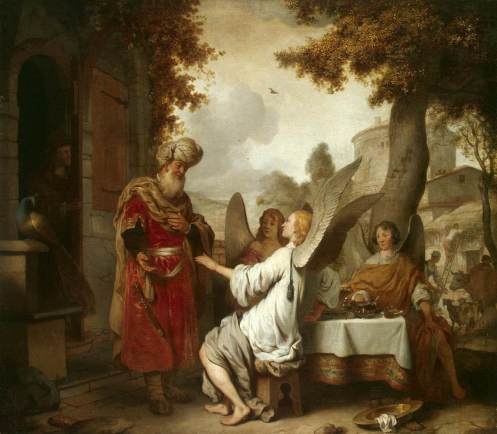
Abrtaham + 3 Angels eeckhout 1656
Abraham and the Three Angels”  Gerbrand van den Eeckhout (1656)
“[Abraham] then brought some curds and milk and the calf that had been prepared, and set these before them. While they ate, he stood near them under a tree.”
– Genesis 18:8

Consider the miracle and mystery of cheese. You take milk. You combine it with the sloughed-off lining of the stomach of a calf called rennet. Store it away and in a few days or weeks and voila! We got cheese!

Neolithic tribes worshiped cheese. Since then, cheese has been intimately entwined with civilization. But for Jews, cheese poses a special problem. The Torah forbids Jews to cook the meat of the kid with the milk of the mother, possibly because of its intrinsic cruelty. In the mystical tradition, milk represents mother’s nurturing and it comes from sheep and cows and goats, animals we domesticate and nurture. Meat requires spilling blood. It is predatory and reminds us of our bestial natures. Milk, then, needs to be protected from meat. They should never touch, and when they have to interact, Jews erect barriers in time and space to separate them. Over the centuries, this has evolved into an elaborate system of kosher rules separating all meat foods from anything that has touched milk. So while serving our body’s need for sustenance by eating milk and meat, kosher laws remind us of the sources of our food. We discipline our cognizance and actions in eating them at separate times off of separate dishes and cooking them in separate pots. Kosher eating is mindful eating.

With all this invested in the barrier between the two realms, then how is it possible that cheese, made with lining from a cow’s stomach, somehow gets an exemption?  The sages of the Talmud give us what seems like a technical reason, but as Aeschylus said, “Wrong should not get by on a technicality.” If we look closely though, we’ll see that the technicality anticipates discoveries only recently made by science. The details of their apparent foreknowledge suggests that the Torah is a channel for knowing things that are only slowly revealed over the millenia by science. To put it more simply, though as a rational modern I resist this conclusion, it seems science is catching up to wisdom revealed thousands of years ago to the Jews. To see that this is more than just a coincidence and the Talmud’s technicalities reveal a true understanding of the science of cheese, we’ll have to dip into we’ve learned more recently about the science behind the magic of cheese. Continue reading “The Quantum Theology of Cheese”

Hearing vs Reading the Bible

The play between orality and literacy in Jethro

When did the Israelites become literate?

If you piece the clues together, the Torah tells us pretty clearly that Moses received the alphabet from God on Sinai.  It happens during the same sequence of revelations that begin with the burning bush and the revelation of God’s Name during their first encounter. God tells Moses to return to Egypt and instruct the elders of Israel in “the signs” or “ the letters” that God shows him.  Moses quails at his assignment.

But don’t worry, God reassures him, “If they don’t heed the voice of the first sign, they will listen to the voice of the last sign.”

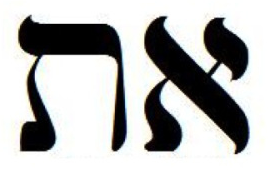
The Aleph Tav
The first and last signs in Hebrew.

The first and last signs might refer to the silent conjuror’s tricks that God has just shown Moses:  a rod turns into a snake and Moses’ hand turns leprous and back again.

But more sensibly, the “voice of the signs” refers to  the core breakthrough that made the phonetic alphabet a monumentally disruptive invention: signs, instead of being pictures for words as in hieroglyphics, are instructions for the voice to make sounds, like musical notes. The first and last symbols refer to the aleph and the tav, the beginning, the whole of this new invention.  God is telling Moses: show the Israelites back in Egypt this new explosive technology, these letters, and with them you shall set them free. Continue reading “Hearing vs Reading the Bible”

“The Hacker We Call God”: Transcendent Writing Machines in Pynchon and Kafka

“Writing is a form of prayer.” – Kafka in his diaries.

The writing machine in fiction is almost always a metaphor used by authors from Swift through John Barth, Italo Calvino, and William Gibson to explain and display their own techniques, an energized funhouse of self-reflection. I’ve looked at many of these over the decades, since they play on the slippery boundary between reason (mechanics) and irrationality (art) in order to question deep assumptions about how their authors, and their cultures, find and express “truth” in fiction. In this essay, I look at two fictional texts about machines that write directly onto the human body. Both mechanisms work to give their subjects knowledge of realms beyond the ken of sheer mechanics. The first is the Sentencing Machine in Franz Kafka’s “In the Penal Colony” (1914), an excruciating device for torturing and executing condemned prisoners by incising tattoos on their bodies . The second is Thomas Pynchon’s much more benign “Puncutron Machine” in Vineland (1990), an electroshock device for adjusting a subject’s spiritual balance, his karmaand send him “purring into transcendence.”  Their comparison shows these two authors’ interest in metaphysics, a territory of twentieth century literature that is curiously under-explored in most criticism. The route to that territory goes from the physical body, through texts written by machines on bodies, to transcendence. Continue reading ““The Hacker We Call God”: Transcendent Writing Machines in Pynchon and Kafka”

Telepathy: A personal note

These demure humming boxes contained the densest working out, the highest tide of everything that collective ingenuity had yet learned to pull off. It housed the race’s deepest taboo dream, the thing humanity was trying to turn itself into.

Richard Price, Plowing the Dark

Here are the four questions that the concept of telepathy helps me answer:

1. Where we are: Our desire for telepathy tells us what we are turning ourselves into: truly intersubjective beings, transmitting pure thought, sensation, and experience to each other instantaneously, without mediation or translation. Artificial intelligence, virtual reality, creating artificial humans, finding alien life, colonizing other planets. Telepathy. These are the science fiction dreams that actually seem to propel billion or trillion dollar worldwide industries. But all of them seem to lie just out of reach, beckoning us. We’re always so close. We’re always not quite there, like Zeno’s Paradox, closing the gap but never reaching our target. Seeing all communication as telepathy tells us something about what it means to be human, maybe a little about what it means to be a living thing at all. My dog is barking, the bees are dancing, the trees are reading each other’s chemical minds. To be alive seems to be to aspire to telepathy.

OLYMPUS DIGITAL CAMERA
Jellyfish at the Monterey Aquarium, 2006

2. What happened? If we use the dream of telepathy as a lens to look back, it helps us understand our history. Older communications technologies – the alphabet, printing press, radio, TV, and the Internet, were revolutions in telepathy, coming with increasing speed through the centuries and now decades, driving us to this ideal: getting experience and thought to pass from mind to mind. Each came with new hopes, new ways of interacting and defining ourselves, and new gods.

3. What comes next? This trajectory helps us map what will come next: Technologically Mediated Telepathy (TMT), or  brain-to-brain experiences through the computer, aided by AI.

4. How to really read: This is minor but it is dear to my heart as an old literature professor: Telepathy implies a way of reading. Reading telepathically means really trying to find out what the author is thinking and intending before finding confirmation of my own bias or theory in the text. They should teach it in every literature class: how to read beyond ideology. Reading is an act of intimacy between the author and me. It comes with a certain responsibility that accompanies all acts of conjugation. I submit to entering and being possessed by another’s mind. When a writer sits down to write in good faith, even the most profane, they are writing a form of liturgy. And I should try to read faithfully, in good faith, like a prayer, beyond prejudice. Every time we try to make ourselves understood or try to understand another, there is a divine hope.

******

About Me:

I’m the author of The Soft Machine: Cybernetic Fiction (Methuen/Routledge), Rope Dances (short stories, The Fiction Collective); A Short Guide to Writing About Science, (HarperCollins & Pearson) and other books, as well as reviews, essays, blogs, fiction, plays, and articles. For 21 years, I was a professor of literature and media at William & Mary and then at Rensselaer. I am also the former CEO, co-founder and executive of several e-learning companies and programs at universities, non-profits and the private sector.

Inspired by the launch of the World Wide Web with the Mosaic browser, I originally explored versions of this material during a sabbatical year as a Fulbright scholar at the Technion in Israel (1993-94). I indulgently took it up with a doctoral class in literature at Rensselaer in 1994. I am indebted to them for their skepticism and indulgence of these “porushian studies,” as they mockingly called my rants, and with good reason. Though wisdom be eternal, cleverness is fleeting, and probably narcissistic.

I published a short version of the larger project appeared here in Mots Pluriels, an Australian journal. Some of it showed up in bits and pieces in numerous dense publications (e.g. “Hacking the Brainstem: Postmodern Metaphysics and Stephenson’s Snow Crash” in Configurations, a Johns Hopkins University journal.) I am most recently grateful to Jason Silva who both resurrected my work and my interest in it by meeting me in San Francisco and then mentioning it in one of his ecstatic video posts “The Urge to Merge.”

I thank my many Talmud teachers and classmates past and present, who often served as the first, suffering audiences, saved me from much foolishness, and have immeasurably enriched my life and thinking. I am especially grateful to my wife, Sally, for her deep and abiding forbearance, to my children, and to my granddaughters for gazing into my eyes for long minutes, even as babies, with questions I can’t answer.

I am inviting you to get lost in this labyrinth, dear telepath, and if you have the time, like a fellow spider in this web, drop me a sticky line at dporush@yahoo.com.