Perpetual Chanukah: A Sermon in the Preposition

For my son, Avraham Benjamin, who was born the first night of Chanukah.
“When the hoof of the swine touches Jerusalem’s walls, the entire foundation of Israel itself shakes.” – Talmud: Sotah

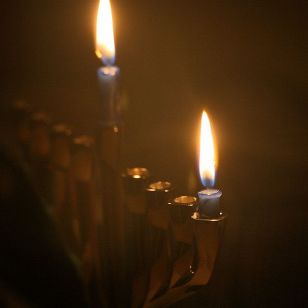
Perpetual Chanukah

Chanukah is both alarming and comforting. Jews are struggling with the growing sense that it’s happening again. Less than eight decades after the Holocaust, anti-Semitism is on the rise in the West. I don’t need to recount the litany of current events and the fear they’re causing. I’m alarmed that we’re still fighting the culture war it commemorates.

The lights and prayers give psychic comfort and hope. They are also the actual weapons to resist the dark tide of history.

Here’s what I mean. On the first night of Chanukah 1st night chanukahwe say a third prayer, the Shehecheyanu, thanking God for bringing us “to this time” (lazman hazeh). This prayer always gets me whenever I say it. Its message is for anyone: be grateful for all the things good and bad that occurred to you, because they brought you to this lovely intersection of fate. Every moment is a miracle.

The second prayer, recited every night over the candles, rhymes with this third. We say bazman hazeh – “in this time” – implying ‘this season on the calendar when we remember what God did for us on Chanukah 22 centuries ago’: letting one night’s worth of oil keep the lamps lit for eight nights after the Maccabees regained the Temple from the Greeks.

There’s a profound lesson in the prepositions, from bazman – in this season repeated every year – to lazmanto this very moment – this particular personal intersection of fate. We’re being told this isn’t just a nice commemoration of history. It’s still happening. We still are in history, or history is brought to our doorstep, at this very moment. That’s why we’re supposed to display the menorah, even putting it out in front of our homes for everyone to see.

Continue reading “Perpetual Chanukah: A Sermon in the Preposition”

Uncloaking the Transcendent Textuality of the Torah

“God works through great concealment”- R. Moshe Chaim Luzzatto, Daas Tevunos 146

The biography of Joseph is a familiar kind of tale about a boy of hidden noble birth who is orphaned in the world, claws his way out of adverse circumstances, and rises to grandiose heroism, like Tom Jones. But the fabric of the text, the original Hebrew, reveals a rich warp and woof of hidden cross-references so intense that it feels like a transcendentally talented artist of wordplay and allusion is at work – a super  James Joyce or Adrienne Rich.

The Joseph story in brief

Jealous of the fact that Joseph is Jacob’s favorite son (he gets a multi-colored coat) and, even worse, that he’s a vain, grandiose “dreamer,” his brothers throw him in a pit. They consider murdering him, but instead sell him into slavery to the Ishmaelites. After the brothers are rid of Joseph, they dip his torn coat in goat’s blood and present it to their father, to imply that Joseph has been eaten by wild beasts. Jacob responds by tearing his own garment (which becomes the Jewish sign of bereavement forever after) and he cries.[1]

941px-Diego_Velázquez_065Joseph’s Coat, by Diego Velázquez (1630)

Meanwhile, the Ishmaelites carry Joseph to Egypt and sell him. His new owner, Potiphar, recognizes that Joseph is gifted and elevates him to be his CEO. Unfortunately, Joseph catches the eye of Potiphar’s wife. She grabs at his coat and begs him for sex. He refuses. As revenge, she gets him thrown in jail, claiming he tried to rape her. He gets out by interpreting the dreams of his cellmates, Pharaoh’s butler and baker, in a prophetic manner.

This neat story has all the makings of a beautifully coherent literary gem. We can see the movie version spun out on a big screen. However, the screenwriters adapting the book would probably cut a couple of problematic parts and its apparently crazy digressions. One is a nonsensical one about Joseph wandering around lost in Shechem looking for his brothers, until a stranger gives him directions. Another is a more interesting and lurid sub-plot about one of Joseph’s brothers, Judah. It doesn’t seem to advance or even connect to the main narrative. But let’s look at it, because it cloaks a couple of interesting features.[2]

Judah and Tamar in brief

Judah has three sons. The eldest marries a woman named Tamar but later dies. The second son, Onan, fulfills his legal obligation to marry his brother’s widow, but because he knows any children will not be counted as his, or because he doesn’t want Tamar to spoil her figure through pregnancy, he “spills his seed,” for which God kills him too. The third son, Shelah, is too young for marriage. Judah tells Tamar to stay in the house until Shelah grows up and then leave when he is of age. Judah worries that if Tamar marries Shelah, his last son will also die.

But by protecting his son, Judah deprives Tamar of her rightful betrothal to the last surviving brother-in-law (called a levirate marriage). Shelah is supposed to save her honor and guarantee her material support. To get their attention, and out of desperation, Tamar disguises herself as a harlot, snares Judah on a road trip, and gets pregnant by him. Judah doesn’t have cash on him for the transaction, so as an honorable man he leaves his signet ring and staff with her as collateral. Three months later, when her pregnancy is visible, Tamar is hauled before the court as a harlot. Judah, in one of the great literary ironies in the Torah, is the chief justice. He is about to sentence her to death by burning when she confronts him with his own signet and staff. Instead of running for cover in embarrassment, he admits his responsibility (would that all public figures and judges issue so full-throated a confession) and even praises Tamar for seeking justice.

This is also a nice story. It could make a cool movie on its own – maybe shorter than Joseph’s, but a brisk, ironic ninety-minute rom com nonetheless. It even has a happy ending. But what’s it doing here?

The literary coherence of the story of Joseph in a single word

The traditional Jewish approach to explicating the Torah is to assume it is famously frugal, parsimonious: it has no extraneous details, no decorative redundancies, no coincidences, no accidental or frivolous puns. If things don’t make sense on first glance, that very incongruity signals a deeper intentiologic or message lurking beneath. So on closer inspection, the literary eye sees not only the jarring digression from Joseph to the story of Judah and Tamar but another remarkable oddity. Because there’s so little other color within this story, when props are brought on stage they get our attention. In fact, they seem like unavoidable metaphors or symbols of … something else.

The props in Joseph’s story are his coat and all the other articles of clothing. Joseph’s coat is the object of his brothers’ envy and symbolizes everything they think is wrong with him: his grandiosity, his preening, his many talents, his favored status which he lords over them in his prophetic dreams. (And yes, as if to prove the point, it even becomes the title of a Broadway musical and then movie, “Joseph and The Amazing Technicolor Dreamcoat.”) The brothers bring the torn, bloody coat to Isaac.

The props that stand out in the digression about Tamar and Judah are also wardrobe items that might be found in any good Canaanite clothing department. And then there’s Tamar’s disguise. The Torah takes the time to tell us that Tamar “takes off her widow’s clothing” in order to don a prostitute’s costume and veil. She later puts her widow’s garb back on to testify against Judah.

When the Torah returns to the second part of Joseph’s story, the prop is again an article of clothing. Potiphar’s wife lusts after Joseph so much that she “grasps at Joseph’s coat.” He flees so quickly that he leaves it in her hand. Then, like any good plot device, the coat returns as she stages it for Potiphar, arranging it by her bedside as proof of her claims that Joseph tried to rape her.

Beged, the MacGuffin

Screenwriters call this type of object a “MacGuffin,”something with little clear intrinsic value that is used to advance the plot (like the titular black statue in the 1941 movie, “The Maltese Falcon,” the letters of transit in “Casablanca”, or the rug in “The Big Lebowski”). Now that we see it, we can re-read the whole story with new eyes.

As we unpack its imagery, the Torah story starts looking like a vaudeville trunk: open it, stand it on its side, and you get a whole wardrobe of costumes.

One of the Hebrew words for clothing is beged (ד-ג-ב, B-G-D). It rings like a bell through the story. Jacob tears his beged (Genesis 37:31–32). Tamar takes off her widow’s beged to play the whore (38:14). She then puts it on again to testify against Judah. Potiphar’s wife tears Joseph’s beged off him in lust as he flees, then arrays it next to her bed, when she plays the injured party to prove Joseph’s guilt. In all, the word beged occurs six times just in this part of the chapter (39:12–18), and twelve times throughout the Torah reading of Vayeishev. As words go, it’s a real lexical MacGuffin.

Veiled meanings

Sure enough, lurking inside the word lies the key to a transcendent understanding of the Torah’s intention: beged means both both ‘clothing’ and ‘treachery’ (as in ‘cloaked motives’, ‘deceit’). As the word rings through these verses, it explains why the interruption about Judah and Tamar, far from being a mere digression from the story of Joseph, may actually explain it.

Once we see it, the theme of treachery ripples out to embrace and tie together larger swaths of the chapter. Joseph’s brothers commit an act of terrible treachery when they first consider murdering Joseph and instead sell him into slavery. They then heartlessly deceive their father into thinking his favorite son is dead.

Judah cheats Tamar by shielding Shelah from marrying her. She repays Judah by deceiving him.

Potiphar’s wife is doubly treacherous too. She first begs Joseph to commit adultery and then lands him in jail on false charges.

We also can’t help but notice that the bedroom comedy between Potiphar and Joseph episode mirrors Tamar’s ruse in the preceding story. But where Tamar has justice on her side, Potiphar’s wife’s trick is a lie. Yet it works to land Joseph in jail. The two stories are flip sides of an allegory of justice perverted. (Hold that thought. We will return to it later.)

Each occurrence of the word beged signifies both an article of clothing and its metaphorical twin, deceit. In fact, the word beged is itself self-referential; it exemplifies the capacity of a word to veil, like words that cloak hidden meanings. It’s a pun on punning, a turn on turning a phrase, a trope on the tropics of textuality.[3]

Once we tug at this literary thread, we unravel entanglements with other double and triple meanings that weave the text together. Here is a sentence describing the source of Tamar’s grievance:

“So she took off her widow’s garb, covered her face with a veil and, wrapping herself up, sat down at the entrance to Enaim, which is on the road to Timnah; for she saw that Shelah was grown up, yet she had not been given to him as wife.” (Genesis 38:14)

What article of clothing implies disguise and deceit? A veil. What does “the entrance to Enaim” mean? Literally, ‘the opening of the eyes’.[4] That would make a fine verse in a poem about appearances here.

The word billows out

With our eyes open, we now see treacheries involving garments billowing out to implicate other events – not just in this portion, but throughout Genesis. As a result of her tryst with Judah, Tamar gives birth to twins. She uses another bit of cloth, article, a red string, to mark the twin that emerges first. It seems obvious that she is trying to avert a repetition of the drama of contested twinship that lurks in their legacy from Jacob, their forefather. Jacob emerged from Rebekah grasping the heel of his twin, Esau, and we saw what mischief spun out from there. ( But fate in the Hebrew family is stronger. Just as Tamar ties the string to avoid getting entangled in God’s apparent script, the first twin is pulled back and the second twin emerges first, tangling things again. The Torah, to paraphrase Mark Twain about history, doesn’t quite repeat itself, but it does rhyme.

A tangled web of deception

The thread of beged brings the play between clothing, disguise, and treachery to center stage. It unlocks the deepest genealogy of the patriarchal family, and makes us look at a destiny that goes to the most complex moral paradoxes in the origin stories of the Hebrews. The treachery of brothers begins with the snake in the Garden of Eden. Cain slays Abel and denies it. Treachery runs through Noah’s family after the flood (his sons uncover his nakedness). It echoes between Abraham and Lot, and becomes the fulcrum of Jewish history as God chooses Isaac over Ishmael. Laban tricks Jacob into laboring for him for 20 years so he can finally wed his true love, Rachel. Joseph’s brothers commit a terrible deception to wipe out the whole city of Shechem after its prince abducts and rapes their sister, Dinah.

The word first occurs in the Torah in the earlier drama between Jacob and Esau. This event originates the calculus of deception that seems to be working itself out like an algebraic proof through the generations after these twins.

Jacob is able to fool Isaac into cheating Esau of his blessing because Rebekah, their mother, has dressed Jacob for the part. She cooks Esau’s best recipes for venison for Jacob to bring his father and then disguises Jacob in Esau’s finest clothes: begado (Genesis 27:15). To prove the deceit worked, when the real Esau comes to Isaac too late to get his blessing, the blind old man is inspired by the smell of Esau’s clothing (begadav). The Sages are alert to the duality of the word. “Read this not as ‘clothes’ but as ‘betrayers’,” they say.[5]

In the end, although Jacob and Esau reconcile in an elaborate display of peacemaking, they are irreconcilable. They embrace, but must live far apart. This mutual exile leads to the first word of this portion of the Torah, Vayeishev – ‘and he settled’. The flavor of the original Hebrew implies that Joseph dwells in the land where his father had to live as a foreigner because he was avoiding Esau and all his descendants, the Edomites. Their elaborate, perverse, tribal genealogy is recounted just before this chapter begins.

The evolution of beged and elaborate design throughout the Torah

The cycles of deceit and family drama among Abraham’s seed don’t end until Moses takes the stage. It’s as if only receiving the Torah can heal the pathological family structure of the Hebrews. Whispering about this transformation in its own small way, the meaning of beged changes as we move from Genesis to Exodus. When beged appears dozens of times throughout Exodus, Leviticus and Numbers, it is only to signify the holy garments of Aaron and his priestly descendants; the garments that need to be washed to be holy or purified; regal clothing signifying elevation, or garments with fringes on their corners (tzitzit) that Jews are commanded to wear in order to control lust. (Recall Judah. Now recall Joseph’s restraint with Potiphar’s wife.) The word mysteriously gets simplified, shedding its alternative, cloaked meanings.

The only place in Exodus where beged retains its sense of ‘treachery’, before it disappears forever, occurs soon after the events of Joseph. It is a law in Exodus 21:8 describing divorce:

“If she please not her master, who has betrothed her to himself, then he shall let her be redeemed: to sell her to a strange nation he shall have no power, seeing he has dealt deceitfully [bevigdo] with her.”

We are subtly reminded of Vayeishev. A man cheats a woman under his control out of what’s owed her by marital rights, as Judah did Tamar. The verse also singles out an odd example of the many ways a husband might cheat a wife out of her due – by selling her to a foreign nation,  – which happens to be exactly what Joseph’s brothers did to him.

A measure of holy justice and honesty

The word beged then does something even stranger. By the time we reach the fifth Book of Moses, Deuteronomy, it seems to disappear entirely. There is just one remarkable exception:

“You shall not pervert the justice due to the stranger, or to the fatherless; nor take the widow’s garment as pledge [collateral].” (Deuteronomy 24:17)

The word calls out here nakedly, without adornment: beged. It has long ago shed its alternative meaning of ‘disguised motives’ or ‘treachery’. Now, though, it is transmuted; elevated to a fundamental symbol of justice. The Torah warns judges: apply justice even-handedly, to the stranger and the orphan. Show mercy – don’t take collateral from the widow. “The widow’s raiment” calls back loudly and clearly to that other widow from four books ago: Tamar.

This one late recurrence of the word beged, by its singularity, seems to trumpet a moral evolution through the other four Books of Moses. We have left the first family treacheries behind us, way back there in the Book of Genesis. We have been instructed elaborately on the mechanics of holiness and purification, especially involving clothes, in three books that follow. And now, through a solitary instance in the final book, we understand the ultimate obligation is to activate those aspirations by connecting the divine to humanity through justice.

What author had this much wit?

What author had the wit to devise this complex and subtle web of signification, woven across so many chapters? How did that author layer so many puns, echoes, cross-references, intertextual reflections, and doubled meanings on one word? Or hide so many clues so deeply that they may never have had any hope of being discovered without a concordance and a computer?

When every fragment of a whole seems to contain all the information of that whole, we call it a hologram. How did the author show such great artistry, to grow and alter the meaning of the word itself, to lose its furtive duality, to evolve its significance in parallel with the much broader arc of the Children of Israel as they evolve from idolatrous Hebrew nomads to a holy nation? Who devised this hologram? Why does one word seem to multiply across Exodus, Leviticus and Numbers, but then seem to be forgotten in Deuteronomy except for one, exquisitely resonant occasion that ripples back and colors all its predecessors?

Are these all signs of inconsistency, proving the Torah was stitched together by many authors across centuries? If it was, who cloaked the secret for those centuries so it could be ultimately manifested?

Or is it proof of such incredible subtlety and coherence in the composition of the Torah that only a single transcendentally gifted Author could possibly have held it in Their mind?


ENDNOTES

[1] Rashi, among many other commentators, flags this intrusion, “Why is this section placed here thus interrupting the section dealing with the history of Joseph?” (Genesis Rabbah, 85:2).

[2] The sages *almost* make the connection that Joseph’s torn clothing makes between parts 1 and 2 of the Joseph story: “A savage beast devoured him. This is a reference to Potiphar’s wife, who would attempt to seduce him.” Midrash Rabbah 84:19.

[3] The technical word for this is “paronomasia.”

[4] Rashi on Torah.

[5] Midrash Rabbah Bereishit,


ACKNOWLEDGEMENTS

I am grateful, again, to my neighbors Michael Morazadeh, Jonathan Choslovsky, and Ron Kardos, members of my informal chavrusa, who challenged me to take a hard look at the Documentary Hypothesis (that the Torah was written by many authors across several centuries instead of by God and Moses). This blog and several before and after were inspired by their challenge. I am also grateful to Rabbi Yale Spalter of Chabad Northern Peninsula for noting what some of the sages had to say about these matters.

The direct inspiration for this treatment of beged came during a celebration of the 19th of Kislev at Chabad of Palo Alto (where I was also accompanied by R. Spalter and Messrs. M, C, & K.). Rabbi Menacham Landa of the Novato Chabad was darshening about Joseph’s incident with Potiphar’s wife and it occurred to me that Joseph seemed to have a habit of losing his clothing in dramatic circumstances. Rabbi Levin of Chabad Palo Alto said, almost off the cuff, that the word beged had a weighty meaning worth looking into.

What is a Jew?

Last week, President Trump extended Title VI protections to Jews – alongside other students of race, color or national origin – on campuses that receive federal funding. This kicked off what the media called “a firestorm.”  It was actually two controversies for the price of one. First, do Title VI rules restrict freedom of speech. Ironically, this became a problem only when Trump protected Jews, even though it’s a 1964 ruling. Second, are Jews like the other protected classes? How so? What are Jews, exactly?

Are we a race, a nation, an ethnic group, an extended family, a religion, or just a bunch of folks who like bagels and lox? All of these fit some Jews, but none fit all Jews, so what is going on? Even Jews debate it all the time. Continue reading “What is a Jew?”

Are Jews a race, religion, nation, ethnicity, tribe, or … what?

This week, President Trump extended Title VI protections to Jews, alongside other students of race, color or national origin on campuses that receive federal funding. This kicked off what the media called “a firestorm.”  It was actually two controversies. First, do Title VI rules restrict freedom of speech (which only came up as a protest when Trump protected Jews, even though it’s a 1964 ruling. No comment). And second, are Jews like the other protected classes? What are Jews, exactly?

This is a debate even among Jews: Are we a race, a nation, an ethnic group, an extended family, a religion, or just a bunch of folks who like bagels and lox? All of these fit some Jews, but none of these fit all Jews, so what is going on? The question is particularly poignant because whatever Jews are, they keep popping up on the stage of history for over 3500 years.

There is a document that defines the essence of Jewish identity, a charter for membership in the gang we call Jews, if you will. It’s called the Torah, and it insists it originates in a divine ideal of what people and the world can be. Jews call this concept “holiness,” but the word is too loaded. Whether you believe it is literally true or not, the proposition that this document originates from God explains the transcendent power and persistence of Jewish identity, even among Jews who reject it. Something mystical seems to be going on that preserves the Jews against all odds. The fact that this essence doesn’t fit any of the usual categories may also explain why Jews are also so persistently reviled and persecuted among other nations. Continue reading “Are Jews a race, religion, nation, ethnicity, tribe, or … what?”

Why Does the Epikoros Lose His Soul?

What’s an epikoros?

In the 1950s, you would think Crown Heights was populated by a gallery of rogues, scoundrels and losers with terrific names like shikker, shnook, shlepper, shmendrick, shnorrer, shlemazel, goniff, mamzer, or my favorite, vance.  One of the most chilling, because I wasn’t sure what it meant but it was always muttered darkly, was epikoros. My grandmother pronounced it with her thick Polish inflection, chapikoiyris, but you could also hear apikoros or apikorsis.

Gustave Dore 6th ring Dante Inferno
Hell for Epicureans: Gustave Dore, 6th Circle, Dante’s Inferno (Paris: Hachette, 1861) from Open Culture

Over time, I realized the word referred to Jews who actively flouted any Jewish observance, a heretic or at least someone who went off the path – the derech as they say in Hebrew – in a serious way. But the word had a long history before it hit the streets of Brooklyn.

Epikoros originates as a Jewish curse at least as far back as the Talmud. The sages single out the epikoros as one of the four kinds of heretics, Jews who lose their immortal souls, an eternal death sentence. But the word sticks out because it doesn’t sound like anything Hebrew and doesn’t have any precedent in Aramaic. It obviously seems to refer to the great Greek philosopher Epicurus (341-270 BCE). Continue reading “Why Does the Epikoros Lose His Soul?”

The Not-So-Hidden Future History of the Jews

When Jews of all peoples don’t realize they are in history, then they inevitably drown in it. Continue reading “The Not-So-Hidden Future History of the Jews”

Pinchas: A five-act play about Jewish legacy

Dedicated for SHABBAT PINCHAS 2779 to my father-in-law, Philip Oliver Richardson, Z”L”, and to his great-granddaughters, Noa and her sisters.

At first glance, Pinchas, like so many other weekly portions of the Torah, looks like a set of disparate pieces, thrown together with no particular logic. Some are boilerplate, others cinematically compelling. G-d rewards a zealot for a terrible act of violence and launches a war, but instead of taking us to the battle scene (the next week picks it up in Matot-Massei), a long, repetitive census interrupts the action. Five daughters provoke a revision in law and Moses dramatically transfers his power to Joshua, but a boring account of sacrifices deflate the end.

On closer inspection, though, Pinchas is a wonderfully coherent five-act play. Its hero isn’t a person but an idea, a revolutionary new concept of how a nation will transfer its legacy from one generation to another. In fact, at the risk of mixing metaphors, once we untangle (and then put back together) the threads, layers, cross-references, and perspectives on Israel’s legacy,  a complex shimmering 3D tapestry – a hologram[1] in which every part resonates with every other and every jot signifies the whole – comes into view. Continue reading “Pinchas: A five-act play about Jewish legacy”

Democracy or Theocracy? Korach’s Fourth of July Rebellion

(On July 4, 1992, Shabbat Korach and the Fourth fell on the same day. I delivered this as a drash in a Conservative shul in upstate New York (Agudat Achim in Niskayuna) before I knew a lick of Rashi or Talmud, so please forgive its incredible ignorance and naivete. Please note this has been edited from the original notes.)
Moses is not the leader of a democracy, as this week’s parsha shows. How does a good Jewish citizen of America choose between allegiance to democracy or to the harsh autocratic theocracy the Torah seems to demand?
Kippah + American Flag
(From Jewish Boston, photo by selimaksan/iStock)

Through a wonderful coincidence, this weeks’ parsha and the Fourth of July fall on the same day. Korach tells the story of a Levite, a leader among the Hebrews wandering the desert, who arises and leads a democratic-style revolution against the leadership of Moses and Aaron. Continue reading “Democracy or Theocracy? Korach’s Fourth of July Rebellion”

It can turn on a dime

My father used to say to us, “It can turn on a dime.” He saw American hospitality to the Jews as a thin veneer, like Germany’s. It could be stripped away at any moment to reveal the anti-Semitism he was sure lurked beneath the surface. He was convinced any nation that suffered us to be their guests long enough would sooner or later turn on us, even this land where religious freedom was enshrined.*  And you couldn’t bet against his paranoia. He had history on his side, 100-1.

I guess I inherited some of his dark vision and even afflicted my children with it. I still tell them half-jokingly, “Keep your passports active.”

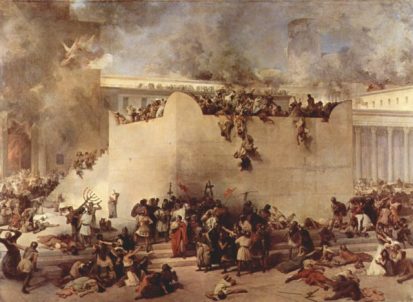
Destruction of Secomd Temple
“Destruction of the Temple” by Francesco Hayez, 1867.

Dad served as Gen. MacArthur’s mapmaker on the voyage of the USS Missouri to accept Japan’s surrender in 1945.  In 1947, he led his army buddies in Brooklyn to gather guns to smuggle to Israel for the Haganah in their fight for independence from the Brits.

Continue reading “It can turn on a dime”

We Are All Esther

The Talmud teaches us that simply reading the Book of Esther can be an act of courage in defense of the Jews

War by word, not sword, in exile

Jews, destroyed and exiled by Rome, may have enjoyed periods of peace. Their leaders at times may even have been personal friends like Judah the Prince and Marcus Aurelius. But it could all turn on a denarum. As the Roman Empire becomes the Holy Roman Empire, too much is at stake and the people are slipping away. Romans slaughtered Jews and then Christians. Now, Romans are becoming Christians. More than ever Jews must keep themselves together, retain their tradition, and know how to avoid further splintering. They need to be told how to distinguish false prophets from true ones. So the sages of the Talmud wage a war, not by sword but by word.

For this, they summon Esther, the queen of living precariously, and press her into service. What better story than hers, one about disguises, furtiveness, veiled meanings, hidden identities, revelations and final triumph? As her people face an official final solution in Persia, Queen Esther the crypto-Jew realizes she is both the avatar and only hope for her people. She risks death by exposing herself to King Ahashveros, and her act saves the day. She deserves her own book of Scriptures, the Megillah, and that book deserves an entire volume of the Talmud commentary, also called tractate Megillah. The Purim drama deserves re-enactment every year in the Jews’ most unrestrained celebration. Indeed, as the Kabbalah tells us, the story is so joyous and potent, Purim will be the only holiday we will still observe after the Messiah comes; not Passover, not Yom Kippur, nor Simcha Torah, but Purim.  

After Esther saves the Jews and the storm is over, the Talmud tells us, Esther tries to call God again from the palace garden. But she has lost her super-power of prophecy. She is so heartbroken and forlorn, she cries out

‘My God, my God, why have You forsaken me’.[1]

Now to the most shocking part of this. This cry is not found in the original Megillah. Instead, it seems that the sages have made a stunningly bold – or foolhardy – move by putting in Esther’s mouth the single most dramatic sentence from the other team’s story! By the time this part of the Talmud was written in the third century CE, everyone from Jerusalem to Rome would hear in Esther’s alleged cry a clear echo of perhaps the most dramatic moment in the most famous story of their time. The gospels of Mark and Matthew say Jesus cried out as he is about to die, crucified

My God, my God, why have you forsaken me?[2]

What were the sages thinking? How dare the rabbis borrowing from the gospels? And for what purpose?

Whose line is it?

To untangle the answer, we have to look at the timeline and intertextuality of the line.  When we do, we find a story in miniature of the battle between Judaism and Christianity over words and their provenance, and inside that story, a tale of how the sages of the Talmud were modeling the practices that would preserve Jews and Judaism in exile.

It goes without saying that Jesus is the ultimate false prophet for the Jews. He and his disciples were all Jews, as was Paul, the first convert. Followers of Jesus expertly re-tell all the stories of the Jewish Scriptures and re-purpose them as a prelude to the story of their hero. Abraham’s near-sacrifice of Isaac is prefigurement of the crucifixion. Chosen by God, Jacob/Israel is a prototype of Jesus. The Passover Seder becomes Jesus’ Last Supper. The lamb of Pesach is a symbol of Jesus’ bloody sacrifice. As redeemer of the Jews, Moses is the archetype, even giving his name to the role: messiah. In short, the gospels deliver a radical re-interpretation of humanity’s relationship to God by appropriating all the relevant Jewish phrases, memes, characters, and tropes as foreshadowing, making the Jews’ Torah an honored but obsolete allegory, an “Old” Testament testifying to the “New” one.

So if this is a textual war, why would the sages steal signals from the opposing team, cite from a source they certainly saw as inimical to theirs, not to mention risk the outrage of their hosts?

On the surface at least, they are simply asserting the rightful Jewish claim to it. The original source of both is Psalms 22,[3] King David’s prophetic lamentation, a wonderful poem whose conceit is that God has forsaken David personally and by extension the nation of Israel:

Many bulls encompass me
strong bulls of Bashan surround me
they open wide their mouths at me
like a ravening and roaring lion

I am poured out like water
and all my bones are out of joint
my heart is like wax
it is melted within my breast
my strength is dried up like a potsherd
and my tongue sticks to my jaws
You lay me in the dust of death

for dogs encompass me
and evildoers surround me
they have pierced my hands and feet
I can count all my bones
they stare and gloat over me
they divide my garments among them
and for my clothing they cast lots[4]

The Gospels borrow this metaphorical, highly charged imagery for a literal description of the crucifixion. King David cries that the teeth of dogs and bulls pierce his hands and feet just, as nails did Jesus’. David imagines his spiritual defeat as if he is killed in war. Enemy soldiers gloat over his dying body and gamble by throwing lots, shooting craps, for his clothes as booty. In Matthew’s appropriation of this imagery, soldiers under the cross gamble for Jesus’ clothes.[5]

The imagery throughout Psalms 22, especially of this metaphor of gambling, evokes Esther’s story, so the Talmud brings it down as a passage missing from the Megillah,[6] a beautiful expression of the pain that Esther must have felt when she, too was abandoned by God at discovering her loss of prophetic power. But by boldly re-claiming the words of David that the disciples put into the mouth of Jesus and putting it into the mouth of Esther, are the rabbis simply asserting a copyright claim? Given the circumstances, as guests in exile to an often hostile host, they are taking quite a risk for the boasting rights.

By evolving prophetic practice into textuality, Talmud preserves the Jews

The context for the message suggests its deeper purpose. In the same page of Talmud, the rabbis praise the power and importance of dedication to texts:

… Israel busy themselves with the Torah, the other nations do not busy themselves with the Torah —… these also reel through wine, and stagger through strong drink, they totter in judgment.[7]

Israel occupies itself with Torah. Every text, every verse, every word, every letter, even the flourishes on top of the letters, their ‘crowns’, can yield multiple interpretations as they did for R. Akiva. This intense polysemous interpretive practice leads to the multiplication, not the reduction of meaning. And this intense involvement in the text is exactly what Jesus attempts to overthrow in favor of a more simple, direct, accessible engagement with God through his own person. From the point of view of the Talmud this must have been the ultimate posture of the false Jewish prophet. The Christian texts appropriate the Jewish narrative to usurp it and along the way efface the glorious complexity and richness of the rabbinic discourse. They take the complex multiplication of interpretations, the parsing of every jot, the involved and sometimes fruitless debates, and reduce them all to a vast allegory with only one symbol, one interpretation: the life and sacrifice of their heroic figure. To resist it, the authors of the Talmud re-assert their faith: Jews are distinguished from other nations because God revealed the Torah to the collective nation on Sinai. Engaging that revelation, both the part transcribed into text and the part transmitted orally and now transcribed, is the one essential practice that preserves Jews, then and now.

The sages are clearly addressing and blocking the gospels’ attempt to steal the Purim story, appropriate it in order to erase its essence. They re-appropriate, they steal it back, with textual virtuosity, reminding everyone that this line belongs to the centuries-older Esther story and the words they put in her mouth comes from the yet centuries-older Davidic psalm. They send many intertwined and cryptic messages at once. For one, the whole intertextual turn makes us see the Jewish exile in Persia as an analog of their own in Rome. Dogs and scavengers gamble over the remnants of Jewish glory after prophecy has departed from usIsrael is defeated and exiled. But Jews will survive.

But the battle over the provenance of the line is only part of their intent here. They also seem to be saying something to the Jews about the truth of prophecy by David and Esther, and how to resist false prophecy in exile when they have none of their own. Their answer is to make the connections and meanings among texts as an extension of the dialogue with God.  They are reading God’s Mind.

There is no more potent text than the story of Esther and no more powerful figure among the prophets on which to play and win this game. God may be nowhere on stage in the Megillah, yet He is there everywhere at once behind it. His plan for history trumps Haman’s anarchic and hateful plan to drive Jewish destiny by mere chance. Haman is just another pathetic dog soldier gambling over the remnants of Jewish subjugation. God’s name never appears in the text of the Megillah, but His meaning is ubiquitous.

In a smaller act of courage, the sages of the Talmud re-enact the Megillah drama in an entire volume of the same name. They tell the textual truth of the matter, exposing a systematic plot, a more insidious and ultimately more successful gambit for utterly destroying a nation: to undermine and erase the Jews by re-telling their own story. Why bother with genocide when you can cancel a culture with words and symbols?

This small bit of storytelling in the Talmudic volume called Megillah is metonymy for the whole volume itself and we could say for the ongoing treatment of Talmudic textual practice as a holy act, an extension of Torah and sanctification. Judah the Prince, by writing down the Oral Law as Mishnah, was prescient. He anticipated that the wait for the next reconstruction of the Temple in Jerusalem was going to be a long one. In the meantime, the Temple’s portal to and connection with God had to be transmuted into something portable and vital, adaptable to alien environments. Architecture becomes architexture, a sprawling text, a vine with many roots and branches sprouting, intertwining, and still spreading. One offshoot may die out but another springs up somewhere else. Burn it, eradicate the people attached to it, and still a single Jew (and a donkey or two) could transport the Talmud to keep the flame alive.

We are all Esther

After the drama is over, God withdraws from Esther, and she doesn’t know when He’s coming back, if ever.  Purim, the Talmud tells us, is about this loss of prophetic power. Esther’s struggle, like ours in our diaspora, is to continue to believe in God’s ubiquity, omnipotence, and attention. The Purim story is a bulwark against our compromised historical condition.  Like Esther, we inhabit a foreign domain, unsure when and if prophecy will return at any time, consigned to trying to read His mind as best we can from what He has left behind, always fighting the temptation to assimilate to false prophets and strange worship.

In other words, we are all Esthers today. Prophecy has withdrawn, lamentably. However much we yearn for it, and however much we shape our actions to deserve it, and however much we are seized by inspiration, legitimate prophecy doesn’t come to us now.  But instead of hopelessness, Purim tells us that the finger of God continues to stir the pot, that His will in our affairs acts invisibly and ubiquitously behind the scenes, and there is an unfolding plan for our fates that is cosmically better conceived than a mere casting of lots.

It’s a struggle to continue to believe in and act according to tradition in the absence of sustained proof and direct communication from God, but it’s the battle that has been granted us to fight, like Esther, and the one Jews have no choice but to join if we are to survive. Who knows but that we have been put into our positions for just this purpose? When I see my granddaughters in their masks and costumes and smiles on Purim, I also see little victories.

 Mountain View 2014. Revised, San Mateo, Purim, 5780 and 5781


ENDNOTES
Thanks to Rabbi Yossi Marcos of Chabad NP (San Mateo) whose new edition of Megillat Esther includes  the chasidus underlying my insights. Thanks to Rabbi Yitzchok Feldman of Congregation Emek Beracha for teaching me about withdrawal of prophecy and the status of the Urim v’Thumim in the Second Temple. Thanks to my many friends and erstwhile editors, including Ron Kardos, Marcos Frid, Yael Esther and Eddy Berenfus. As always, remaining errors and narishkeit are all my own.

[1] Tractate Megillah 15b2. “The Gemara returns to its explanation of the verses of the Megilla. The verse states with regard to Esther: “And she stood in the inner court of the king’s house” (Esther 5:1). Rabbi Levi said: Once she reached the chamber of the idols, which was in the inner court, the Divine Presence left her. She immediately said: “My God, my God, why have You forsaken me?”  R Levi lived at the time of R Yochanan, around 290-310 CE

[2]  Mark 15:34; Matthew 27:46

[3] Psalms 22, certainly composed no later than the fifth century BCE but attributed to and possibly composed as early as the tenth century BCE uses the Hebrew ‘azvatani’ as it is in the Talmud’s quotation of Esther

אֵלִי אֵלִי, לָמָה עֲזַבְתָּנִי;

The Gospel’s version uses the word ‘Sabachthani’, but it is the Aramaic equivalent (from the Greek root ‘shebaq” = σαβαχ = סבאח.

[4] Psalms 22:12-18

[5]  Matthew 27:35-37

[6] Psalms here uses the word goral (גורל), not pur (פור). When parties had equal claims to spoils of war or booty or simple property, the goral was an official method of divvying them up by means of casting dice or lots, common throughout ancient civilizations, including Persia and Rome.  The Megillah, sure enough, equates them: v’hipil pur hu ha’goral – literally “and they cast the pur, which is the goral.” Esther, 3:7. These were also pagan methods of determining fate through sympathetic magic. If you believe the cosmos is simply a matter of circumstance, coincidence, happenstance, or chance, then casting dice or lots is a way of divining or determining the future as good as any other. The fact that Haman’s lottery falls on the date of Moses’ birthday is one of the secret ways the Megillah signals to us who is really in control of fate.

[7] Tractate Megillah 15 b2