After Oct 7, Passover reminds us to outwardly perform being Jewish
“For here the day comes burning as a furnace” – Malachi 3:19
This Passover, many Jews will celebrate another seder with special intensity. Oct 7 sharpened the knowledge that we are in history. The Angel of Death still hovers on the threshold of the Hebrew home.
The slaughter on Oct 7 was atrocious enough. But Jew hatred erupted all over the world, stunning Jews and making many cower. On campuses, in the workplace, on the streets, Jews hid their kippahs, Stars of David and even mezuzahs. Maybe this was forgivable self-preservation. But there were other Jews who joined with those who outed themselves as Jew-haters, their old political allies who want the West and Israel to disappear. Their betrayal is hard to forgive.
The Bible tells us where they went wrong and gives us clear advice for how to survive our post-Oct 7 crisis when it tells us how to celebrate Passover.
The original command
As the Hebrews await the tenth plague of the Angel of Death, the Book of Exodus instructs them how to keep the Angel of Death away. Here’s a fairly literal translation:
Then take a bunch of hyssop and dip [it] in the blood collected in the basin,
and touch the lintel and the two doorposts with some of the blood which is in the basin, and don’t go out, any man from the entrance to his house, until daybreak. God will strike Egypt and see the blood on the lintels and on the two posts and God will pass over the entrance and will not allow The Destroyer to enter your homes and strike you.  (Ex 12:23)[1]
It concludes by telling them this is not just for Egypt but for all time:
And you are to keep thisthing as a statute for you and for your children, forever! (Ex 12:24)
What’s “this thing” we’re supposed to keep forever?[2] It should be obvious but the Sages see a problem: no one has smeared blood on their doorposts since Egypt. That cannot be the ritual which we observe for all time. Normally “this thing” simply refers to what just immediately preceded it. “This thing” must instead refer to something else. But what? The majority conclude it’s not marking the doorway to avert the Angel of Death, a one-time event, but to sacrificing the Paschal lamb, the enduring centerpiece of the seder. The trouble is, that was mentioned way back twenty-one verses earlier in the Bible, a really lost antecedent![3]
A solution
However, let’s take the Torah at its word and read “this thing” in its plain sense of referring to what came before. Then we see smearing the blood on the door is only the culmination of a continuous set of instructions about how to observe Passover. The Hebrews are told to identify the sacrificial lamb, to sacrifice it, to share it among households, and to eat it. They must also save the lamb’s blood in a basin and use it to mark their doorways.[4] In other words, it is all one piece, connected by the lamb and its blood.
So for all time, rather than choose between the eating of the paschal lamb, as the Sages would have it, or smearing of blood as a marker for God, as grammar and logic suggest, it should be both/and. But are we literally supposed to smear the blood on our doorway?
Message for today: Don’t bait the Angel of Death
A tradition they don’t tell you in Hebrew school is that 80% of the Hebrews died in Egypt. They preferred their miserable but tangible reality as slaves in Egypt to the intangible promise of an uncertain redemption promised by an abstract God. They were chained to a secular, materialistic vision of the world, unable to make a leap of faith despite the awesome display of plagues God performed for them. These Hebrews, like so many generations after them did, disappeared with the empires they assimilated to.
After Oct 7, some Jews have donned the keffiyah, literally or figuratively. Perhaps they think that placating the Hamasniks will preserve them, though weakness, denial and submission only incite the bloodthirsty to attack. Maybe they are genuinely reacting to Israel’s response in Gaza out of misplaced colonial guilt, or simply following the crowd on social media, or naively following the lead of tv news, or joining the rallies on campus to be cool and skip classes. Maybe they are too committed to a progressive ideology to change their minds, or too lazy or ignorant to look at the evil of the terrorists and the horror of their acts. But these Jews are like those Hebrews lost for all time back in Egypt. They’re baiting the Angel of Death. They forfeit God’s protection. They’re abandoning their own and their descendants’ immortal identity.
Being a Jew Means Performing It
The Talmud says the seder is a performance for children, a night of elaborate stagecraft to get their attention so they will transmit it to their children.[5] Oct 7 teaches us that the transmission includes performing the outward sign of being Jewish, repeat the ritual of the lamb not just in the seder but always, openly, visibly, especially when it’s most scary out there.
Billboard in California on Hwy 101.
It’s hard to believe that even in the 21st century, we should publicly display our Jewish identities for the Angel of Death to pass over us. The Nazis made Jews wear yellow stars to make them easier targets for round up, which contradicts this advice to go public. Jew haters attacked identifiable Jews in New York, Amsterdam and many other places after Oct 7, and Rabbi Meir Kogon was killed in the UAE. But the Passover command in Ex 12:23 suggests the need to be courageous anyway, make public signs of our faith (unless, of course, there is imminent danger to one’s life).
Three other Hebrew words suggest this in the our verse.
And you are to keep this thing as a statute for you and for your children, forever! (Ex 12:24)
Chok [חׇק], “statute,” refers to a special kind of commandment, one with an impenetrable rationale that transcends normal understanding, like the commandment of the Red Heifer.
The second is et [אֶת], a preposition that points to what comes next very particularly, in this case “this thing” we must observe. Rabbi Akiva tells us that this almost insignificant and often overlooked particle actually contains deep secrets, hidden intentions of God, and requires extra interpretation. We are on supernal ground here and should tread carefully before drawing conclusions about what God intended for all time.
The third is d-b-r[דבר], the “thing,” the “matter” we are to observe. But the Hebrew as it is written in the Torah scroll – without vowels – could also mean “plague” if we pronounce it dever instead of davar. So we could read the verse as
“Guard – give heed to, be on the outlook for – this plague for all your children forever. [שְׁמַרְתֶּם אֶת־הַדָּבָר].”
The world burns. The tenth plague returns. Jews again have to choose between Egypt and redemption. Now is the time for a courageous, affirmative public sign, We Here Are Jews! After all, what more powerful act could we to perform for our children this Passover?
ENDNOTES
Thanks to Marcos Frid for fixing a big error I made in the original draft. I’ll sure there’s more to find if he looks.
[3] The Sages untangle the contradiction by noting other occasions in the Bible when a commandment and its reference were separated.
[4] In fact, the command in Ex 12:23 is first mentioned in Ex. 12:7 in the middle of these instructions. The repetition indicates the continuity of the Passover instructions.
[5]Pessachim 108-109. Thanks to R. Feldman for teaching me this.
“.. to take refuge from the fiery stream and rain, when You rain coals upon the wicked”
“May it be Your Will”- Prayer said in the succah
Israeli soldier prays in sukkah in Gaza. Courtesy of Israel Live News 70 on WhatsApp Oct 20, 2024.
Yahya Sinwar orchestrated the October 7 massacre by Hamas to inflict maximum pain on Israel and Jews.
Whether he timed it for Simchat Torah, the most joyous religious holiday on the Jewish calendar, may never be known, but our enemies always know us better than we do ourselves, and Sinwar was an assiduous, if evil, student of Jews and Israel.
Almost certainly he also knew about the Nova Festival of Peace, a wonderfully soft target on the Gaza border that week. The festival organizers did schedule Nova deliberately for the last days of Sukkot because it is an Israeli national holiday. Maybe they and all the festival goers consciously intended it as an alternative Simchat Torah, a secular celebration of the religion of music, peace, sensuality, drugs, sex, and indulgence. In any case, the targets were ripe. Israel was caught off-guard. Hamas went on a rampage. They raped, murdered, beheaded, burnt, and tortured unspeakably any Israeli they could get their hands on. They took almost 250 hostages to the hell tunnels of Gaza.
On the first day of Sukkot the next year, 2024, Israeli troops assassinated Sinwar in Rafah, where they long suspected he hid.
I’m writing this sitting in my succah, sunlight streaming through the straw roof. It’s the one time of the Jewish year when the mitzvah surrounds us, envelops us, shelters us: we are in the mitzvah as opposed to the mitzvah being in us. And so it’s hard in this placid moment staring at the calendar not to reflect on the coincidence of dates: Sinwar’s terror the day after Sukkot; his assassination a year later on the first day the next year. It opens a space on the calendar, a temporary parenthesis that alters consciousness, a week that happens to be Sukkot, when we live as if we just fled Egypt and dwelled in temporary wilderness huts 3200 years ago. In the succah we dwell in the temporary, the temporal. History accordions in on itself. What does it mean?
Of course, if you see the world filled with miracles, there are no coincidences. God is talking to us through His time, His calendar. In His time, infinite opposing currents can be true, tumbling into and flowing over each other in dense layers of meaning. Past and future collapse into one unifying vision of truth. Looked at this way, the signs are explosive, hard to ignore, like reports of gunfire around the corner. Maybe we can read His mind about the week:
Enter My space, the canopy of peace. My soldier’s rifle is nearby. Bullet holes riddle the wall outside the window. Light halos him. This is a temporary if holy peace. The succah roof is makeshift, gerryrigged over destruction, yet My light streams in. My soldier summons seven heroes from the Jewish past. They faced horror and survived disasters and are now his guests. He has carved out a bittersweet moment of peace on the battlefield. It is fleeting. That’s the nature of human time, but it looks forward to a future of permanent and perfect peace.
When you try to read a perfect text it becomes a religious experience
“God always likes to veil his symbols a little bit, being among His other attributes, the perfect literary artist.” – Herman Wouk, The Caine Mutiny1
Telepathy: Why we read
Every time we read, we play a game of telepathy. The author uses words to get what was in his or her head into ours. My wife wrote “eggs” on the grocery list. If I pick up eggs, not brussel sprouts, I won the game.
Literature, the kind of stuff you read in university classes, is intentionally more complicated. T. S. Eliot’s “The Waste Land” (1922) set the standard for impenetrability. It had 433 footnotes just to explain the allusions. Elizabeth Bishop’s “A Miracle for Breakfast” (1937) or W.H. Auden’s “Paysage Moralisé”(1933) – both complicated poems called “sestinas” – or Wallace Stevens’ “The Idea of Order at Key West” (1923) had even tighter weaves of word play within themselves, greater gravity, pound for pound, than Eliot’s. Words attain multiple meanings and the poet uses symbols, sound, repetition, cadence and any number of hundreds of well-known ways to play with words (called “rhetorical devices”) to draw connections within and across the text, creating webs of interpenetrating meanings. All these seem to defeat the telepathic purpose of writing. At least, they make it much darn harder to get a clear telepathic message.
The job of the teacher is to get the class to appreciate the purpose of a literary text beyond just telling great stories. We read authors precisely because they didn’t try to be perfectly clear. It’s the varsity version of the telepathy game. The ambiguities and tricks leave us trying to get answers. What was she thinking? Stevens wrote another dense poem, “Notes Toward a Supreme Fiction,” that both describes and illustrates what a great work of literature does. As the title says, however, even this master poet could only scribble “notes” that gesture “toward” what a “supreme fiction” could do. Stevens is telling us that the supreme fiction is transcendent, unattainable. A reader could find traces and glimpses and perhaps whole sublime works that transport them briefly to divine inspiration,
but there are no humanly attainable “supreme fictions.” We can only try to write one before a keen sense of the limitations of our own mortality bring us back to earth. It’s an asymptote, a point that the word artist always approaches but never reaches, an aspiration:
.
Imagine a Perfect Text
Now imagine a perfect author, perfect in the scientific sense: he or she completely comprehends the universe and everything in it, all its laws and interactions down to the quantum level and across its massive, wheeling galaxies in a 19 billion light years expanse, knows the past, present and future, in one integrated whole, an incarnation of science’s god, a Grand Unified Theory. Imagine that the author is also perfect in the active, creative sense, continually exercising every super-power: shaping time, space and matter, reading every mind in the universe all at once, weaving together all the events in that vast universe in every instant always.
Now imagine this perfect author took time out from a busy schedule to compose a perfect literary text. I don’t mean perfect as in “perfectly clear” – that would take the mystery and fun out of it and reduce it to computer code. Perfect in the literary sense, like the hardest poem you ever had to read for literature class: dense, almost impenetrably thick with meaning. Every word has a purpose and has infinite depths of possible meaning and resonates with every other word. Every line interpenetrates and colors every other line, changing how we understand what we just read and will read next. A perfect poem is like a hologram, where every word or phrase contains an aspect of the whole. When Adrienne Rich writes a poem that begins
Night-life.
and ends
…the night becomes our inner darkness, and sleeps
like a dumb beast, head on her paws, in the corner2
She wants the lines to speak to each other and to the dozens of lines between. She wants the poem to change what we feel about darkness, sleep and night. When she uses the word “conceived” in the middle of the poem, we know she means both “having a thought” and “giving birth” and “creating” (including creating the poem we are reading) all at the same time. That’s what poems do. Mean more than one thing at the same time. It’s the opposite of computer code or a grocery list where if something is ambiguous it fails.
In a perfect fiction, the story would be perfectly plotted, more tightly wrought than the best thriller or detective story ever. It would have an intriguing beginning, complicated middle and fulfilling end like other fictions. It would be filled with clues, casual incidents, remarks, and symbolic objects. Even the setting and clothes are metaphorical, lambent with meaning, shadowing events ahead and echoing back, creating a hidden order that defies temporal logic. Chekhov’s gun in Act I must go off before the curtain closes. Is Hemingway’s old man just a simple fisherman? Is the sea only water? Are the “lions” he dreams in the end only wild felines? Why is the sole survivor of the last line in “Moby Dick” named “Ishmael” in the first line? Again, we re-understand the first line through the last. Everything creates a context for everything else. Nothing is wasted. Pages fold over onto each other like a giant accordion. Imagine what a perfect author, who sees yesterday and tomorrow as unfoldings from a single principle, would do with time in a plot.
Imagine how much more difficult – and intriguing and tantalizing and rewarding – this interpretation game, this literature class, would be if the author was perfect? Imagine how much more urgent it would be if you thought the author was real (really perfect) and had all those powers (like creating the universe and everything in it every second everywhere for all eternity, not to mention your own personal destiny and soul).
The Jewish Project
Jews have been playing this game since Moses wrote the Five Books of the Scripture. In fact, it is the premise of Jewish faith. Traditional Jews believe that an omniscient, all-powerful God announced a supreme, transcendent text in front of the entire Israelite nation at Sinai. The text testifies to their collective revelation, the first and only time many thousands of people swear to a simultaneous transcendent experience. Since this event would be impossible to falsify (imagine getting three people to agree to testify to the same thing, let alone hundreds of thousands of disputatious Jews), it is their job to figure out what the message was. Herman Wouk called this author “the perfect literary artist.” Jews who believe that God is the source of the words in the Torah are literally trying to read a depthless, alien, and supernal Mind. Playing the telepathy game is one of the pillars of Judaism. Jews have been playing it for a long time with great urgency.
When Jews read the Bible they assume that God is the Author, or at least He dictated it. When the Israelites, newly freed from slavery in Egypt, were confounded by God’s awesome voice from atop Sinai, they begged their leader Moses to translate the message in comprehensible form. So Moses spent forty days on two different occasions listening to the perfect author and transcribing (some of) the words God spoke to him using a new, incredibly potent invention, the alphabet. It was finite, but had infinite potential: a miraculous communications technology.
Jews know their interpretation of the original transmission is imperfect because they know the author’s mind is by definition ineffable in its vast infinity and superpowers. As a result, the Five Books of Moses have given rise to 3,000 years and millions of words of interpretation. What was He trying to say to us? Each commentary feeds on the original text and on the interpretations that preceded it creating layers of reference and authority and cross-talk. They aren’t like geologic strata frozen into stony stasis, but a dynamic hypertextual broadcast of many-to-many across time and space. When it’s your turn to try, you are humbled by the mighty river. Literally every verse, every word, every letter – even the jots and dots and scribal variations, even the spaces between words – have been already subjected to intense scrutiny by folks who were very dedicated and very smart, some of them writing thousands of years ago.
On the other hand, as mortals try to read and understand the Godmind’s intentions for this text, they have help. After all, the game would be pretty unfair (and useless) if it was written in a completely alien tongue. The very first chapter of the text tells us that the Author endowed us with the operating system, a bit of Himself to ensure that at least some of what’s in the text would be readable, the ability to read and the desire, sometimes an overwhelming urgency, a passion, to open hailing frequencies with Him through the text. Lightning strikes with sudden illumination and an electric rush of feeling. You see transcendent unity, or a piece of it. You’ve made telepathic contact. Call this gleaming pathway of potential understanding “soul” or “consciousness.”
The Longest Game
This game of interpreting a text composed by a perfect author – telepathy with a divine mind – is the longest continuous game of its kind in human history. It begins in the 14th c BCE with the invention of writing and its adoption by a nation of liberated slaves. By all archeological evidence, the phonetic alphabet was only invented once in the 14th century bce in the South Sinai). The Five Books of Moses is also what literary scholars call a “self-reflexive” text: it is aware of its own existence as a written text. In other words it’s an autobiography. It tells us about how it came to be written. If you read between the lines of the Hebrew text, it also tells the story of how the Israelites got the phonetic alphabet and became literate. In any case, it’s the first document in the history of the world to be written in it. It’s still a bestseller.
It explains how God created the world, then humans, and then selected the Hebrew ancestors, Abraham and Sarah, Isaac and Rebecca, Jacob and Rachel and Leah and the Children of Jacob (Israel) to carry the message of God’s oneness and reality. It promises the newly freed slaves the unimaginable: a nation of their own. It gives them a utopian vision of order and humanity – laws for how to behave in that nation, once they get there, not only how to treat their God and each other but how to treat themselves, how to tame and take responsibility for their own thoughts and intentions. In other words for the first time in history we have a document of the interior universe of human experience, subjectivity. It puts people on the hook for the interior reality of other souls. Everyone has one. Imagine a nation built on this monumental recognition.
Forty years wandering the deserts scours off the slavish dependency of the original generation that came out of Egypt. It refines them, rehearses them in the art of governing and protecting themselves collectively. It makes them hungry and determined and practiced as a terrifying military force. They descend onto the land of Canaan under Moses and then his successor, Joshua, Moses’ chosen successor, and they conquer it. They establish their new social experiment, ancient Israel, whose system of laws design a utopia before they even have the land. It is first ruled by prophets and then by kings. Ancient Israel holds onto a kingdom with the Torah as its constitution on and off for several centuries. Like other nations, they are distinguished by glorious achievements but also riven by scandal, failed kings and faltering faith in their original charter. The Babylonians conquer and decimate a weakened Israel in 586 BCE and carry most surviving Jews into captivity. They give the Israelites permission to return to their nation a few decades years later. Many do, many don’t. The Israelites build a Second Temple in the fifth century BCE and again hold onto their kingdom. Conquest by war, sectarian divisions and cultural assimilation especially to the gleaming modernity of their Greek conquerors weaken it on and off, until the Romans send them into the diaspora in 70 CE, an exile that defined Jews until the establishment of the State of Israel in 1948 by the UN.
I repeat the story of the Bible and history of the Jews because from the time when Moses writes down his Five Books, with its laws and legends from a divine author, the text binds the Israelite nation together. Even when the disruptions of history and politics, dispersion, persecution and holocausts rob them of every other constant, including a country of their own, the one thing every other people needed (up until the twentieth century) to maintain their identity over any significant time, It gives them a continuous identity, and still does. Commentaries then become their own central texts, as scholars and rabbis debate their application of the Torah’s laws to dozens of circumstances where the Jews live as guests. Jews enshrine these texts, too, a tradition of debate and commentary called the Mishnah, Gemorah (together, the Talmud) through 500 CE. More written commentaries (by the Geonim in Babylonia) spring up from 800-1000 CE and these, too, are folded into the tradition. The most famous commentators on the whole tradition, Rashi, Rambam and Ramban write in the 11th and 12th centuries all across Spain, France, Italy and Northern Africa, and their work is also folded into the Great Telepathy Game. Jews in every language and country where they lived continue to add hundreds of thousands of pages of additional commentary. Through the Medieval period when Western culture was stagnating, geniuses continue to write and correspond with each other, debating every nuance with the intensity and uncertainty that the original (according to the rules of the game transcendently authored, quasi-impenetrable but perfect text) demands.
Why play this game?
Maybe you cannot persuade yourself that the Five Books of Moses comes down to this century in the way that Jews say it did. And maybe you cannot persuade yourself that the interpretation of that text has any authority, let alone divine authority. But just playing the interpretation game this way- to acting as if you believe – has at least three mind-bending virtues and benefits.
For one you will be investing yourself into a refined version of one of the best things a mind can do with itself: philosophy in its purest form. You’ll be taking a philosophical position – like putting on a uniform to take the playing field – in good faith, so to speak. The whole idea is based on acting as if you believe in an irrational axiom – an unprovable assertion, like why nine innings makes a game and three strikes makes an out – such as “the universe is perfectly rational.” Now build a world of self-consistent thought out of it – say, mathematics.
If you’re an enlightened 21st century modernist, you are likely to wave off the entire Jewish believing tradition and its arcane rituals and practices, not to mention the six billion people in the world who have religious beliefs – as mere foolish superstition. But superstition is a funny word. Philosopher Jacques Derrida brilliantly exposes the foundations of all sciences and philosophies in “superstition.” He plays on the Greek root of the word – “to stand apart or above” – to show how all great attempts to make order of the unknowable cosmos, including science itself, requires an assumption that one fundamental unprovable axiom is true.3 It’s tantamount to a leap of faith. In other words, even physics requires a metaphysics at its core. Derrida suggests that if you dig deeply enough, your secular beliefs in a deterministic accidental cosmos as science suggests it is, is also founded on a superstition.
Secondly, you will be practicing the most important form of self-liberation, which is freedom from ideology. Ideology is toxic to pure interpretation. It poisons our ability to hear what the author is trying to say, to see reality as it is. It’s a noisy monologue in our heads that interferes with the signal. I’ve seen it at work in the literature classroom or even in discussing almost anything political with anybody. Ideology makes you listen for preconceived notions about the intentions of the author. It doesn’t give the author a chance to bring their own point of view. When we read or view or listen to anything created by somebody else we unavoidably bring our assumptions, prejudices, firmly-held beliefs and biases. Can’t read Shakespeare because he was a sexist. Can’t read Twain because he uses the ‘n’ word. Can’t read the Bible because it’s violent and filled with immorality. Or it’s made up by craven politicos and priests forging a narrative that will maintain their power.
If we have an ideology, we want the text to confirm or deny that ideology. You want everything to fit your view of the universe. Of course. That’s also what it means to have a mind. Conception is another word for preconception. If you don’t have a preconceived idea about how everything works, you can’t survive. We’re looking to prove something. You’re either for us or against us. This is true of every artefact, whether a written text, a movie, a virtual reality game, a painting in a museum or the fantastic immersively virtual multimedia product of an AI or some future quantum mind we haven’t yet invented. By positing the perfect author of a perfect if inscrutable text you get to place aside your assumptions, at least while you’re on the playing field. Try it. It’s liberating. And I don’t think ChatGPT can do it very well.
In other words, playing The Game is a very humanizing act. That’s the third fruit of playing it. You get to be fully human. As you play it, you have to pretend you believe in something on faith. The word for it is deluded – from the Latin for ludere – gaming – and de – down. Of course we read it as a form of deprecation, to be diminished by false belief. But we can re-appropriate the word for something positive: down here, in material mortality, all we get to do is play at the true reality, which is transcendent and supernal. To live is to be superstitious. Everyone chooses their delusions. Some just can’t admit they’re deluded.
By playing the Telepathy Game you have the opportunity to take a place to stand apart or above the medium of ideas that you swim in like a fish, without hardly being aware of it, let alone challenging its reality. You can jump out of your bowl – your channel – to see what makes us all human.
Finally, if you believe its Author is who He says He is, this is the most important game in the world. Its purpose is nothing less than to teach you how to live meaningfully, integrated with and acknowledging the creative integrity of an entire cosmos where everything is connected to each other and originates – derives its dynamism – from one source. The text tells you how to do it, yes, but it also shows you why. At the same time, by its perfection of making meaning through complexity, it exemplifies this true order in the universe. Only a supernal mind could have written the Torah and our every act of reading it in good faith awakens the spirit with a telepathic jolt.
ENDNOTES
Herman Wouk, The Caine Mutiny (Garden City, NY: Doubleday and Company, 1951) p. 90
2. “Adrienne Rich, “The Origins and History of Consciousness,” Dreams of a Common Language: Poems 1974-1977
3. See the transcript of an interview with Jacques Derrida in 1980 in Tellez, F., & Mazzoldi, B. (2007). “The Pocket‐Size Interview with Jacques Derrida,” Critical Inquiry, 33(2), 362–388. https://doi.org/10.1086/511498
The story of Joseph and his brothers is one of the most novelistic passages in the Bible, filled with hidden motives, deep emotion, staged revelations, ambiguous plots and an apparently happy ending. Joseph finally reunites with the eleven brothers in Egypt. He puts them through an elaborately staged torture in Pharaoh’s court, but finally Joseph reveals his true identity and can’t wait to see his father, so he sends his brothers back to fetch him.
The Bible lavishes ten verses on Pharaoh’s and Joseph’s eagerness to get all of the Hebrews to Egypt. They load donkeys and wagons with clothing and goods and gold to bring back the families and entice Joseph’s father, Jacob, now 130 years old, to come too.
Nonetheless, when the brothers return to Canaan and tell Jacob the good news, his “heart goes numb.” The brothers give him CPR with reassurances, Joseph’s fabulous story, and showing him the wealth Joseph sent. When Jacob sees all the stuff and hears their story, his first reaction is, “רַב עוֹד־יוֹסֵף בְּנִי חָי.”
The Hebrew has so much feeling and hidden meaning it should be a song, maybe a Jewish anthem, and I want to pay it tribute. While the usual translation captures the sense – “Enough! My son Joseph still lives!” – the poetry and depth is lost. The Hebrew eye might immediately notice the repetition of three words for abundance in a row:
ravרַב – is translated as an exclamation “enough,” but it really means much, many, great
ohd, עוֹד – an adverb that seems to modify “live” as in “Joseph still lives” but beyond continuance (still) also implies besides, again, more and directly modifies Joseph as in “more (still, yet) Joseph …”
Yosef –יוֹסֵף – Joseph’s name is prophetic. It means He will add.
Together the three words express “much more greater enlargement.” Jacob’s sudden burst of emotion expresses deep currents.
“Much more greater enlargement!”
Jacob knows the wagons are symbolic of Joseph’s essence and exclaims it with a burst of emotion. His favorite son’s very presence, even as a young boy, seems to make life bigger and more extravagant. Joseph’s lavish coat is just outward expression of his unrestrained charisma. Even his dreams are tinged with megalomania, but he brings his fantastic dreams and those of others to life. Through him, dreams become true. Joseph’s whole life is the story of bursting the bounds of one adversity after another: snake-filled pits, slavery, jail, marooned in a strange country. Everywhere he goes, he expands the borders of life itself. He brings fabulous fantasies into reality. He is the source of survival and abundance for his adopted nation, Egypt, and his own tribe, the Hebrews. The wagonloads of goodies symbolize his lavish success.
Jacob evokes this enlargement of reality that Joseph brings to the world here: “My son adds so much more life.” The father sees the son’s spiritual potential, not the material illusion of the coat that arouses his brothers. Jacob isn’t swayed by the lavish riches in front of him. He’s not toting up the wealth presented to his earthly senses, but what it evokes in his heart. He is rich in material things, but the loss of his beloved son has dug a pit of loss in his soul. And now, by this wagon, he sees instantly Joseph has been miraculously reincarnated.
And then, in case we thought we were just kanoodling around with wordplay, there’s a clincher. When Jacob revives, he is called by his birthname: “the spirit of Jacob revived.” But in the next verse he is “Israel,” the prophetic name he got after winning a wrestling match with an angel. Israel is Jacob’s spirit name, the name of the father of nation that is redeemed – resuscitated – from slavery in Egypt and who also get a lavish gift beckoning them to their destiny. In short, the verse is altogether prophetic, concentrating the whole history of the Hebrews in a few words. Jacob suffers a mini-death and is resurrected as Israel by his son Joseph’s spiritual largesse. He knows the prophecy of exile that awaits his family and their descendants, yet immediately embarks on the fateful journey almost joyfully.
Now if we read Jacob’s cry sideways, the whole verse says,
And he said, ‘Israel to have much more life must go down to my son before I (Israel) die’.
They will go to Egypt to survive the famine as a re-united family, endure a spiritual famine, and emerge as Israel. As Hebrews they all must march through the portal Joseph has opened in history to be resurrected as liberated slaves with the Torah as their fusion engine.
Rashi reads the poetry
Then Rashi tells us there’s yet another secret message encoded in the wagons. The word for wagons – ahgalot – contains a pun for eglot – calves. They may even be etymologically related at a deep level to the primitive root for turning, circling, wheeling. Just as calves cavort by running in circles, wagons run on wheels that turn round and round. In that pun, Jacob sees the last law in the Torah father and son studied before Joseph disappeared: the eglah arufah. If a corpse is found in the wilderness between two cities, how do we assign responsibility for burial and pursuing justice? You can’t just let the corpse lie there. The priests of the closest town must go into the wilderness, sacrifice a calf by breaking its neck, throw it over a cliff, and thus cancel the bill for an unsolved injustice and guilt that would come due to innocent townsfolk. (Deut 21:1-9)
On the surface, Rashi’s neat detective work forms a nice sermon (never mind the anachronism of father and son reading the Torah before Moses brings it down from Sinai. The sages assume that the patriarchs had the Torah). We now see that all the prior stagecraft about loading the eleven wagons with stuff from Egypt fior the brothers to bring back to Jacob in Canaan carried a double message from the prodigal son to grieving father that only the two of them would understand.
Poetry of the Torah and dreams connect the material and spiritual world
The Lubavitcher Rebbe expands our understanding of this ritual. Though he doesn’t refer to this scene with the wagon explicitly, he deepens our understanding of it even more by parsing the meaning of the wagon-calf secret message Joseph sent to Jacob. The elaborate ritual involves sacrificing the calf by severing its neck. Why? The Rebbe calls the neck “the precarious joint.” In the Torah, he notes,
“the neck is a common metaphor for the Holy Temple.” It links “heaven and earth, points of contact between the Creator and His creation. … G-d, who transcends the finite … chose to designate a physical site and structure as the seat of His manifest presence in the world …. The Sanctuary, then, is the ‘neck’ of the world … the juncture that connects its body to its head and channels the flow of consciousness and vitality from the one to the other.”
The unclaimed corpse leaves unattached guilt lying around in a no-man’s land unaccounted for. It is intolerable. The guilt must be expiated. If we cannot determine which city owns it, we sever the calf’s neck to show that the integrity of the Holy Land has been broken and restore it symbolically.
Joseph’s wagon is an invitation to walk through the portal in history. Time collapses as the whole vista of Hebrew destiny appears to Jacob upon seeing the wagon laden with gifts. That walk leads down to Egypt and then up to Sinai and the Torah and eventually the landscape of the Promised Land, an Israel with towns and a system of justice and order and holy calculus so sensitive that an unaccounted for corpse has to be brought back into balance. The Torah is itself the gateway to a whole other consciousness about the world for an entire nation, connecting the material world to the spiritual world. Joseph here is the avatar of this new understanding, introducing dreamspace into reality, enlarging the world through the flow of consciousness and vitality between the different channels in our senses. Reading the Torah as poetry enables us to rehearse, to recapitulate this connection over and over. We are always standing before the wagons, laden with treasures, symbol of resuscitation and reading secret messages, interpretation.
Layers of meanings and cross-references within the text and outside it deepen rather than interfere with one another. The means to deciphering the scene before us is not only through our senses but by short-circuiting our rational, empirical senses. They see only the goodies. We need to open up to the mysteries inside the poetry, the associative, artistic, aesthetic resonance of the images and words acting together. We need to have the Joseph super-power, to see the reality in the dream. Like him, and like Jacob on seeing the wagon, we must create a channel, a precarious joint, from the spiritual realm to the material one. This way of reading life and the Torah and the world before us enlarges everything. The original Hebrew, without vowels or punctuation is Moses’ transcription of God’s one long transcendent utterance atop Sinai and virtually demands that we approach it with openness.
I’m no prophet, but I imagine this is how it must work and why the prophets are such great poets: they are seized by a sudden flooding expansion of their senses, a wheeling, prophetic perception of past and future unfolding in the fateful moment. We can get some small taste of this if we read the poetry in the Hebrew: Israel, summoned by a secret sign from his son, sings a song of extravagant overflowing joy and in that moment can’t wait to go down to Egypt.
The story of the Israelites’ journeys really ends at the finale of the fourth of the Five Books of Moses, Numbers.
The official fifth book of the Torah is the next one, Deuteronomy, but only one thing happens in the entire book. Moses gives a five week long motivational speech to all the Israelites on the Plains of Moab. Then he exits. It’s an Aristotelian tragedy. It has unity of time, unity of place, and unity of action.
Five-tier wedding cake
It’s not like the fifth book doesn’t have plenty of drama. After all, the Israelites are poised to enter Israel. Everything up to this point has been for this moment, to seize the promise God made to Abraham, Isaac, and Jacob more than four centuries ago. The suspense alone is magnificent: the Israelites seem to hold their breath as Moses expends his. Everyone, including Moses himself, knows he is about to die before he enters Israel, because God told him so. In a monumental effort, he gives one of the most inspiring – and certainly the longest – series of motivational speeches in history. For five weeks, he recaps, deepens and enhances the entire teaching from the prior four books. He adds plenty of clarifications, new laws and cosmic views. He achieves soaring heights of inspired poetry and fiery rhetoric that capture the transcendent pathos of the moment. He exhorts, inspires, cajoles, admonishes, rebukes, and threatens. He even breaks into a transcendent song filled with a keening sense that his own lifecis about to end even as Israel is about to be born in full. The official tradition grants that Moses delivered all of the book as a speech that is later transcribed and added to the four prior books.
The Greek name for the book captures this flavor: Deuteronomy – the Second (deutero-) Telling (-nomy). The Recap. Or as we say in the literature game, the denouement, the unknotting.
So the end of the epic of Hebrews for all intents and purposes is the end of the Book of Numbers. The Israelites are encamped at the other side of the Jordan River on the plains of Moab. They know they’re going to war once they swoop down on the Canaanite tribes that live there. But that book lands on what seems a very curious, sputtering choice for a climax. After the story of Creation, the Flood, the romance of the patriarchs and matriarchs, the descent into Egypt, the plagues, the redemption and exodus out of Egypt, the many failures and dramas in the wilderness, Numbers’ final concern seems to be to clear up a technicality left dangling from several chapters ago: the rights of women to inherit land if they marry whomever they choose.
What makes the daughters of Zelophechad and the legal back and forth about their rights worthy of such a premier position in the Torah?
If we dig into the language, we find a joyous, celebratory climax is right there before our eyes. Like the afikomen at the Passover seder, it’s hidden in the beginning but it comes out at the end, a dessert with rewards to the children who discover it. In fact, the word ‘afikomen’ is the perfect analogy: it also comes from Greek (transported into the seder through Aramaic, the language of the Talmud sages). It means ‘dessert’, specifically the dessert at the end of a wedding feast: afi (from epi – ‘on top of’) and komon (from comus – the name of the fertility rite and the pagan god who presides over it). The same name gives us the word ‘comedy’.
Let us unwrap the afikomen from where we discovered it – just where my Pop placed it every year, under the tablecloth – and taste the dessert. I believe it will reveal that the Torah, if we end at the Book of Numbers, is a comedy. Though it may not be apparent at first glance – it’s been a long and rocky road for the Israelites to get to the Promised Land and figure out how to fulfill their deal with God – the final verses make it clear that the Torah has been a love story all along that is now being consummated. It even has a happy ending. In fact, we could call the end of Numbers a comedy – a komus – in the classic tradition. It ends with a merry festival of love.[1]
The Daughters of Zelophechad Inspire Two Revolutions
The people of Israel haven’t even begun to conquer the land of Israel, but they have already divvied it up among the tribes proportionate to their size and then by individual clans by lottery. A good deal of the last portion of Numbers detail the borders of the tribal states and specify the land given to the clans within them. It’s a divinely inspired strategy designed to forestall any territorial squabbles. At the same time, it shows amazing self-confidence: these former slaves have been forged into God’s warriors. They are completely certain of victory in conquering the Canaanites.
But wait. There’s a fly in the ointment. A few chapters ago, the parents of five daughters have died, leaving them with no brothers. They want to keep their father’s inheritance in the family, but women are not allowed to inherit the land. Shouldn’t they have the right to continue their father’s legacy like any other heirs? So they screw up their courage to appeal directly to Moses. Their gumption – and love of the prospective land – is compelling, but Moses is stumped. This is beyond his pay grade. Nothing like this has ever happened, or at least ever before in recorded human history. Prior teachings of the Torah don’t cover it. Moses appeals to God. In a stunning innovation not only of the rules for the Israelites but for all human civilization, God makes an incredible new decree on the spot in the daughters’ favor. These brotherless women, the daughters of Zelophechad, shall inherit their father’s land.
Yet this creates another problem, a loose end which the finale of Numbers dramatizes in its last short chapter. The heads of the daughtes’ tribe, Menashe, now protest to Moses. What happens if these girls marry a guy from another tribe? We’ll lose our lands to them! Not to mention the gerrymandering – the broken patchwork of territorial rights – this will cause. There could be a hostile clan’s reservation right in the middle of our state!
You’ve got a point, Moses agrees. So here’s the solution according to God. He then offers another neat reconciliation:
This is what G-d has commanded concerning the daughters of Zelophehad: They may become the wives of anyone they wish, provided they become wives within a clan of their father’s tribe. (Num 36:7)[2]
But is this really deserving of the closing shot? It all seems like such an anticlimactic technicality, a Talmudic dispute you might hear a couple of millenia later, but not the finale of the Hebrew epic in the 13thc BCE.
The future feminine plural of active creation
This is the second part of the text I quoted above in Hebrew:
….they become wives within a clan of their father’s tribeNumber 36:7
The Bible seems eager for us to look at those two words (in bold) that it repeats. The Hebrew is “tihyeynah l’nashim” (תִּהְיֶינָה לְנָשִׁים). It’s hard to translate perfectly into English. It’s the future feminine plural of the verb ‘to be’. We first encounter the basic verb in the Genesis 1:3 as God declares “’Let there be light’ and there was light!” (יְהִי אוֹר וַיְהִי־אוֹר׃ ).
Hold that thought, because it reveals a critical shortcoming in most standard translations.
Most translations of our repeated phrase fold it into the passive or at least ambiguous sense of “becoming wives” like this comon mis-translation of the Hebrew above: “They may become the wives of anyone they wish, provided they become wives within a clan of their father’s tribe.”
But the verb is the future feminine plural of active creation. The daughters don’t just become wives, they now get to choose to make themselves wives, to wed by their own volition.
The next verse of Torah gives God’s reasoning. Most translations separate it out as a standalone declaration:
The inheritance of the Children of Israel is not to go ‘round from tribe to tribe… (Num 36:7)
But this is also a mis-translation. This rationale sounds like a command. Don’t make a mishmash of tribal boundaries through intermarriage. Wait. In one breath the daughters are told they can choose to wed anyone they wish, and in the next that it has to be a man from their own tribe?
But there’s a sneaky “and” (vav) at the beginning of that line, conjoining its logic to the prior verse. It is still ambiguous whether this makes it an imperative – Andmarry in your tribe! – or a conditional. Make yourselves wives of anyone you love; wed in your tribe and you inherit the land.
The repetition of the words tihyeynah l’nashim suggests there are two separate possibilities, a choice the consequences of which this next line spells out. Choose anyone you wish from any tribe, but only if you marry intra-tribally (the technical term is endogamy) do you keep your inheritance.
This more liberating reading is confirmed in our celebration called Tu B’Av (the 15th of the month of Av) when we are commanded to be joyous, perhaps as a tonic to the deepest day of mourning six days prior, Tisha B’Av (the 9th). The sages tells us that the reason for joy is that it’s the exact date of this ruling (15th of Av, 1273 bce), “when tribes were permitted to intermarry.”[3]
So a better reading of the two verses, putting it all together, would be this:
Women should wed anyone who pleases them, but if they want inherit the land, they should choose a husband from their own tribe so land doesn’t circulate from tribe to tribe
Yes, God told them in a revolutionary moment, women deserve their father’s inheritance. And now, perhaps even more monumentally, God reveals to them and the world that women can wed whomever they please, from any tribe. But to balance it all, in exchange for your newfound freedom, He says, I gotta restrict the other revolutionary liberty I gave you (to inherit the land) so that you get it only if you choose to wed someone from your own tribe. Otherwise, the inheritance of the children of Israel will circle from tribe to tribe, mash up the neat map we just drew, and our peaceful utopia will be doomed before we even get there.
The deepest love
If this is a perfectly logical rationale, the next line is soul music. In the next breath, the same verse, God then explains – or mandates – the deeper spiritual force behind His compromise between love and inheritance:
“…because each Israelite must cling to the land of the tribe of his father.” [4] (Num 36:7)
The text’s word for ‘cling’, or the more antic ‘cleave’[5] – d-b-k, devek – is the same word Torah uses for other transcendent attachments, good and bad. It’s the same word for the God-given mystical connection between a man and his wife in Genesis. It describes Shechem’s deep, illicit lust for Dinah and also how persistent the plagues against the Israelites were, clinging to them. Later it applies to the deepest embrace between the Israelites and God. “You must cling to Him, for He is your life.” In later Jewish tradition it inspires the deep mysticism of devekus. But here it’s the engine of a love triangle: the Israelites love of Israel equals the love between man and woman equals the love between us and God.
And as if winking at us the Torah confirm this reading a few lines later. There are those same words bracketing this end of this story – tihyeynah … l’nashim:
The verse says, “They chose (Tihyeynah )- Mahla, Tirtza, Hogla, Milka and Noa the daughters of Zelohechad”– the Torah names them here again to honor their importance – “to their cousins to be wives (lenashim).” The sages say Moses wasn’t telling them what to choose, but offering good advice from God. They heeded Him.
Having motivated two earthshattering revolutions through their chutzpah, they now show their modest wisdom. They choose to wed their cousins “so that their inheritance went along with the tribe of the clan of their father” (Num 36:12). It’s a great call. They get to have their wedding cake and eat it too.
With such a satisfactory wrap up, Numbers is quick to close the curtain with a swift last line: “These are the commandments and the laws that God commanded by the hand of Moses to the Children of Israel, in the Plains of Moab, by Jordan-Jericho.” (Num 36:13) Good show. Cue the soaring happy score.
Torah’s afikomon
We usually read the final weekly reading of Numbers, Masei, along with the one before, Matot. Together they create the longest reading of the year. The significance of the climax to Numbers may slide by us in the rush to get through the reading and as we get tangled in the technicalities of the revolution in marriage laws. The commentary is silent mostly about the startling fact that we’ve just heard the announcement of an unprecedentedly massive wedding, a five-fold celebration of women choosing their own mates. This even beats Shakespeare’s record in his comedy As You Like It, which famously ends with four simultaneous weddings.
Once we join the party, the message for the sweep of the epic narrative of the Hebrews starts getting deeper and clearer. It is really a celebration of the entire joyous covenant of the Torah, its climax. So let’s swiftly recap that epic in the light cast back by this happy moment.
Israel preserved its identity since the promise to Abraham through slavery in Egypt. They hear God pronounce His pact with them, newly-liberated slaves, on Sinai. They then get it in writing from Moses. It includes a detailed constitution, a set of laws for establishing a prospective heaven on Earth in the union of the people and land of Israel. They should have been eager to rush across the Red Sea and Sinai to seize their destiny, but they are not up to it. They fail every which way imaginable: through idolatry, cowardice, doubt, backsliding, violence, rebellion, complaining, lawlessness, debauchery, ambition, treason. Others have peeled away to return to Egypt. Some disappeared through assimilation with pagans. Some withered by wandering off in the desert. By far, God’s many plagues, afflictions, earthquakes, fire and snakes have eliminated the bulk of the spiritually weak, the rebels, the sinners and the merely conflicted. Their failures doom them to wander 40 years in the wilderness until the entire generation of former slaves die out. Even at the last moment, Moses faces two breakaway tribes, Reuben and Gad. They want to take the fat, fertile Moabite territory on the other side of Jordan, outside the borders of Israel proper. Moses first loses his temper when he hears their request. He compares them to the spies whose cowardly refusal to take Israel when they had the chance was the immediate cause of their wandering. But then Moses relents. Maybe he thought it would be better to let them pursue their corrosive greed outside of the utopia now rather than risk them rotting the future Israel from the inside, spiritually. Even so, to make sure they’re not just dodging the draft for the impending war against the Canaanites, he cuts a deal with them. He demands that they fight with their brethren before they take up residence across the border, build their cities and graze their cattle. Reuven and Gad readily agree. In fact, they’ll serve as shock troops, the most daring of the warriors. They’ll win the war and only then return to occupy their fat Transjordan lands. Are they loyalists who can’t resist their materialism or are they mercenaries? No matter. Moses has made the final selection of the spiritually fittest.
The only Israelites left are a new generation of fearsome, enspirited warriors. They’ve defeated the Sihon and Og, the Bashan, the Ammonites. They’ve just overcome the Moabite’s evil prophecy with superior God prophecy. They then completely decimate the even stronger Midianites for trying to seduce their whole nation.[6] They leave almost nothing alive, taking only the cattle, gold and remaining virgins as booty. Then they carve up the land of Israel as if the outcome is assured, though they haven’t yet stepped foot in it.
In short, these vital Israelites are about to take, in the very Biblical sense, Israel. Israel the people are about to consummate their long-forestalled, pent-up ecstatic promised union with Israel the land. It’s a magnificent climax.
Jewish mystical tradition and literature overflow with the metaphor of groom and bride in this union between the people and the land.[7] They interpenetrate and fertilize each other. They are meant to cleave to each other, just as bride and groom in the three-way union of man and wife with God as the not-so-silent partner. History proves the mysticism is real. When Jews occupy the land, it is fertile. Josephus in 75 CE testified to Israel’s abundance before the Romans destroy the Temple and scatter the Jews.[8] To humiliate them, the Romans call it Palestine after the Jews’ bitter enemies the Philistines. The land never recovers for almost two thousand years. Empire after empire, Rome, Byzantium, the Holy Roman Empire, Ottomans, England – all try and fail to make it anything less than desolate. Ramban (1194-1270), flees Spain for the Land of Israel. In Acco, he couldn’t even find nine other Jews to pray with. He wrote to his son, “Many are Israel’s forsaken places, and great is the desecration. The more sacred the place, the greater the devastation it has suffered. Jerusalem is the most desolate place of all.” He prophesied that Israel will remain desolate until the Jewish reoccupy the land.
Riding on horseback through what is now is the fertile Jezreel Valley in 1867, Mark Twain observed, [9]“There is not a solitary village throughout its whole extent – not for 30 miles in either direction.” He calls it “the curse of a Deity… that has ruined its fields and fettered its energies. …Of all the lands there are for dismal scenery, I think Palestine must be the prince.”
Travel to Israel today and you can see immediately the instantiation of the metaphysical inter-fertilization of people and land both named Israel. When I last visited with my brother and sister, we traveled up and along the middle and northern borders – along the territory known as the West Bank, up north along Lebanon and Syria. Driving around and up the hairpin steepness of two lush mountains in Golan, a sudden gap opened in front of us. It was a vista of a forsaken, arid landscape in the distance, framed by green
“What’s that?” my sister asked, startled by the contrast.
“It’s Syria.”
“It looks dead.”
When the Jews are absent from Israel, the land suffers. Where they go, the land blossoms. Yes, there are exceptions. The territories Reuven and Gad bargained for, now Jordan, are still mostly lush, though I doubt anyone there still calls themselves a child of Israel. They still make wonderful wine in the Bekaa valley (mentioned in the Talmud) of southern Lebanon. Yes, there are mundane explanations for Israel’s fertility: Wealth, education, pent-up historical yearning, Western science and technology, sheer energy. But the mundane meets the miraculous halfway and the former disguises the latter from our dim mortal sight.
The Jews of Israel today are a testament to this mystically fertile union, especially after many of their great grandfathers shriveled (physically) in the shtetls of Europe before being incinerated. Brown, robust, social. Almost every man and woman serves in the military when they are 18. Their voices have music in them. In the last worldwide survey, Israel is one of the top countries for self-reported happiness despite the fact they’re surrounded by enemies, neighbors regularly pledge to eliminate them (the Palestinians and Iranians), and they’re despised by many nations of the world who should know better.
So why end with these women who have been given the new right to marry for love? Because their wedding is neither by force nor convenience. They’ve been given the Divine right to choose to marry whomever they wish, whoever they love – men who “find grace in their eyes” as the Hebrew literally says. They have expanded the domain of human joy and freedom by actively choosing their own paths. The daily ubiquitous miracles we mistake for the coincidences of material reality require us to meet divine will at least halfway on the road to fulfilling it.We’re not in Egypt anymore. we’re free to choose and act. You can’t just lay about and huddle in your hovel and wait for the hand of the Almighty to intervene. After all, He sent you a raft, a rowboat and a helicopter. You have to choose to take the ride. Israel the nation is now, finally, stepping into the boat. Tihyeynah.
What is a more fitting, complete ending to our epic adventure of the Hebrews than a five-fold wedding that we commemorate for all time? We celebrate it like that other, best of all liberation meals, the Passover seder. We end with the special dessert that, in its very name, celebrates the fertile conjugation of wife, husband and God through their separate deliberate acts of choosing, creation. It was set aside from the beginning only to be fulfilled now. It’s the Torah’s afikomon.
Tihyeynah. The future feminine plural. The Torah doesn’t have to tell us how the comedy ends. The daughters lived happily ever after. After all, this is true love.
– David Porush
Simchateo 5782
Aug 1, 2022
ENDNOTES
I am indebted to my study mates in our Friday Noon Parsha Shmooze for delving this reading of Matot-Masei with me: Nicolas Cruz, Ron Kardos, Bobby Lent, and Brad Diller. I am also indebted to Rabbi Yossi Marcus for his Shabbos drash on the significance of Aaron’s yahrzeit being mentioned here out of place (it’s the 15th of Av; Aaron dies on the 1st). Aaron earns the only yahrzeit date explicitly mentioned in Torah. It comes to teach us the fundamental aspect of love for our fellow humans suffused in the Torah through Aaron. Finally, I am indebted to Rabbi Yitzchok Feldman for confirming the meaning of the key word here – t’hiyeynah – as the future feminine plural of “to be,” and even more so for responding positively to this particular reading of the end of Numbers as a comedy.
[1] As Lord Byron quipped, “All tragedies are finished by a death. All comedies are ended by a marriage .” Most Shakespearean comedies end with a wedding: The Taming of the Shrew, All’s Well That Ends Well, A Midsummer’s Night’s Dream, many others. As You Like It ends with four weddings.
Going further back, we see the modern wedding comedy as a civilized version of its primitve pagan roots. The genre of comedy originated in ancient Greece as Dionysian fertility revelries. Komus was the Greek god of merrymaking who brought wine to his father, Dionysus, for his infamous parties. The annual spring rituals of komus weren’t so much weddings as festive orgies of appetite.
[2] The Contemporary Torah, Jewish Publication Society, 2006.
[3]Rabban Simon b. Gamaliel said: “Never was there any more joyous festival than the fifteenth of Ab and on the Day of Atonement, etc.” It is readily understood why the Day of Atonement should be a day of rejoicing, because that is a day of forgiveness, and on that day the second tables of the Law were given to Moses; but why should the fifteenth of Ab be a day of rejoicing? “Because,” said R. Judah in the name of Samuel, “on that day the members of the different tribes were permitted to intermarry.” What passage did they interpret to prove this? (Num. 36, 6) [Ein Yaakov (Glick Edition), Taanit 4:11]
[4] In fact, Ramban berates Rambam for not listing the imperative for Jews to “cling to the land” as one of Rambam’s 613.
[5] The word is a contranym; it means two opposite things at the same time. Cleave could imply “to bind or unite”, or it could mean “to sever completely, (as with a cleaver).” The implication is that two entities have a deeper wholeness or unity.
[6] There’s another whole drash to be written about the connecting theme in Matot-Masei of willful, feminine choice, encoded in the verb of “to be.” This one is the contrast between the daughters of Zelophechad and the evil choice of the Midianite women to seduce the men of Israel: The consequence of their debased choice is that all the women are slaughtered and the virgin daughters become booty בָּזָז׃. “The Israelites seized the women of the Midianites and their children and all their beasts, all their herds, and all their wealth as booty. [Num 31:9]… “Moses became angry with the commanders of the army, the officers of thousands and the officers of hundreds, who had come back from the military campaign. Moses yells at them: “You have spared every female! Yet they are the very ones who made it happen הָיוּ to seduce the sons of Israel to the bidding of Balaam, to trespass against HaShem in the matter of Peor, so that G-d’s community was struck by the plague.
[7] From the Kabbalistic tradition: “Behold the holy Torah and Eretz Yisrael have a unique relationship. So too the Jewish people have a unique deep spiritual relationship to the land of Israel. This can be seen from the prophet Ezekiel (chapter 48) dividing up the land between the twelve tribes, granting each tribe the parcel of land best suited for its needs. This was accomplished by each tribe bordering the place from where the soul of his tribe emanates from. Thus each mitzvah performed in Eretz Yisrael ascends and adorns each of the borders in relationship to the soul of each tribe. In this way, the completeness of the soul is dependent upon which portion of land it dwells in. And the fulfillment of the land is dependent upon the souls that dwell there in accordance with its existence. The essence of this is that Zion is the point of the original creation (Gemara Yoma 54b) For, from that point the rest of the world unfolded. That point of course is associated with the Shechina.” Chabad https://www.chabad.org/kabbalah/article_cdo/aid/380682/jewish/A-Land-for-Every-Nation-21.htm
Also Kabbalah: “The land of Israel and its cities also represent a sexual aspect. The first sin caused a split between the masculine principle of the divine powers (symbolized by the sefirah of Glory or Foundation) and the feminine principle (symbolized by Kingship). The coupling of the two principles is already symbolized in early Kabbalah by the unification of “Zion” (Glory or Foundation) and “Jerusalem” (Kingship). Since the righteous person similarly is symbolized by the sefirah of Foundation, the sexual aspect is also reflected in the fact that only perfectly righteous people can possess the land.” https://www.myjewishlearning.com/article/mystical-israel/
[8] “These two Galilees, of so great largeness, and encompassed with so many nations of foreigners, have been always able to make a strong resistance on all occasions of war; for the Galileans are inured to war from their infancy, and have been always very numerous; nor hath the country been ever destitute of men of courage, or wanted a numerous set of them: for their soil is universally rich and fruitful, and full of the plantations of trees of all sorts, insomuch that it invites the most slothful to take pains in its cultivation, by its fruitfulness; accordingly it is all cultivated by its inhabitants, and no part of it lies idle. Moreover, the cities lie here very thick, and the very many villages there are here are every where so full of people, by the richness of their soil, that the very least of them contain above fifteen thousand inhabitants.” Note how Josephus connects the robustness of the warriors and their dauntless spirit with the fertility of their land. Josephus, The Book of Wars transl. by William Whiston, (London: 1737) 3, 3:2
“Calculus… ironically the word means ‘pebble’” – Herman Wouk, The Language God Talks (2010)
You come on a small, still pond in a clearing in the woods. Someone just tossed a pebble into it seconds ago, but now they’re gone. You can tell because waves ripple out from where it plopped in. You watch as the rings radiate out to reach every point in the pond.
From Physics Stack Exchange
Imagine now that you arrived just after two pebbles dropped into the pond. You can tell where they went in by tracing the two concentric patterns back to their two centers. Then you notice that the two patterns collide. Looking closely, some waves add their energy to each other to make bigger waves with higher troughs and crests. Some waves cancel each other, making smaller waves or even points of calm water. As the waves radiate out, the whole pond now shows that two pebbles dropped in.
If you were clever, it might be possible to look at any smaller section of the pond, even without looking at the whole, and reconstruct the fact that two pebbles dropped in. You might even be able to deduce more information, like how heavy the pebbles were, how far away from each other they dropped or even how soon the second pebble hit after the first.
Now imagine thousands of pebbles dropped in the pond. Every part of the pond would register every dropped pebble in an extremely complex array of waves. Maybe it would take a super-computer to tell how many pebbles, where and when they were dropped, etc., but the surface of every part of the pond, however far away from the original pebbles, registers all the information about them. You could read any part of the surface of the pond and it would tell a story about the original events, even though you weren’t there to see the pebbles enter the water.
Holograms
Without getting too deep into the technicalities (laser beams are split and recorded after they bounce off an image) making a hologram uses the same phenomenon as the pebbles in the pond: a wave interference pattern (see this at “Explain That Stuff”). The “holo” in hologram refers to the whole image it projects.
It is a curiosity of a hologram that if you cut out a tiny piece of the original hologram and shine a laser through it, it would display the whole image, if in lower resolution and smaller. So a hologram is also holistic because every part, however small, registers and represents the whole, just like you could (theoretically) look at a small section of the pond at its edge and reconstruct where, how many, and when the pebbles dropped.
Like the surface of the pond, every point of a hologram contains a trace of the whole. Every point resonates echoes the original events (the object on which the laser shone; pebbles dropping) that created the text (waves forming an interference pattern on the medium of a holographic plate or the pond’s surface). Every point also resonates with every other. It is a whole – (“holo”) – writing or record (“gram”). We can read the text of the pond to tell what happened before we got there.
Holistic thinking
The hologram is a great metaphor not only for reading a literary text but for reading the cosmos as a hologram. A holistic approach means you cannot fully understand any part of something without seeing the whole and vice versa. Holistic thinking is a compelling approach to the world. Dissect a frog as much as you want, but it won’t explain why it jumps at a fly. You might even kill the essence of the thing you’re after.
We know instinctively, especially when we think of living beings that somehow the whole has an identity and integrity that no part in itself can describe on its own. Holistic healing treats the whole person because it assumes that every organ, every cell, is intimately connected to every other. Further, it knows the body and the mind, maybe even the personality and spirit are all connected. Your dynamic habits and experiences affect the physical part of your body. Your fingernails and hair say something about your diet. An examination of your eye could tell the opthamologist that something is wrong with the liver or heart. And it is a cliche that your attitude towards life affects your health. In turn, the health of every individual organ can affect and be affected by every other. Holism gives us a more powerful and intuitively appealing way of looking at a very complex phenomenon or system than by just picking it apart and analyzing its components
One scientific theory applies this concept to the whole cosmos. David Bohm, an associate of Einstein’s at Princeton in the late 1940s and early 1950s, was one of the most significant physicists of the twentieth century. Based on his work on quantum waves, he proposed a view of the entire universe as an interconnected whole. In his view, the universe has an explicitorder we can see and intuit, and a deeper level of reality, a hidden implicit order that underlies it and ties it all together, what he called “the Holographic Universe.”
An associate of Bohm’s, neuroscientist Karl Pribram, speculated that the brain also worked like a hologram. As he put it, the brain was “holonomic.” When you see something new or feel a great emotion, it stimulates waves of neural impulses. Even the firing of a single neuron propagates waves of neuro-electrical impulses across the whole brain, just as waves from pebbles dropped in a pond.
If you look at videos of lightning storms in the upper atmosphere as seen from space, they seem to dance across vast regions as if they were in tune to some secret music. The entire atmosphere is an interconnected ecosystem. Standing on the ground and watching a single bolt of lightning gives you no clue to this implicate order in the sky.
Reading the Bible as a hologram
The Hebrew Bible records an experience just like this. An entire nation of Hebrews, six hundred thousand men and their wives, children and parents, flee slavery in Egypt to the desert. Moses leads them to Mount Sinai. They huddle around its base as he warns them of an awesome event about to happen. Then lightning flashes, thunder rumbles. A prolonged incomprehensible sound blasts out, growing louder. God is talking. The Hebrews are overwhelmed. They can’t comprehend what they hear and they’re afraid the unprecedented show will kill them.
They ask Moses to intercede. He goes up the mountain and returns forty days later with a transcript of what God wanted them to hear, written in the brand-new medium of the phonetic alphabet. Later, according to some interpretations, Moses writes more extensively about what God told and continues to tell him. The result is the Bible, the Five Books of Moses, the Torah.
God’s performance atop the mountain is transient and long gone. Jews have a national memory of the event. They are the only people who claim a deity spoke to them en masse and they survived. They have a collective national memory of a story that would be impossible to falsify. Did millions of people conspire to make it up and then agree that this thing really happened? Would Moses say this happened to them, and they just don’t remember? Would he say it DID happen and their folks just forgot to tell you about it or covered up the source of your national identity and purpose? So the only way to fully understand the Torah is to see it as an accurate record – an autobiography – of its birth, but how? If we take its testimony seriously, the Bible obliges us to understand what God meant us to hear. However, the text is only the trace, the transcript, of this incomprehensible event: the prolonged blast of a divine voice.
So this singularity – the fancy word is theophany – requires a singular approach to reading. For this I recruit the hologram. A holographic approach to reading assumes that the Torah is the dictation of a single divine Author. The hologram models how to read a text that traces an event that happened before we got there but where every part of the text is implicated with every other and with the original event like pebbles in a pond. The minutest part, a single word, letter, the embellishments on a letter – even the silent spaces between the words – represent and register and resonate with the whole (as I show in various parshas such as Chukat, Vayigash, Vayikra, Noah, Emor and elsewhere). Every jot sings the theme of a larger song, however softly and faintly. The text is an interference – or better yet an interconnection – pattern, intensely dynamic, complex hyper-inter-textual.
If the waves on the surface of the pond comprise the text, the pebbles are the writing instrument or channel used by an “author” or actor to transmit his or her intentions. But as we come on the rippling pond in the glade in the woods, we come after the original event is long over, and different readers will have different interpretations. Some deny there was ever a girl in the glade dropping pebbles in a pond. A naive explorer might come on the pond, look at the complex interference pattern the pebbles caused, and say, “Whoah, windy day.” He sees only a chaos of waves and has no idea that someone dropped a bunch of pebbles into the water before he got there. A skeptic might say, “You’ve been staring at the pond too long. You’re imagining things.” The cynic has a completely alternative explanation. He sees the complexity of the waves but says, “It’s just a natural coincidence.”
If we believe we know someone plopped pebbles into the water before we arrived, that leaves us with the challenge of reconstructing the hologram, reading the dynamic traces of the original act and reconstructing what happened. After all, pebbles and waves are two completely different media, one the cause, the other the effect. No number of waves in water will ever form themselves back into the original pebbles that caused them. But the clues are there. There’s enough information to of it. The waves present a mystery. Who was the original pebble-dropper? Why’d she do it in the first place? Was she just passing the time idly amusing herself? Was she trying to achieve something?
Reading in the hologram and Jewish tradition
This approach to reading the Torah as a trace or transcript has a long provenance. The great medieval sage Rambam (1138–1204) expressed it as one of his “Thirteen Principles of Faith”:
We believe that the entire Torah in our possession was given [to us] by the Almighty through Moshe Our Teacher by means of the medium we metaphorically call “speech.” No one knows the real nature of this communication except Moshe, to whom it was transmitted. He was like a scribe receiving dictation. He wrote the history, the stories, and the commandments. Therefore he is called “[the] inscriber.”There is no difference between the [the apparently trivial and most profound verses]. For it is all from God; it is all God’s perfect Torah, pure, holy and true.
Rambam is very clear. The Torah is the transcript of a dictation. It is always already a translated version of an original utterance and intention. As A.J. Heschel put it, the Torah from Moses is already a “midrash,” literally “from the word,” a commentary. Traditional Jewish interpretations call themselves mishnehs – “repetitions”.
So during their chat atop Sinai, when Moses took God’s dictation, was he fast enough to write every word? Was the new medium of the phonetic alphabet agile enough to capture everything? Did it capture more than we could parse by the fact it had no vowels and so any string of consonants could be parsed multiple ways? Did God want everything He said written, or were there elaborations, digressions, and occult and secret revelations? The Jewish tradition is built on this inevitable fact. Midrash encompasses the entire Jewish interpretive tradition since Sinai, including the Mishnah (brought down from Oral Law into written form in the second century CE), Gemara (which with Mishna forms the Talmud), and the almost two millenia of ongoing commentary, debate, legends, exemplars, parables, and case law conducted across time, space and cultures since then.
Hologram and spirituality
The approach to Torah as a hologram also has a deeper spiritual dimension. An essential Jewish belief is the oneness of God and the unity of the cosmos He created. God did not perform His blast, nor create the universe, and then disappear or stand idly by to admire it work. His involvement in Creation is intimate and continues and compels at least acknowledgement, if not gratitude. The holistic approach to reading mirrors these beliefs.
The final more mystical concept is the congruence of the physical universe and the Torah. In Kabbalah, Torah is the cosmic cookbook. God wrote it before He brought the world into being. He consulted its recipe to recite the words that “He spoke” (Vayomer Elohim) to create light, sky, earth, and life. A kabbalistic tradition suggests that the written letters formed God’s script and were (it’s too tempting to say literally) the instruments of Creation. It demands an approach that transcends our usual ideas of reading and interpreting to hint, however faintly, at a divine creativity implicit in every word, letter, flourish and even silence.
Now Aaron’s sons Nadab and Abihu each took his fire pan, put fire in it, and laid incense on it, and they offered before the LORD alien fire, which He had not commanded them. And fire came forth from G-D and consumed them, so they died in front of G-D. (Lev 10:1-2)
Rosh Chodesh Nissan, 1312 BCE: It’s one of the most mystical days in our calendar. Kabbalah tells us it’s the anniversary of G-d’s very conception of Creation. The trans-dimensional portal that enables Him to visit us, the mishkan, is complete. Moshe, Aaron and his sons have tested it for a week. Everything works. It’s show time.
In an excess of wine-induced ecstasy or zeal or chutzpah, these two princes enter the most transcendent and dangerous place in the cosmos to offer that most esoteric of sacrifices, incense. Rather than accepting the incense as it did two verses before, G-d’s fire instead eats their souls, leaving their bodies still in their tunics. Moses tells Aaron, with what feels like incredible sangfroid, “G-d warned us this is how His glory works to bring us near,” and commands Aaron not to mourn his sons openly.
Was it a Divine kiss or punishment? Did they transcend or transgress? At this miraculous interface between the supernal and mundane, all is beyond comprehension, suprarational.
I began writing this on Nadav and Abihu’s yahrzeit 2020. In these days of plague that will include Pesach, our mystical calendar is talking to us across the millenia. Too many have become Aarons, enduring the unimaginable pain of burying loved ones without proper mourning.
Yet, perhaps there’s solace for us. The function of the mishkan was to sublime the physical into transcendent holiness. Today, while we wait to rebuild it, its invitation to elevate matter into spirit through sacrifice is everywhere, if we look for it.
There’s a murky encounter between two strangers in the middle of the Joseph story. It comes at a pivotal moment in the drama of Joseph and his brothers, but it’s really weird and begs us to shed light on it.
Joseph meets the angel Gabriel in a field outside Shechem
“A dog might as well speculate on the mind of Newton,” – Charles Darwin on God
“We should not immediately refute any idea which comes to contradict anything in the Torah, but rather we should build the palace of Torah above it.” – Rav Avraham Yitzchok Kook, the first chief Ashkenazi rabbi of Palestine
When does human life begin? Are there divine implications in the process? Before you make up your mind, how much do you know about what really happens when an egg is fertilized? It’s almost beyond belief in its complexity and mystery. When we delve it, right down to the part that gets mysterious, it invokes a metaphysical explanation.
The story of Joseph and his brothers is one of the most novelistic passages in the Bible, filled with hidden motives, deep emotion, staged revelations, ambiguous plots and a happy – if portentous – ending. After Joseph finally reunites with the eleven brothers in Egypt after their kabuki, he can’t wait to see his father, so he sends his brothers back to fetch him.
The Bible lavishes ten verses on Pharaoh’s and Joseph’s eagerness to get all of the Hebrews to Egypt. They load donkeys and wagons with clothing and goods and gold to bring back the families and Joseph’s father, Jacob.
To sweeten the deal, they reserve the fattest part of Egypt to settle the whole tribe when they come – the land of Goshen down river towards the Nile delta where the soil is rich. We can spend a lot of time delving all their motives. The plain sense is that Joseph wants to see his father and secure the future of his family in Egypt, especially as they face a famine in Canaan also. Pharaoh is all too eager to secure the permanent service of his magical CEO Joseph and, perhaps, genuinely wants him to be completely comfortable. But we know how that goes for the Hebrews. We read the scene a little like a horror story when we know the ghost is lurking in the closet and we want to shout to the characters, “No! Don’t!”




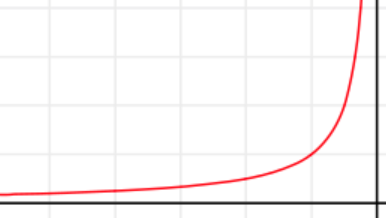

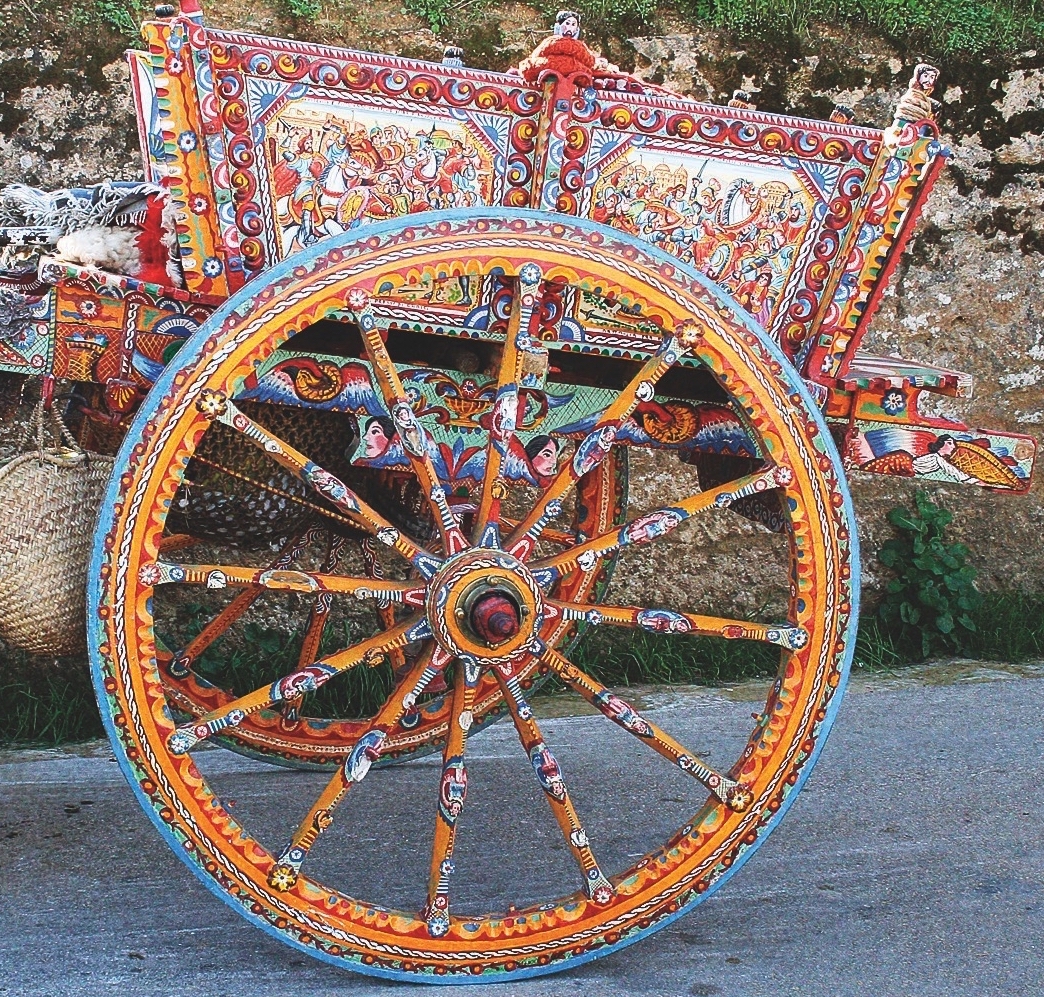


 Telepathy
You must be logged in to post a comment.