Z-Zero

The “Used-to-be-Jews”

I play poker with the same group of guys every week, mostly Jews. One is a fellow on whom life has smiled. He’s even lucky at cards. I’ll call him Paul (not his real name). A few months ago we were talking about the wars in Israel, and he said, “I used to be a Jew.” It’s a phrase I never heard back East, but I’ve heard it several times out here in California. It’s a thing.

The other day, the talk at poker returned to Israel. I think I said something about how tough it still was on my kids being Zionists in Northern California. Paul seemed startled. He asked sincerely, “You’re Zionists? What do you mean?”

I said, “I’m Jewish. So I’m a Zionist. God promised the specific land of Israel to Abraham, Isaac and Jacob thousands of years ago. That’s the origin of Judaism. It’s in the Bible.

“Huh! I never heard that!” Paul said.

“What did you hear?”

“I thought it was an extremist view by a few crazy Jews.”

Failure on the Seventh Front

Hamas brutally attacked Israel October 7th, 2023, raping, torturing and slaughtering. It was followed literally the next day by a global surge of raw hatred of Israel. It seemed spontaneous, but it was fueled by a long-prepared strategic propaganda campaign by a perfect storm of forces conspiring against us, including Islamic states, Western academia, the UN, communist countries, many European countries, progressive politics, media bias, the long-suppressed violence implicit in the hyphen Judeo-Christian …. The assault is global, stark in its persistence, and personal. It’s depressingly resistant to fact or reason. It’s frightening in its emergence from spaces we thought safe, even in our strongest Jewish havens outside Israel, like NYC. Every day brings new propaganda atrocities so absurd they would be funny if they weren’t so malign and effective.

Judging by Paul, it’s working. It sure seems like the world is trying its hardest to finally extinguish Israel, The Jewish State, and with it all the Jews who, our enemies tell us, are Zionists by default. Maybe our enemies know us better than we know ourselves.

Many Jews were forced to declare they were not the kind of Jew who supports Israel. They agreed with the enemy to be a good Jew means you were not a Zionist. Some even became prominent “as-a-Jews” (as Bari Weiss, Bret Stephens and others call them). They performed the charade: “I am Jewish. I denounce Israel because (yes, it’s committing genocide, starving Gazans, racist, colonialist, imperialist, fascist, Nazi…)”.  Younger generations of Jews are turning away from Israel, let alone Judaism.

Israel as the Jewish State doesn’t intend to go away. It has won many victories in its ongoing war against six enemies simultaneously: Hamas, terrorism on the West Bank, Hezbollah, the Houthis in Yemen, Iran, and Syria. Astonishing tactics and surprises have given it victories, like the pager maneuver against Hezbollah and the US bombing of Iran’s nuclear weapons. But it’s pretty clear that in the long run to survive, it must also win the war in the “airwaves”—on the “seventh front” of global political discourse.

Jews who remain Zionists responded with a mixture of grief, fear, solidarity, activism and counterpropaganda. Israel reinvested in telling its story (hasbara). In and out of the Diaspora we had great arguments: Jews were there first. We are fighting on the front lines of civilization against barbarism and terror. Israel is just like other nations fighting for our survival, why are you focused on us? Biased media, influencers and nations: you are purposely lying about Israel. It’s not fair.

Of course we need to continue these efforts to shield Israel and hold off the world. But without a deeper foundation, our arguments devolve into fortresses built on desert sands. Our cry for “fairness” or claims “we were here first” or that “we’re defending Western culture” or “truth” are doomed to fail against overwhelming odds – eight billion against fifteen million – much fewer if we count the Jews who even want to fight on our side. We need a firmer, permanent, global basis for how Jews defend Israel’s existence.

Z0

“Show me a place to stand and I can leverage the whole world,” Archimedes said.

Let’s find the place Jews must stand. Let’s boil it down to the bone, the most fundamental axiom, one that will survive the worst sandstorm of Jew hatred and violence in the 21st century:

To be Jewish is to be Zionist.

This is not a proclamation, it is a definition, a simple statement of fact. Jews are heirs to an eternal covenant between a single family and God.

THE COVENANT THAT DEFINES JEWS: As long as this family, its descendants, and converts – adopted into the family – keep their side of the deal, God will give Israel to them and guide their destiny. They will thrive and become a model to the whole broken world until it’s perfected.  

The deal was first announced to Abraham in the 20th c BCE. It was reiterated to his specific descendants Isaac, Jacob (Israel) and his twelve sons who became the Twelve Tribes – the Children of Israel. In the 14th century BCE at Sinai, God then made the deal with them all – Hebrew slaves newly liberated from Egypt, along with plenty of details that He gave to Moses in writing and orally, The Torah. It gives plenty of specifics of what the party of the first part (Jews) has to do to fulfill their end of the bargain and what the Party of the Second Part (God) will do if they don’t. Since then there has been a continuous, documented transmission and elaboration of the deal to us today (the rest of the canon, Talmud, and all that follows) by our tradition.

This covenant is more profound than a contract, more enduring and intimate than a quid pro quo. It’s an understanding that goes all the way down to the deepest sense of self. As Rabbi Sacks said, “A Contract is about interests; a Covenant is about identity.”[2]  Its outlines are simple, though the terms are complex. It’s more like a marriage where there are implicit as well as explicit understandings, things that go unsaid, ineffable intimacies, in this case with a transcendent Partner

When God announced the Covenant to the entire family of Israel and gave it to them in writing it changed the world. It created an entire empire of morals with its source in an absolute authority. The Torah lays out the laws of a utopian, holy nation – Israel – founded on them. It’s the world’s foundational document of liberation, where in Israel everyone is family and slaves all go free.

To put it another way, Jews have a divine right to Zion. God is on our side. All our other defenses stem from this fundamental axiom. Jews and the Jewish State can’t define themselves coherently without it.

I call this Z0 – Zionism 0.0, inspired by my friends, Zack Bodner and Rabbi Amitai Fraiman of Palo Alto who created a growing and powerful movement called Z3. In Bodner and Fraiman’s construction:

Zionism 1.0 is the dream of Herzl in the 1880s that led to the founding of the state in 1948.

Zionism 2.0 assumed Israel would be the sole focus of Jewish life and the diaspora would fade away, a national ideal that sustained Israel from 1948 to early 2000s.

Zionism 3.0 – Z3 – recognizes the mutual strength and interdependence of both Israel and the diaspora, equal partners in ensuring the life and endurance of Jews. Z3’s goal is to map the way forward.

Z0 solidifies Z3 by specifying the immortal bond between Jews everywhere and Israel. Jews in the Diaspora and Israel share a common, cosmic identity, belief and purpose. Z0 declares what they believe, to others and themselves.

The Sturdy Few: A Formula for Survival: She’erit and Pletah

Yet, Z0 is the single fundamental declaration that the some Jews in the Diaspora are unable to make. Even those who passionately support Israel or identify as Jews with one of the brands of Jewish religion (Reconstructionist, Reform, Conservative…), or are culturally but not religiously Jewish or already assimilated can’t bring themselves to declare that God gave Israel to the Jews to be a light to other nations. Even many Orthodox Jews, who believe Z0 in their kishkes as an article of faith, keep it to themselves. Over thousands of years of exile, Jews have developed a completely understandable allergy to claiming that they are The Chosen People. As a guest in other nations at very best it’s impertinent, at worst suicidal.

Z0 is the declaration most Jews can’t say even though our religiously-motivated enemies all over the world attack us with a similar weapon: They claim Hamas (Hezbollah, Iran, the Islamic world…) has the right to extinguish the Jewish State because their version of God told them so. A few others – on the Left, the Right, in Europe and Islamic or communist countries – don’t share their belief in a Jew-hating God, but sympathize with their cause to extinguish Jews anyway.

Maybe that’s the Jewish problem. The fierce declaration we need to make sounds like the thing deplorable, benighted and barbaric nations say to justify bloody campaigns. We Jews are too sophisticated, too cosmopolitan, too ethical and compassionate, too civilized, too empathic.

Z0 is exactly the firmness we need to defend ourselves. We need to believe – or at least act like we believe – that we’re marching on a mission from God. We aren’t a race, ethnicity, people, or even just a nation. We are a family who’ve made a Divine Deal. This is the bedrock of emotional and spiritual strength for Jews in the Diaspora and Israel as we face overwhelming forces gathered to annihilate us together.

Z0 counters and resists the malevolence of “as-a-Jews” and the ignorance of many others who have separated Jews from Zion. It sends us into battle on the Seventh Front with a powerful weapon: the conviction that Israel’s destiny transcends our current crises and will survive the frothing of a noisy anti-Zionist world that threatens us.

Z0 is an invitation to everyone who calls themselves a Jew, by definition.

Yet we know some Jews will define themselves out of the Z0 definition. Awe may lose more Jews. Many, including Israeli Jews who’ve bled and suffered in waging these wars since 2023, won’t and don’t accept it. It sounds like it demands becoming religious.

Z0 means declaring that God gave Israel to the Jews, but it doesn’t require religion. It doesn’t require wearing a black coat or even observing the Shabbat or keeping kosher. It doesn’t mean following the strictures of Judaism. It only means knowing and acting like Israel’s right to exist as Jewish State and being Jewish are completely identical. Jews and Zion are born inseparably at the same instant in history when Abraham and God shake on it.

Nevertheless, we know Z0 will lose many Jews. They won’t be able to make this leap of faith anyway.And while we need as many Jew-Zionists as we can get and it seems unnecessarily zealous to draw this line in the sand, it’s not a numbers game.  Our history clearly demonstrates that after every cycle like the one we’ve now begun, only a fragment of Jews remain to carry on. And our Torah prophesies it.

A single remarkable verse in the book of Genesis encapsulates the prophesy. Joseph has become the viceroy of Egypt through his obvious talent and a miraculous-seeming series of coincidences. The famine that Joseph prophesied drives his brothers from Canaan to Egypt to seek refuge. They come before the imposing Viceroy of Egypt. They don’t recognize him, having assumed Joseph is dead. Joseph stays in disguise and plays the role to the hilt. He exacts some revenge and gets them to fetch his little brother Benjamin and aging father Jacob to Egypt. Only then does he reveal himself. After a tearful reunion, they are remorseful for their original crime and seek his forgiveness. Joseph comforts them with this remarkable phrase:

   וַיִּשְׁלָחֵנִי אֱלֹקים לִפְנֵיכֶם לָשׂוּם לָכֶם שְׁאֵרִית בָּאָרֶץ וּלְהַחֲיוֹת לָכֶם לִפְלֵיטָה גְּדֹל

V’yishlachani Elokim liphnaichem l’soom l’chem she’erit ba’aretz olhachayot l’chem l’pleitah gadol

And God sent me before you to place you as a remnant(she’erit) in the earth and to keep you alive as a mighty survivor (or “as a great rescue”) (pleitah). Gen 45:7 

She’erit means “the remnant.” Pletah means the “act of deliverance” or “the survivor.” The plain sense is this: God orchestrated a painful fate so that Joseph would be the remnant, the solitary Jew, who ploughs the field of destiny for the survival of his family. As viceroy, he restructures the whole nation of Egypt and secures Goshen for his family, paving the way for the survival of all the Children of Israel.

This verse encapsulates a prophecy of the entire Jewish story and models a strategy for eternal survival:

The small but faithful remnant of Israel survives catastrophe to be the seed of a mighty renewal.

Against all odds, millenia of Jewish history fulfills this prophecy over and over again, confounding historians:

  • Moses only took a fraction of the Hebrew population out of slavery in Egypt. A stunning 80% stayed behind. They died because they preferred the material guarantee of survival over belief in the abstract God of Moses. In other words, they assimilated.
  • When the Assyrians destroyed the Northern Kingdom of Israel in 722 BCE, they slaughtered, enslaved, or dispersed ten of the tribes. They were lost. Judah (the Southern Kingdom) remained, but barely.
  • Babylon captured Israel in 586 BCE, laid waste Jerusalem and the First Temple, exiling several hundred thousand Jews to Babylon. Fifty years later Cyrus of Persia set Jews free and urged them to return and rebuild the Temple. But only a small minority did. Ezra gives a marvelously specific census: “42,360 Jews, 7337 servants and 200 singers came back under Zerubbabel.” Only a fraction returned – maybe 5-10% – because Jews thrived and became materially comfortable in Babylon.[iii]  Our tradition tells us that Judea after the return was “poor and thin” in population.[iv] Only the “righteous remnant” returned,[v] “to rebuild.”[vi]  Modern historians confirm this picture.[vii]
  • When the Seleucids (Greeks) reigned over Israel in the second century BCE, many Jews adopted Hellenism. It was modern, enlightened, liberal, sophisticated. It had an alluring, rational, scientific picture of the cosmos. In 164 BCE, Mattathias and Judah Maccabee led a faithful core of a few thousand to an impossible victory against overwhelming odds. They purified the Temple and initiated the Jewish revival we now celebrate at Chanukah.
  • The Great Revolt of 66–70 CE ended with large-scale destruction and depopulation of Israel. The Romans destroyed the Temple and renamed the devastated country Palestine after the Jews’ perennial enemies, the Philistines. Josephus reports over a million Jews were slaughtered and a hundred thousand enslaved. Although his numbers are likely inflated, archaeological and demographic studies confirm Judea’s population shrank to a few hundred thousand.[xii] Shimon bar Yochai survived (he wrote the Kabbalah while hiding in a cave for thirteen years). He emerged to lead a small remnant of Jews to regroup at Yavneh, reestablish a court and maintain the traditions.
  • A Roman historian reports that in the failed Bar Kochba revolt (132–135 CE), 580,000 Jews were killed, a figure modern historians treat cautiously but accept as indicating massive losses.[xiv] Again, a remnant survived. They relocated to Galilee, where the sages eventually produced the Mishnah around 200 CE.[xv] Josephus reports that only about 6,000 Pharisees preserved halakhic Judaism.[xi]
  • In the centuries following Hadrian, Judea remained sparsely populated by Jews, while Babylonia held a large and thriving community of hundreds of thousands.The remnant there, thriving from the original Babylonian Diaspora, developed the Babylonian Talmud, 1500 years later still the central text of traditional Judaism.
  • In the millenia that follows Rome, the cycle comes every four generations or so virtually everywhere Jews have tried to make a home. The countries that formally expelled and/or systematically killed Jews is a dark trace of history itself: Byzantine Empire, Almohad Caliphate, Mamluk Sultanate, England, France, Spain, Portugal, Italy, Austria, Germany, Switzerland, Netherlands, Hungary, Russia, Soviet Union, Poland, Czech Republic, Romania, Ukraine, Lithuania, Latvia, Belarus, Croatia, Slovakia, Iran, Iraq, Yemen, Egypt, Syria, Libya, Algeria, Tunisia, Morocco…

We Must All Be Maccabees

The same formula traces a dark fall line with mechanical regularity through the chaos of history, as if a divine force is stirring the pot of Jewish destiny.  Jews disappear because they are slaughtered or assimilate. They have forgotten or given up hope or simply abandoned the covenant, and with it, the promise of the Promised Land of Zion that defines what it is to be a Jew.

After Oct 7  we are willy nilly facing the same choice. We have to reconcile to the facts and embrace Z0 as our definition, our strategy, our destiny. We don’t need to be religious zealots. We need only claim that to be a Jew is to be a Zionist. It is our impregnable rock against the enemy’s attempt to split every Jew from his or her essence. Only Jews who are firmly convinced that they must fulfill God’s deal will ensure Israel’s survival. Now, we must all be Joseph, or Judah Maccabee, or Shimon bar Yochai.

This remnant-survival cycle may be depressing, as we see our Jewish family splinter and get lost, but it also strengthens us collectively and psychically as individuals. It explains our history and why we are so few. It gives us the courage to fight and the promise that we will. Against all odds, after horrible catastrophe, we’re still here: refined to a core of what Paul, my “used-to-be-a-Jew” friend, thinks are the crazy, zealous exceptions.

Anyway, it sure seems like God is on our side. How else should we explain that we’re still fulfilling an ancient prophecy, the remnant sent ahead to keep us alive until the perfection of the world?


The Angel of Death Visits the 21st Century

After Oct 7, Passover reminds us to outwardly perform being Jewish

  “For here the day comes burning as a furnace” – Malachi 3:19

This Passover, many Jews will celebrate another seder with special intensity. Oct 7 sharpened the knowledge that we are in history. The Angel of Death still hovers on the threshold of the Hebrew home.

The slaughter on Oct 7 was atrocious enough. But Jew hatred erupted all over the world, stunning Jews and making many cower. On campuses, in the workplace, on the streets, Jews hid their kippahs, Stars of David and even mezuzahs. Maybe this was forgivable self-preservation. But there were other Jews who joined with those who outed themselves as Jew-haters, their old political allies who want the West and Israel to disappear. Their betrayal is hard to forgive.

The Bible tells us where they went wrong and gives us clear advice for how to survive our post-Oct 7 crisis when it tells us how to celebrate Passover.

The original command

As the Hebrews await the tenth plague of the Angel of Death, the Book of Exodus instructs them how to keep the Angel of Death away. Here’s a fairly literal translation:

Then take a bunch of hyssop and dip [it] in the blood collected in the basin,
and touch the lintel and the two doorposts with some of the blood which is in the basin, and don’t go out, any man from the entrance to his house, until daybreak. God will strike Egypt and see the blood on the lintels and on the two posts and God will pass over the entrance and will not allow The Destroyer to enter your homes and strike you. (Ex 12:23)[1]

It concludes by telling them this is not just for Egypt but for all time:

And you are to keep this thing as a statute for you and for your children, forever! (Ex 12:24)

What’s “this thing” we’re supposed to keep forever?[2] It should be obvious but the Sages see a problem: no one has smeared blood on their doorposts since Egypt. That cannot be the ritual which we observe for all time. Normally “this thing” simply refers to what just immediately preceded it. “This thing” must instead refer to something else. But what? The majority conclude it’s not marking the doorway to avert the Angel of Death, a one-time event, but to sacrificing the Paschal lamb, the enduring centerpiece of the seder. The trouble is, that was mentioned way back twenty-one verses earlier in the Bible, a really lost antecedent![3]

A solution

However, let’s take the Torah at its word and read “this thing” in its plain sense of referring to what came before. Then we see smearing the blood on the door is only the culmination of a continuous set of instructions about how to observe Passover. The Hebrews are told to identify the sacrificial lamb, to sacrifice it, to share it among households, and to eat it. They must also save the lamb’s blood in a basin and use it to mark their doorways.[4] In other words, it is all one piece, connected by the lamb and its blood.

So for all time, rather than choose between the eating of the paschal lamb, as the Sages would have it, or smearing of blood as a marker for God, as grammar and logic suggest, it should be both/and. But are we literally supposed to smear the blood on our doorway?

Message for today: Don’t bait the Angel of Death

A tradition they don’t tell you in Hebrew school is that 80% of the Hebrews died in Egypt. They preferred their miserable but tangible reality as slaves in Egypt to the intangible promise of an uncertain redemption promised by an abstract God. They were chained to a secular, materialistic vision of the world, unable to make a leap of faith despite the awesome display of plagues God performed for them. These Hebrews, like so many generations after them did, disappeared with the empires they assimilated to.

After Oct 7, some Jews have donned the keffiyah, literally or figuratively. Perhaps they think that placating the Hamasniks will preserve them, though weakness, denial and submission only incite the bloodthirsty to attack. Maybe they are genuinely reacting to Israel’s response in Gaza out of misplaced colonial guilt, or simply following the crowd on social media, or naively following the lead of tv news, or joining the rallies on campus to be cool and skip classes. Maybe they are too committed to a progressive ideology to change their minds, or too lazy or ignorant to look at the evil of the terrorists and the horror of their acts. But these Jews are like those Hebrews lost for all time back in Egypt. They’re baiting the Angel of Death. They forfeit God’s protection. They’re abandoning their own and their descendants’ immortal identity.

Being a Jew Means Performing It

The Talmud says the seder is a performance for children, a night of elaborate stagecraft to get their attention so they will transmit it to their children.[5] Oct 7 teaches us that the transmission includes performing the outward sign of being Jewish, repeat the ritual of the lamb not just in the seder but always, openly, visibly, especially when it’s most scary out there.

Billboard in California on Hwy 101.

It’s hard to believe that even in the 21st century, we should publicly display our Jewish identities for the Angel of Death to pass over us. The Nazis made Jews wear yellow stars to make them easier targets for round up, which contradicts this advice to go public. Jew haters attacked identifiable Jews in New York, Amsterdam and many other places after Oct 7, and Rabbi Meir Kogon was killed in the UAE. But the Passover command in Ex 12:23 suggests the need to be courageous anyway, make public signs of our faith (unless, of course, there is imminent danger to one’s life).

Three other Hebrew words suggest this in the our verse.

וּשְׁמַרְתֶּם אֶת־הַדָּבָר הַזֶּה לְחׇק־לְךָ וּלְבָנֶיךָ עַד־עוֹלָם׃

And you are to keep this thing as a statute for you and for your children, forever! (Ex 12:24)

Chok [חׇק], “statute,” refers to a special kind of commandment, one with an impenetrable rationale that transcends normal understanding, like the commandment of the Red Heifer.

The second is et [אֶת], a preposition that points to what comes next very particularly, in this case “this thing” we must observe. Rabbi Akiva tells us that this almost insignificant and often overlooked particle actually contains deep secrets, hidden intentions of God, and requires extra interpretation. We are on supernal ground here and should tread carefully before drawing conclusions about what God intended for all time.

The third is d-b-r [דבר], the “thing,” the “matter” we are to observe. But the Hebrew as it is written in the Torah scroll – without vowels – could also mean “plague” if we pronounce it dever instead of davar. So we could read the verse as

“Guard – give heed to, be on the outlook for – this plague for all your children forever. [שְׁמַרְתֶּם אֶת־הַדָּבָר].”

The world burns. The tenth plague returns. Jews again have to choose between Egypt and redemption. Now is the time for a courageous, affirmative public sign, We Here Are Jews! After all, what more powerful act could we to perform for our children this Passover?

ENDNOTES


Thanks to Marcos Frid for fixing a big error I made in the original draft. I’ll sure there’s more to find if he looks.

    [1] My attempt at a literal translation.

    [2] Called in grammar “the antecedent.”

    [3] The Sages untangle the contradiction by noting other occasions in the Bible when a commandment and its reference were separated.

    [4]  In fact, the command in Ex 12:23 is first mentioned in Ex. 12:7 in the middle of these instructions. The repetition indicates the continuity of the Passover instructions.

    [5] Pessachim 108-109. Thanks to R. Feldman for teaching me this.

    Sinwar, Simchat Torah, Sukkot and Peace

    “.. to take refuge from the fiery stream and rain, when You rain coals upon the wicked”

    “May it be Your Will”- Prayer said in the succah

    Israeli soldier prays in sukkah in Gaza. Courtesy of Israel Live News 70 on WhatsApp Oct 20, 2024.

    Yahya Sinwar orchestrated the October 7 massacre by Hamas to inflict maximum pain on Israel and Jews.

    Whether he timed it for Simchat Torah, the most joyous religious holiday on the Jewish calendar, may never be known, but our enemies always know us better than we do ourselves, and Sinwar was an assiduous, if evil, student of Jews and Israel. 

    Almost certainly he also knew about the Nova Festival of Peace, a wonderfully soft target on the Gaza border that week. The festival organizers did schedule Nova deliberately for the last days of Sukkot because it is an Israeli national holiday. Maybe they and all the festival goers consciously intended it as an alternative Simchat Torah, a secular celebration of the religion of music, peace, sensuality, drugs, sex, and indulgence. In any case, the targets were ripe. Israel was caught off-guard. Hamas went on a rampage. They raped, murdered, beheaded, burnt, and tortured unspeakably any Israeli they could get their hands on. They took almost 250 hostages to the hell tunnels of Gaza.

    On the first day of Sukkot the next year, 2024, Israeli troops assassinated Sinwar in Rafah, where they long suspected he hid.

    I’m writing this sitting in my succah, sunlight streaming through the straw roof. It’s the one time of the Jewish year when the mitzvah surrounds us, envelops us, shelters us: we are in the mitzvah as opposed to the mitzvah being in us.  And so it’s hard in this placid moment staring at the calendar not to reflect on the coincidence of dates: Sinwar’s terror the day after Sukkot; his assassination a year later on the first day the next year.  It opens a space on the calendar, a temporary parenthesis that alters consciousness, a week that happens to be Sukkot, when we live as if we just fled Egypt and dwelled in temporary wilderness huts 3200 years ago. In the succah we dwell in the temporary, the temporal. History accordions in on itself. What does it mean?

    Of course, if you see the world filled with miracles, there are no coincidences.  God is talking to us through His time, His calendar. In His time, infinite opposing currents can be true, tumbling into and flowing over each other in dense layers of meaning. Past and future collapse into one unifying vision of truth.  Looked at this way, the signs are explosive, hard to ignore, like reports of gunfire around the corner. Maybe we can read His mind about the week:

     Enter My space, the canopy of peace. My soldier’s rifle is nearby. Bullet holes riddle the wall outside the window. Light halos him. This is a temporary if holy peace. The succah roof is makeshift, gerryrigged over destruction, yet My light streams in. My soldier summons seven heroes from the Jewish past. They faced horror and survived disasters and are now his guests. He has carved out a bittersweet moment of peace on the battlefield. It is fleeting. That’s the nature of human time, but it looks forward to a future of permanent and perfect peace.

    The Divine Telepathy Game – A Jewish Project

    When you try to read a perfect text it becomes a religious experience

    “God always likes to veil his symbols a little bit, being among His other attributes, the perfect literary artist.” – Herman Wouk, The Caine Mutiny1

    Telepathy: Why we read

    Every time we read, we play a game of telepathy. The author uses words to get what was in his or her head into ours.  My wife wrote “eggs” on the grocery list. If I pick up eggs, not brussel sprouts, I won the game. 

    Literature, the kind of stuff you read in university classes, is intentionally more complicated. T. S. Eliot’s “The Waste Land” (1922) set the standard for impenetrability. It had 433 footnotes just to explain the allusions. Elizabeth Bishop’s “A Miracle for Breakfast” (1937) or W.H. Auden’s “Paysage Moralisé”(1933) – both complicated poems called “sestinas” – or Wallace Stevens’ “The Idea of Order at Key West” (1923) had even tighter weaves of word play within themselves, greater gravity, pound for pound, than Eliot’s. Words attain multiple meanings and the poet uses symbols, sound, repetition, cadence and any number of  hundreds of well-known ways to play with words (called “rhetorical devices”) to draw connections within and across the text, creating webs of interpenetrating meanings. All these seem to defeat the telepathic purpose of writing. At least, they make it much darn harder to get a clear telepathic message.

    The job of the teacher is to get the class to appreciate the purpose of a literary text beyond just telling great stories. We read authors precisely because they didn’t try to be perfectly clear. It’s the varsity version of the telepathy game. The ambiguities and tricks leave us trying to get answers. What was she thinking? Stevens wrote another dense poem,  “Notes Toward a Supreme Fiction,” that both describes and illustrates what a great work of literature does.  As the title says, however, even this master poet could only scribble “notes” that gesture “toward” what a “supreme fiction” could do. Stevens is telling us that the supreme fiction is transcendent, unattainable. A reader could find traces and glimpses and perhaps whole sublime works that transport them briefly to divine inspiration,

    but there are no humanly attainable “supreme fictions.” We can only try to write one before a keen sense of the limitations of our own mortality bring us back to earth. It’s an asymptote, a point that the word artist always approaches but never reaches, an aspiration:

    Imagine a Perfect Text

    Now imagine a perfect author, perfect in the scientific sense: he or she completely comprehends the universe and everything in it, all its laws and interactions down to the quantum level and across its massive, wheeling galaxies in a 19 billion light years expanse, knows the past, present and future, in one integrated whole, an incarnation of science’s god, a Grand Unified Theory.  Imagine that the author is also perfect in the active, creative sense, continually exercising every super-power: shaping time, space and matter, reading every mind in the universe all at once, weaving together all the events in that vast universe in every instant always.

    Now imagine this perfect author took time out from a busy schedule to compose a perfect literary text. I don’t mean perfect as in “perfectly clear” – that would take the mystery and fun out of it and reduce it to computer code. Perfect in the literary sense, like the hardest poem you ever had to read for literature class: dense, almost impenetrably thick with meaning. Every word has a purpose and has infinite depths of possible meaning and resonates with every other word. Every line interpenetrates and colors every other line, changing how we understand what we just read and will read next. A perfect poem is like a hologram, where every word or phrase contains an aspect of the whole. When Adrienne Rich writes a poem that begins

    Night-life.

    and ends 

    …the night becomes our inner darkness, and sleeps

    like a dumb beast, head on her paws, in the corner2

    She wants the lines to speak to each other and to the dozens of lines between. She wants the poem to change what we feel about darkness, sleep and night. When she uses the word “conceived” in the middle of the poem, we know she means both “having a thought” and “giving birth” and “creating” (including creating the poem we are reading) all at the same time. That’s what poems do. Mean more than one thing at the same time. It’s the opposite of computer code or a grocery list where if something is ambiguous it fails.  

    In a perfect fiction,  the story would be perfectly plotted, more tightly wrought than the best thriller or detective story ever. It would have an intriguing beginning, complicated middle and fulfilling end like other fictions. It would be filled with clues, casual incidents, remarks, and symbolic objects. Even the setting and clothes are metaphorical, lambent with meaning, shadowing events ahead and echoing back, creating a hidden order that defies temporal logic. Chekhov’s gun in Act I must go off before the curtain closes. Is Hemingway’s old man just a simple fisherman? Is the sea only water? Are the “lions” he dreams in the end only wild felines? Why is the sole survivor of the last line in  “Moby Dick” named “Ishmael” in the first line? Again, we re-understand the first line through the last. Everything creates a context for everything else. Nothing is wasted. Pages fold over onto each other like a giant accordion. Imagine what a perfect author, who sees yesterday and tomorrow as unfoldings from a single principle, would do with time in a plot.

    Imagine how much more difficult – and intriguing and tantalizing and rewarding –  this interpretation game, this literature class, would be if the author was perfect? Imagine how much more urgent it would be if you thought the author was real (really perfect) and had all those powers (like creating the universe and everything in it every second everywhere for all eternity, not to mention your own personal destiny and soul). 

    The Jewish Project

    Jews have been playing this game since Moses wrote the Five Books of the Scripture. In fact, it is the premise of Jewish faith.  Traditional Jews believe that an omniscient, all-powerful God announced a supreme, transcendent text in front of the entire Israelite nation at Sinai. The text testifies to their collective revelation, the first and only time many thousands of people swear to a simultaneous transcendent experience. Since this event would be impossible to falsify (imagine getting three people to agree to testify to the same thing, let alone hundreds of thousands of disputatious Jews), it is their job to figure out what the message was. Herman Wouk called this author “the perfect literary artist.” Jews who believe that God is the source of the words in the Torah are literally trying to read a depthless, alien, and supernal Mind. Playing the telepathy game is one of the pillars of Judaism. Jews have been playing it for a long time with great urgency.

    When Jews read the Bible they assume that God is the Author, or at least He dictated it. When the Israelites, newly freed from slavery in Egypt, were confounded by God’s awesome voice from atop Sinai, they begged their leader Moses to translate the message in comprehensible form. So Moses spent forty days on two different occasions listening to the perfect author and transcribing (some of) the words God spoke to him using a new, incredibly potent invention, the alphabet. It was finite, but had infinite potential: a miraculous communications technology.

    Jews know their interpretation of the original transmission is imperfect because they know the author’s mind is by definition ineffable in its vast infinity and superpowers. As a result, the Five Books of Moses have given rise to 3,000 years and millions of words of interpretation. What was He trying to say to us? Each commentary feeds on the original text and on the interpretations that preceded it creating  layers of reference and authority and cross-talk. They aren’t like geologic strata frozen into stony stasis, but a dynamic hypertextual broadcast of many-to-many across time and space. When it’s your turn to try, you are humbled by the mighty river.  Literally every verse, every word, every letter – even the jots and dots and scribal variations, even the spaces between words – have been already subjected to intense scrutiny by folks who were very dedicated and very smart, some of them writing thousands of years ago. 

    On the other hand, as mortals try to read and understand the Godmind’s intentions for this text,  they have help. After all, the game would be pretty unfair (and useless) if it was written in a completely alien tongue. The very first chapter of the text tells us that the Author endowed us with the operating system, a bit of Himself to ensure that at least some of what’s in the text would be readable, the ability to read and the desire, sometimes an overwhelming urgency, a passion, to open hailing frequencies with Him through the text. Lightning strikes with sudden illumination and an electric rush of feeling. You see transcendent unity, or a piece of it. You’ve made telepathic contact.  Call this gleaming pathway of potential understanding “soul” or “consciousness.”

    The Longest Game

    This game of interpreting a text composed by a perfect author – telepathy with a divine mind –  is the longest continuous game of its kind in human history. It begins in the 14th c BCE with the invention of writing and its adoption by a nation of liberated slaves. By all archeological evidence, the phonetic alphabet was only invented once in the 14th century bce in the South Sinai). The Five Books of Moses is also what literary scholars call a “self-reflexive” text: it is aware of its own existence as a written text. In other words it’s an autobiography. It tells us about how it came to be written. If you read between the lines of the Hebrew text, it also tells the story of how the Israelites got the phonetic alphabet and became literate. In any case, it’s the first document in the history of the world to be written in it. It’s still a bestseller.

     It explains how God created the world, then humans, and then selected the Hebrew ancestors, Abraham and Sarah, Isaac and Rebecca, Jacob and Rachel and Leah and the Children of Jacob (Israel) to carry the message of God’s oneness and reality. It promises the newly freed slaves the unimaginable: a nation of their own. It gives them a utopian vision of order and humanity – laws  for how to behave in that nation, once they get there, not only how to treat their God and each other but how to treat themselves, how to tame and take responsibility for their own thoughts and intentions. In other words for the first time in history we have a document of the interior universe of human experience, subjectivity. It puts people on the hook for the interior reality of other souls. Everyone has one.  Imagine a nation built on this monumental recognition.

    Forty years wandering the deserts scours off the slavish dependency of the original generation that came out of Egypt. It refines them, rehearses them in the art of governing and protecting themselves collectively. It makes them hungry and determined and practiced as a terrifying military force. They descend onto the land of Canaan under Moses and then his successor, Joshua, Moses’ chosen successor, and they conquer it. They establish their new social experiment, ancient Israel, whose system of laws design a utopia before they even have the land. It is first ruled by prophets and then by kings. Ancient Israel holds onto a kingdom with the Torah as its constitution on and off for several centuries. Like other nations, they are distinguished by glorious achievements but also riven by scandal, failed kings and faltering faith in their original charter. The Babylonians conquer and decimate a weakened Israel in 586 BCE and carry most surviving Jews into captivity. They give the Israelites permission to return to their nation a few decades years later.  Many do, many don’t. The Israelites build a Second Temple in the fifth century BCE and again hold onto their kingdom. Conquest by war, sectarian divisions and cultural assimilation especially to the gleaming modernity of their Greek conquerors weaken it on and off, until the Romans send them into the diaspora in 70 CE, an exile that defined Jews until the establishment of the State of Israel in 1948 by the UN.

    I repeat the story of the Bible and history of the Jews because from the time when Moses writes down his Five Books, with its laws and legends from a divine author, the text binds the Israelite nation together. Even when the disruptions of history and politics, dispersion, persecution and holocausts rob them of every other constant, including  a country of their own, the one thing every other people needed (up until the twentieth century) to maintain their identity over any significant time, It gives them a continuous identity, and still does. Commentaries then become their own central texts, as scholars and rabbis debate their application of the Torah’s laws to dozens of circumstances where the Jews live as guests. Jews enshrine these texts, too, a tradition of debate and commentary called the Mishnah, Gemorah (together, the Talmud) through 500 CE. More written commentaries (by the Geonim in Babylonia) spring up from 800-1000 CE and these, too, are folded into the tradition.  The most famous commentators on the whole tradition, Rashi, Rambam and Ramban write in the 11th and 12th centuries all across Spain, France, Italy and Northern Africa, and their work is also folded into the Great Telepathy Game. Jews in every language and country where they lived continue to add hundreds of thousands of pages of additional commentary. Through the Medieval period when Western culture was stagnating, geniuses continue to write and correspond with each other, debating every nuance with the intensity and uncertainty that the original (according to the rules of the game transcendently authored, quasi-impenetrable but perfect text) demands.

    Why play this game?

    Maybe  you cannot persuade yourself that the Five Books of Moses comes down to this century in the way that Jews say it did. And maybe you cannot persuade yourself that the interpretation of that text has any authority, let alone divine authority. But just playing the interpretation game this way- to acting as if you believe – has at least three mind-bending virtues and benefits. 

    For one you will be investing yourself into a refined version of one of the best things a mind can do with itself:  philosophy in its purest form. You’ll be taking a philosophical position – like putting on a uniform to take the playing field – in good faith, so to speak. The whole idea is based on acting as if you believe in an irrational axiom – an unprovable assertion, like why nine innings makes a game and three strikes makes an out – such as “the universe is perfectly rational.” Now build a world of self-consistent thought out of it – say, mathematics. 

    If you’re an enlightened 21st century modernist, you are likely to wave off the entire Jewish believing tradition and its arcane rituals and practices, not to mention the six billion people in the world who have religious beliefs – as mere foolish superstition. But superstition is a funny word.  Philosopher Jacques Derrida brilliantly exposes the foundations of all sciences and philosophies in “superstition.” He plays on the Greek root of the word – “to stand apart or above” – to show  how all great attempts to make order of the unknowable cosmos, including science itself, requires an assumption that one fundamental unprovable axiom is true.3 It’s tantamount to a leap of faith.  In other words, even physics requires a metaphysics at its core. Derrida suggests that if you dig deeply enough, your secular beliefs in a deterministic accidental cosmos as science suggests it is, is also founded on a superstition

    Secondly, you will be practicing the most important form of self-liberation, which is freedom from ideology. Ideology is toxic to pure interpretation. It poisons our ability to hear what the author is trying to say, to see reality as it is. It’s a noisy monologue in our heads that interferes with the signal. I’ve seen it at work in the literature classroom or even in discussing almost anything political with anybody. Ideology makes you listen for preconceived notions about the intentions of the author. It doesn’t give the author a chance to bring their own point of view. When we read or view or listen to anything created by somebody else we unavoidably bring our assumptions, prejudices, firmly-held beliefs and biases. Can’t read Shakespeare because he was a sexist.  Can’t read Twain because he uses the ‘n’ word. Can’t read the Bible because it’s violent and filled with immorality. Or it’s made up by craven politicos and priests forging a narrative that will maintain their power.

    If we have an ideology, we want the text to confirm or deny that ideology. You want everything to fit your view of the universe.  Of course. That’s also what it means to have a mind. Conception is another word for preconception. If you don’t have a preconceived idea about how everything works, you can’t survive. We’re looking to prove something.  You’re either for us or against us.  This is true of every artefact, whether a written text, a movie, a virtual reality game, a painting in a museum or the fantastic immersively virtual multimedia product of an AI or some future quantum mind we haven’t yet invented. By positing the perfect author of a perfect if inscrutable text you get to place aside your assumptions, at least while you’re on the playing field. Try it. It’s liberating.  And I don’t think ChatGPT can do it very well.

    In other words, playing The Game is a very humanizing act. That’s the third fruit of playing it.  You get to be fully human. As you play it, you have to pretend you believe in something on faith. The word for it is deluded – from the Latin for ludere – gaming – and de – down. Of course we read it as a form of deprecation, to be diminished by false belief.  But we can re-appropriate the word for something positive: down here, in material mortality, all we get to do is play at the true reality, which is transcendent and supernal. To live is to be superstitious. Everyone chooses their delusions. Some just can’t admit they’re deluded.  

    By playing the Telepathy Game you have the opportunity to take a place to stand apart or above the medium of ideas that you swim in like a fish, without hardly being aware of it, let alone challenging its reality. You can jump out of your bowl – your channel – to see what makes us all human.

     Finally, if you believe its Author is who He says He is, this is the most important game in the world. Its purpose is nothing less than to teach you how to live meaningfully, integrated with and acknowledging the creative integrity of an entire cosmos where everything is connected to each other and originates – derives its dynamism – from one source. The text tells you how to do it, yes, but it also shows you why. At the same time, by its perfection of making meaning through complexity, it exemplifies this true order in the universe. Only a supernal mind could have written the Torah and our every act of reading it in good faith awakens the spirit with a telepathic jolt.


    ENDNOTES

    1. Herman Wouk, The Caine Mutiny (Garden City, NY: Doubleday and Company, 1951) p. 90

    2. “Adrienne Rich, “The Origins and History of Consciousness,” Dreams of a Common Language: Poems 1974-1977

    3. See the transcript of an  interview with Jacques Derrida in 1980 in Tellez, F., & Mazzoldi, B. (2007). “The Pocket‐Size Interview with Jacques Derrida,” Critical Inquiry, 33(2), 362–388. https://doi.org/10.1086/511498

    A couple of small questions about science and religion: Is a Cosmic Consciousness Involved Every Time an Egg is Fertilized? Can science and religion fertilize each other?

    “A dog might as well speculate on the mind of Newton,” – Charles Darwin on God
     “We should not immediately refute any idea which comes to contradict anything in the Torah, but rather we should build the palace of Torah above it.” – Rav Avraham Yitzchok Kook, the first chief Ashkenazi rabbi of Palestine

    Moment of fertilazation
    “Moment of fertilization,” from 123rf.com

    The fertilization tango

    When does human life begin? Are there divine implications in the process? Before you make up your mind, how much do you know about what really happens when an egg is fertilized? It’s almost beyond belief in its complexity and mystery. When we delve it, right down to the part that gets mysterious, it invokes a metaphysical explanation.

    Continue reading “A couple of small questions about science and religion: Is a Cosmic Consciousness Involved Every Time an Egg is Fertilized? Can science and religion fertilize each other?”

    What is a Jew?

    Last week, President Trump extended Title VI protections to Jews – alongside other students of race, color or national origin – on campuses that receive federal funding. This kicked off what the media called “a firestorm.”  It was actually two controversies for the price of one. First, do Title VI rules restrict freedom of speech. Ironically, this became a problem only when Trump protected Jews, even though it’s a 1964 ruling. Second, are Jews like the other protected classes? How so? What are Jews, exactly?

    Are we a race, a nation, an ethnic group, an extended family, a religion, or just a bunch of folks who like bagels and lox? All of these fit some Jews, but none fit all Jews, so what is going on? Even Jews debate it all the time. Continue reading “What is a Jew?”

    Are Jews a race, religion, nation, ethnicity, tribe, or … what?

    This week, President Trump extended Title VI protections to Jews, alongside other students of race, color or national origin on campuses that receive federal funding. This kicked off what the media called “a firestorm.”  It was actually two controversies. First, do Title VI rules restrict freedom of speech (which only came up as a protest when Trump protected Jews, even though it’s a 1964 ruling. No comment). And second, are Jews like the other protected classes? What are Jews, exactly?

    This is a debate even among Jews: Are we a race, a nation, an ethnic group, an extended family, a religion, or just a bunch of folks who like bagels and lox? All of these fit some Jews, but none of these fit all Jews, so what is going on? The question is particularly poignant because whatever Jews are, they keep popping up on the stage of history for over 3500 years.

    There is a document that defines the essence of Jewish identity, a charter for membership in the gang we call Jews, if you will. It’s called the Torah, and it insists it originates in a divine ideal of what people and the world can be. Jews call this concept “holiness,” but the word is too loaded. Whether you believe it is literally true or not, the proposition that this document originates from God explains the transcendent power and persistence of Jewish identity, even among Jews who reject it. Something mystical seems to be going on that preserves the Jews against all odds. The fact that this essence doesn’t fit any of the usual categories may also explain why Jews are also so persistently reviled and persecuted among other nations. Continue reading “Are Jews a race, religion, nation, ethnicity, tribe, or … what?”

    Thanksgiving and the Jews

    Jews in America are especially lucky on Thanksgiving. Who else gets a choice of turkey or brisket?

    As the quintessential American holiday, it somehow also feels more Jewish than any other.

    Pilgrims as Jews
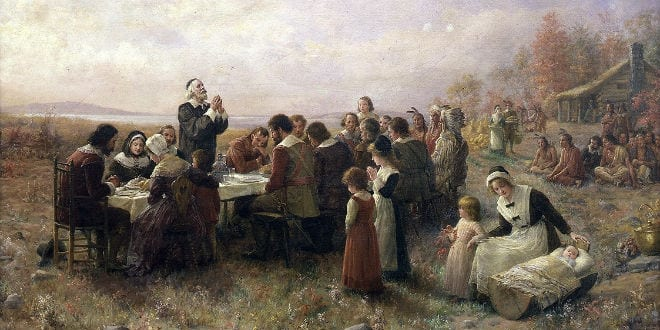
    Is that a yarmulke he’s wearing? [“The First Thanksgiving at Plymouth”, Jennie A. Brownscombe., 1914. Wikimedia Commons]

    That may be because the first Thanksgiving had its roots in the Jewish fall harvest festival, Sukkot (which started on October 1st in 1621). Or maybe because the very name “Jew” stems from the word for “thanks” (Judah), and our word for “blessing” – beracha – is related to the word for “knee” – berach – which we take in the posture of gratitude. Thanksgiving also, obviously, resonates with Passover: big family meals, political debate, too much wine, and then a boisterous game of pinochle for pennies (isn’t that the universal tradition?). Oh yeah, and celebrating gratitude for our miraculous liberation from slavery.

    The original pilgrims fled religious persecution on the model of the exodus of the Hebrews from Egypt. Puritans believed the Anglican Church had introduced too many impure practices. They sought to return Christianity to its roots in the Jewish Bible. America, in their narrative, was the Promised Land. They consciously imitated the Jews by trying to establish both a Holy Land and an earthly utopia, free from tyranny. They called it the New Eden. In their worship, civil life, and ideology they were at least as attached to the Old Testament as the new one.

    A standard Puritan greeting was, “You’re a good Jew!”

    They also imbibed the message of that Hebrew Bible: the human soul is enslaved to no earthly power.

    As the Sixth Lubavitcher Rebbe said:

    “All the people on the face of the earth must know this: That only our bodies have been sent into exile and the servitude of rulers. But our souls have not been exiled or enslaved.

    In the Bible  a powerful king of the Philistines, Avimelech, harasses Isaac and his tribe in what is now Gaza  by stopping up every well he digs. Nonetheless, Isaac retraces his steps and re-opens the wells. He thrives and grows wealthier. Avimelech eventually “comes to Isaac,” submitting to him to ask for a peace treaty.

    The lesson is the stuff of Hollywood: eventually, the huge and powerful bow to the superiority of the small and brave who stick to their mission and their authenticity.

    On this Thanksgiving, my personal gratitude is for the few and the just who still overcome the mighty and many, just as the movies promised me when I was a kid. I’m thankful that the very sign we have a soul is our yearning to be free. Its our connection to a divine force beyond forced bondage to any terrestrial thing.

    Except maybe my wife’s transcendent brisket.

    Pinchas: A five-act play about Jewish legacy

    Dedicated for SHABBAT PINCHAS 2779 to my father-in-law, Philip Oliver Richardson, Z”L”, and to his great-granddaughters, Noa and her sisters.

    At first glance, Pinchas, like so many other weekly portions of the Torah, looks like a set of disparate pieces, thrown together with no particular logic. Some are boilerplate, others cinematically compelling. G-d rewards a zealot for a terrible act of violence and launches a war, but instead of taking us to the battle scene (the next week picks it up in Matot-Massei), a long, repetitive census interrupts the action. Five daughters provoke a revision in law and Moses dramatically transfers his power to Joshua, but a boring account of sacrifices deflate the end.

    On closer inspection, though, Pinchas is a wonderfully coherent five-act play. Its hero isn’t a person but an idea, a revolutionary new concept of how a nation will transfer its legacy from one generation to another. In fact, at the risk of mixing metaphors, once we untangle (and then put back together) the threads, layers, cross-references, and perspectives on Israel’s legacy,  a complex shimmering 3D tapestry – a hologram[1] in which every part resonates with every other and every jot signifies the whole – comes into view. Continue reading “Pinchas: A five-act play about Jewish legacy”

    Democracy or Theocracy? Korach’s Fourth of July Rebellion

    (On July 4, 1992, Shabbat Korach and the Fourth fell on the same day. I delivered this as a drash in a Conservative shul in upstate New York (Agudat Achim in Niskayuna) before I knew a lick of Rashi or Talmud, so please forgive its incredible ignorance and naivete. Please note this has been edited from the original notes.)
    Moses is not the leader of a democracy, as this week’s parsha shows. How does a good Jewish citizen of America choose between allegiance to democracy or to the harsh autocratic theocracy the Torah seems to demand?

    Kippah + American Flag
    (From Jewish Boston, photo by selimaksan/iStock)

    Through a wonderful coincidence, this weeks’ parsha and the Fourth of July fall on the same day. Korach tells the story of a Levite, a leader among the Hebrews wandering the desert, who arises and leads a democratic-style revolution against the leadership of Moses and Aaron. Continue reading “Democracy or Theocracy? Korach’s Fourth of July Rebellion”