What is a Jew?

Last week, President Trump extended Title VI protections to Jews – alongside other students of race, color or national origin – on campuses that receive federal funding. This kicked off what the media called “a firestorm.”  It was actually two controversies for the price of one. First, do Title VI rules restrict freedom of speech. Ironically, this became a problem only when Trump protected Jews, even though it’s a 1964 ruling. Second, are Jews like the other protected classes? How so? What are Jews, exactly?

Are we a race, a nation, an ethnic group, an extended family, a religion, or just a bunch of folks who like bagels and lox? All of these fit some Jews, but none fit all Jews, so what is going on? Even Jews debate it all the time. Continue reading “What is a Jew?”

Are Jews a race, religion, nation, ethnicity, tribe, or … what?

This week, President Trump extended Title VI protections to Jews, alongside other students of race, color or national origin on campuses that receive federal funding. This kicked off what the media called “a firestorm.”  It was actually two controversies. First, do Title VI rules restrict freedom of speech (which only came up as a protest when Trump protected Jews, even though it’s a 1964 ruling. No comment). And second, are Jews like the other protected classes? What are Jews, exactly?

This is a debate even among Jews: Are we a race, a nation, an ethnic group, an extended family, a religion, or just a bunch of folks who like bagels and lox? All of these fit some Jews, but none of these fit all Jews, so what is going on? The question is particularly poignant because whatever Jews are, they keep popping up on the stage of history for over 3500 years.

There is a document that defines the essence of Jewish identity, a charter for membership in the gang we call Jews, if you will. It’s called the Torah, and it insists it originates in a divine ideal of what people and the world can be. Jews call this concept “holiness,” but the word is too loaded. Whether you believe it is literally true or not, the proposition that this document originates from God explains the transcendent power and persistence of Jewish identity, even among Jews who reject it. Something mystical seems to be going on that preserves the Jews against all odds. The fact that this essence doesn’t fit any of the usual categories may also explain why Jews are also so persistently reviled and persecuted among other nations. Continue reading “Are Jews a race, religion, nation, ethnicity, tribe, or … what?”

The Two Floods, Double Rainbows, and the Cosmic Limitations of Engineering

On double rainbows in Noah

A few years ago, my daughter showed me a viral video of a stoned guy blissing out on a double rainbow in Yosemite. “It’s … it’s a double rainbow!” He moans. “Oh my G-d, oh my G-d,” he repeats over and over, “It’s so bright.  Ohhhh, it’s so beautiful!” He breaks down in full-on sobbing, crying in a seizure of ecstasy. “What does it mean?” he asks, his mind blown.

I’m not sure, dude. But one thing you missed in your rapture is a curious phenomenon: look carefully and you can see that the colors of the second rainbow invert the usual order: VIBGYOR.

Double Rainbow
“Double Rainbow” by SlimJones123

As early as 1520 or so, the Jewish sage Sforno[i] noted that even by his time, the double rainbow was already a cliché.

“Scientists have already tired of trying to explain why the various colors of the second rainbow appear in the opposite order of the colors in the original rainbow.”[ii]

Nonetheless, he uses it to explain the rainbow following Noah’s flood. Since the ordinary rainbow already existed at the time of Creation, Sforno reasons, the actual rainbow displayed after the Flood must be this second rainbow, a much rarer and more startling sight (as our ecstatic friend saw in Yosemite). The reverse order of the colors are a warning:

 “When this rainbow appears it is high time to call people to order and to warn them of impending natural calamities unless they change their ways.”[iii]

Sforno’s insight made me think of another secret duality in Noah: there’s really not one but two floods in this weekly reading. I believe they’re connected. Continue reading “The Two Floods, Double Rainbows, and the Cosmic Limitations of Engineering”

Jacob and the Cosmic If

Esau’s Clever Pun

Genesis doesn’t have many witticisms. It has ironic laughter (“What? Am I going to get pregnant at the age of 90?”) and defensive sarcasm (“What? Am I my brother’s babysitter?”) and passive aggression (“What’s 400 shekels between old friends like us?”). But witty wordplay is rare.

So it’s surprising that one of the more brooding and athletic characters, Esau the bloody hunter, gives us a great instance of eloquent punning, and in a moment of high drama, too. Continue reading “Jacob and the Cosmic If”

Thanksgiving and the Jews

Jews in America are especially lucky on Thanksgiving. Who else gets a choice of turkey or brisket?

As the quintessential American holiday, it somehow also feels more Jewish than any other.

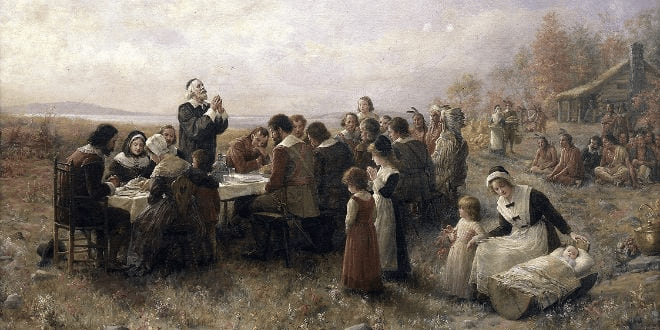
Pilgrims as Jews
Is that a yarmulke he’s wearing? [“The First Thanksgiving at Plymouth”, Jennie A. Brownscombe., 1914. Wikimedia Commons]

That may be because the first Thanksgiving had its roots in the Jewish fall harvest festival, Sukkot (which started on October 1st in 1621). Or maybe because the very name “Jew” stems from the word for “thanks” (Judah), and our word for “blessing” – beracha – is related to the word for “knee” – berach – which we take in the posture of gratitude. Thanksgiving also, obviously, resonates with Passover: big family meals, political debate, too much wine, and then a boisterous game of pinochle for pennies (isn’t that the universal tradition?). Oh yeah, and celebrating gratitude for our miraculous liberation from slavery.

The original pilgrims fled religious persecution on the model of the exodus of the Hebrews from Egypt. Puritans believed the Anglican Church had introduced too many impure practices. They sought to return Christianity to its roots in the Jewish Bible. America, in their narrative, was the Promised Land. They consciously imitated the Jews by trying to establish both a Holy Land and an earthly utopia, free from tyranny. They called it the New Eden. In their worship, civil life, and ideology they were at least as attached to the Old Testament as the new one.

A standard Puritan greeting was, “You’re a good Jew!”

They also imbibed the message of that Hebrew Bible: the human soul is enslaved to no earthly power.

As the Sixth Lubavitcher Rebbe said:

“All the people on the face of the earth must know this: That only our bodies have been sent into exile and the servitude of rulers. But our souls have not been exiled or enslaved.

In the Bible  a powerful king of the Philistines, Avimelech, harasses Isaac and his tribe in what is now Gaza  by stopping up every well he digs. Nonetheless, Isaac retraces his steps and re-opens the wells. He thrives and grows wealthier. Avimelech eventually “comes to Isaac,” submitting to him to ask for a peace treaty.

The lesson is the stuff of Hollywood: eventually, the huge and powerful bow to the superiority of the small and brave who stick to their mission and their authenticity.

On this Thanksgiving, my personal gratitude is for the few and the just who still overcome the mighty and many, just as the movies promised me when I was a kid. I’m thankful that the very sign we have a soul is our yearning to be free. Its our connection to a divine force beyond forced bondage to any terrestrial thing.

Except maybe my wife’s transcendent brisket.

Why Does the Epikoros Lose His Soul?

What’s an epikoros?

In the 1950s, you would think Crown Heights was populated by a gallery of rogues, scoundrels and losers with terrific names like shikker, shnook, shlepper, shmendrick, shnorrer, shlemazel, goniff, mamzer, or my favorite, vance.  One of the most chilling, because I wasn’t sure what it meant but it was always muttered darkly, was epikoros. My grandmother pronounced it with her thick Polish inflection, chapikoiyris, but you could also hear apikoros or apikorsis.

Gustave Dore 6th ring Dante Inferno
Hell for Epicureans: Gustave Dore, 6th Circle, Dante’s Inferno (Paris: Hachette, 1861) from Open Culture

Over time, I realized the word referred to Jews who actively flouted any Jewish observance, a heretic or at least someone who went off the path – the derech as they say in Hebrew – in a serious way. But the word had a long history before it hit the streets of Brooklyn.

Epikoros originates as a Jewish curse at least as far back as the Talmud. The sages single out the epikoros as one of the four kinds of heretics, Jews who lose their immortal souls, an eternal death sentence. But the word sticks out because it doesn’t sound like anything Hebrew and doesn’t have any precedent in Aramaic. It obviously seems to refer to the great Greek philosopher Epicurus (341-270 BCE). Continue reading “Why Does the Epikoros Lose His Soul?”

The Not-So-Hidden Future History of the Jews

When Jews of all peoples don’t realize they are in history, then they inevitably drown in it. Continue reading “The Not-So-Hidden Future History of the Jews”

Pinchas: A five-act play about Jewish legacy

Dedicated for SHABBAT PINCHAS 2779 to my father-in-law, Philip Oliver Richardson, Z”L”, and to his great-granddaughters, Noa and her sisters.

At first glance, Pinchas, like so many other weekly portions of the Torah, looks like a set of disparate pieces, thrown together with no particular logic. Some are boilerplate, others cinematically compelling. G-d rewards a zealot for a terrible act of violence and launches a war, but instead of taking us to the battle scene (the next week picks it up in Matot-Massei), a long, repetitive census interrupts the action. Five daughters provoke a revision in law and Moses dramatically transfers his power to Joshua, but a boring account of sacrifices deflate the end.

On closer inspection, though, Pinchas is a wonderfully coherent five-act play. Its hero isn’t a person but an idea, a revolutionary new concept of how a nation will transfer its legacy from one generation to another. In fact, at the risk of mixing metaphors, once we untangle (and then put back together) the threads, layers, cross-references, and perspectives on Israel’s legacy,  a complex shimmering 3D tapestry – a hologram[1] in which every part resonates with every other and every jot signifies the whole – comes into view. Continue reading “Pinchas: A five-act play about Jewish legacy”

Democracy or Theocracy? Korach’s Fourth of July Rebellion

(On July 4, 1992, Shabbat Korach and the Fourth fell on the same day. I delivered this as a drash in a Conservative shul in upstate New York (Agudat Achim in Niskayuna) before I knew a lick of Rashi or Talmud, so please forgive its incredible ignorance and naivete. Please note this has been edited from the original notes.)
Moses is not the leader of a democracy, as this week’s parsha shows. How does a good Jewish citizen of America choose between allegiance to democracy or to the harsh autocratic theocracy the Torah seems to demand?
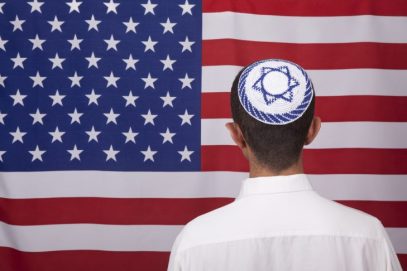
Kippah + American Flag
(From Jewish Boston, photo by selimaksan/iStock)

Through a wonderful coincidence, this weeks’ parsha and the Fourth of July fall on the same day. Korach tells the story of a Levite, a leader among the Hebrews wandering the desert, who arises and leads a democratic-style revolution against the leadership of Moses and Aaron. Continue reading “Democracy or Theocracy? Korach’s Fourth of July Rebellion”

It can turn on a dime

My father used to say to us, “It can turn on a dime.” He saw American hospitality to the Jews as a thin veneer, like Germany’s. It could be stripped away at any moment to reveal the anti-Semitism he was sure lurked beneath the surface. He was convinced any nation that suffered us to be their guests long enough would sooner or later turn on us, even this land where religious freedom was enshrined.*  And you couldn’t bet against his paranoia. He had history on his side, 100-1.

I guess I inherited some of his dark vision and even afflicted my children with it. I still tell them half-jokingly, “Keep your passports active.”

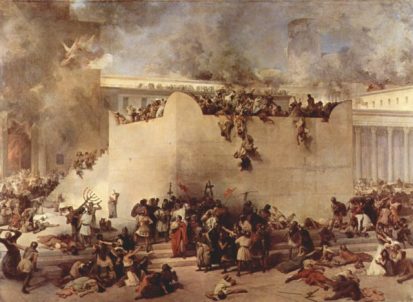
Destruction of Secomd Temple
“Destruction of the Temple” by Francesco Hayez, 1867.

Dad served as Gen. MacArthur’s mapmaker on the voyage of the USS Missouri to accept Japan’s surrender in 1945.  In 1947, he led his army buddies in Brooklyn to gather guns to smuggle to Israel for the Haganah in their fight for independence from the Brits.

Continue reading “It can turn on a dime”